色谱 ›› 2026, Vol. 44 ›› Issue (11): 1380-1388.DOI: 10.3724/SP.J.1123.2026.01037

• 研究论文 • 上一篇    下一篇

FeCl3催化/铁源双功能制备咔唑基超交联磁性聚合物及其对水体中痕量四环素类抗生素的富集与检测

祝青山1, 刘雨葳2, 秦童童1, 马丽1,*(), 赵文杰1,*()   

  1. 1.河南工业大学化学化工学院,河南 郑州 450001
    2.吉林省药品检验研究院,吉林 长春 130028
  • 收稿日期:2026-03-16 出版日期:2026-11-08 发布日期:2026-11-03
  • 通讯作者: * Tel:0371-67756718,E-mail:wjiezh@126.com(赵文杰);Tel:0371-67756718,E-mail:mamarry@haut.edu.cn(马丽).
  • 基金资助:
    国家自然科学基金(22574040)

Preparation of carbazole-based hypercrosslinked magnetic polymer via FeCl3-catalyzed/iron source dual strategy for enrichment and detection of trace tetracyclines in water

ZHU Qingshan1, LIU Yuwei2, QIN Tongtong1, MA Li1,*(), ZHAO Wenjie1,*()   

  1. 1.School of Chemistry and Chemical Engineering,Henan University of Technology,Zhengzhou 450001,China
    2.Jilin Institute for Drug Control,Changchun 130028,China
  • Received:2026-03-16 Online:2026-11-08 Published:2026-11-03
  • Supported by:
    National Natural Science Foundation of China(22574040)

摘要:

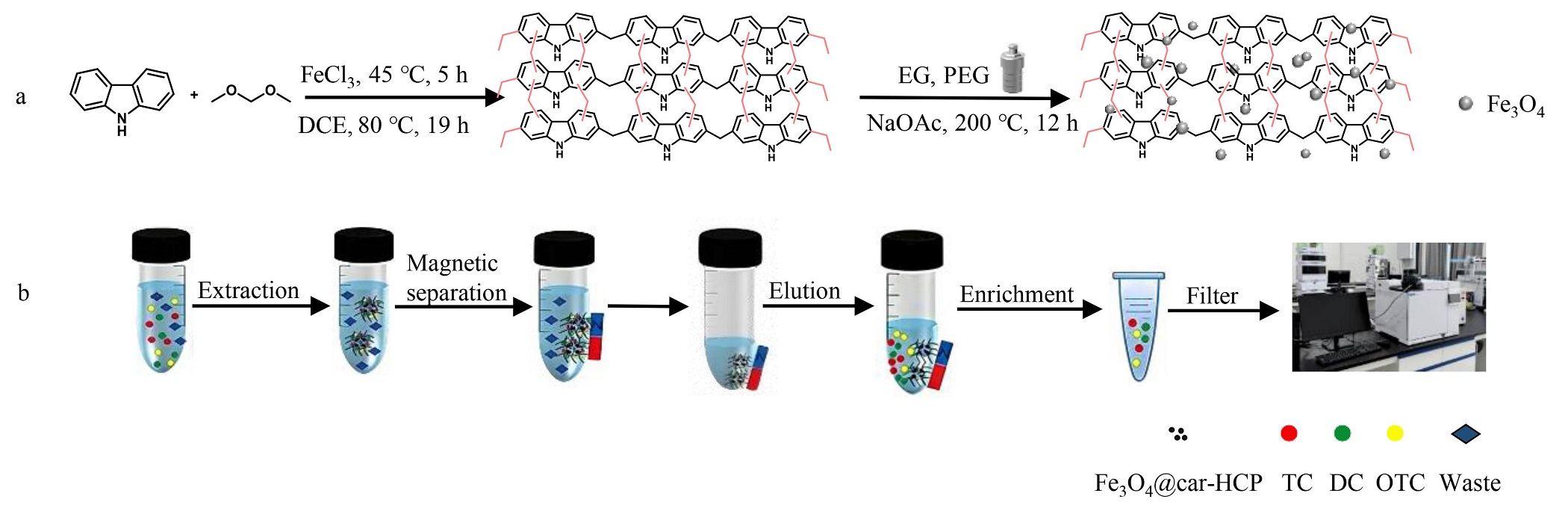
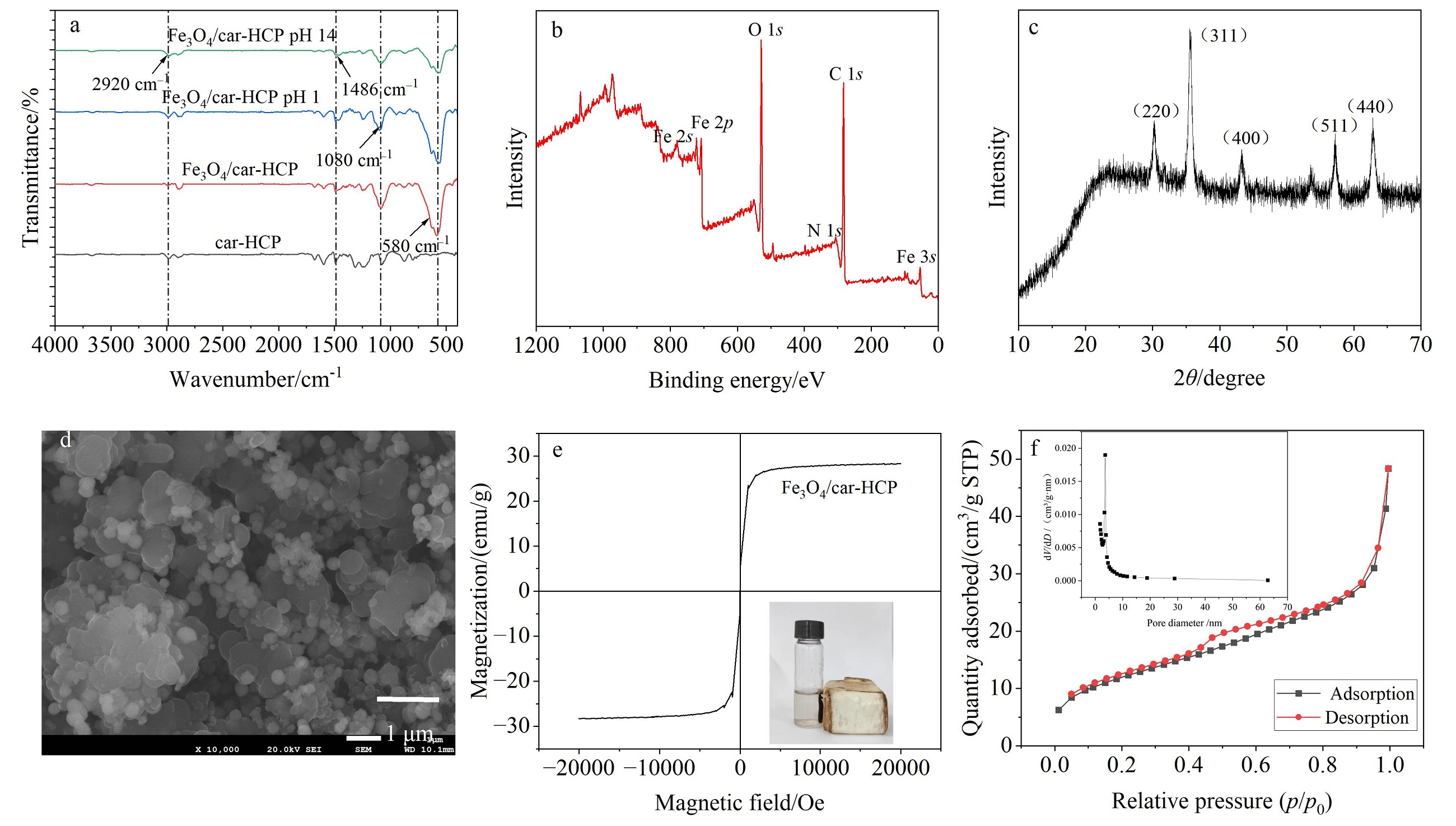
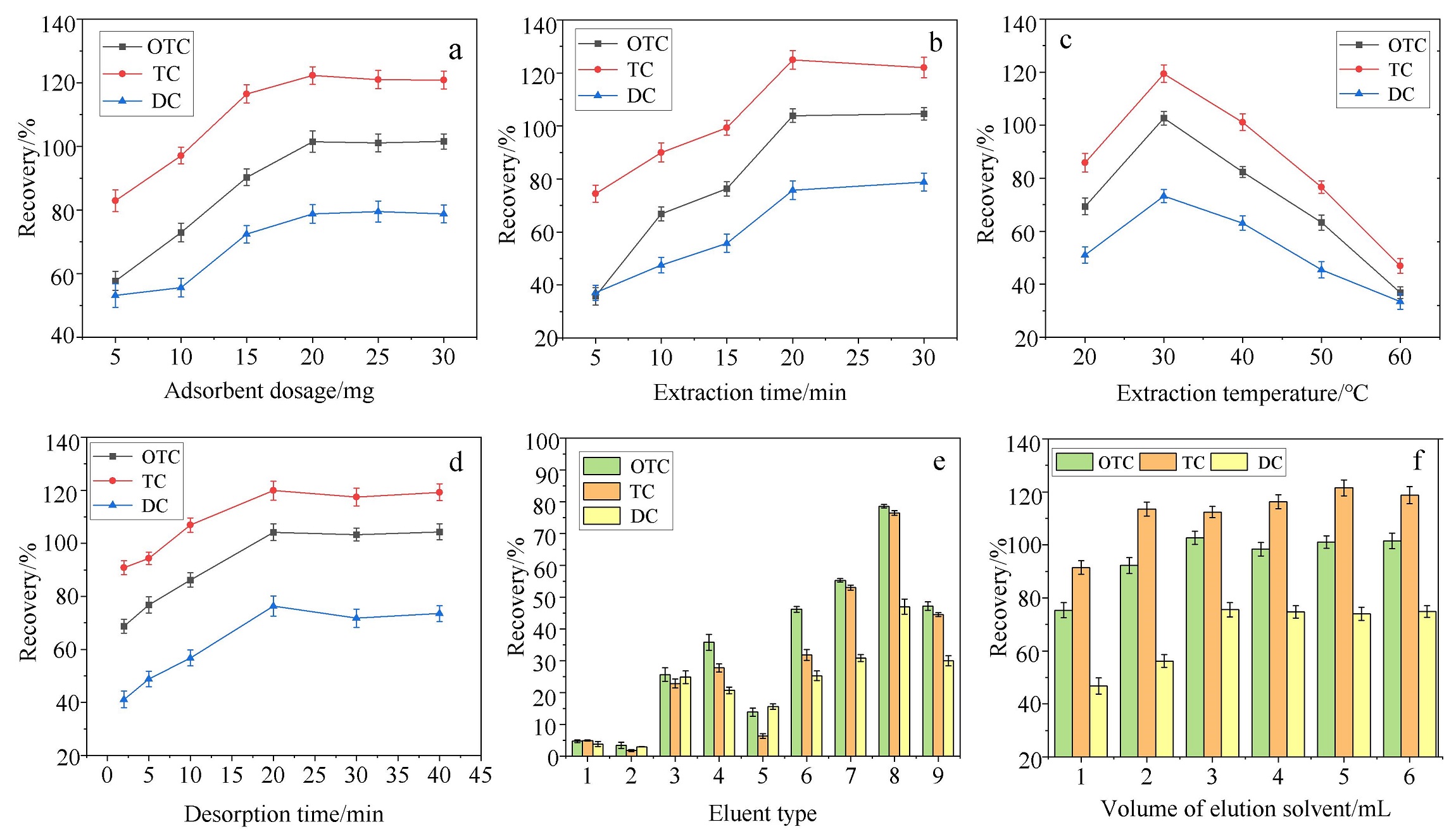
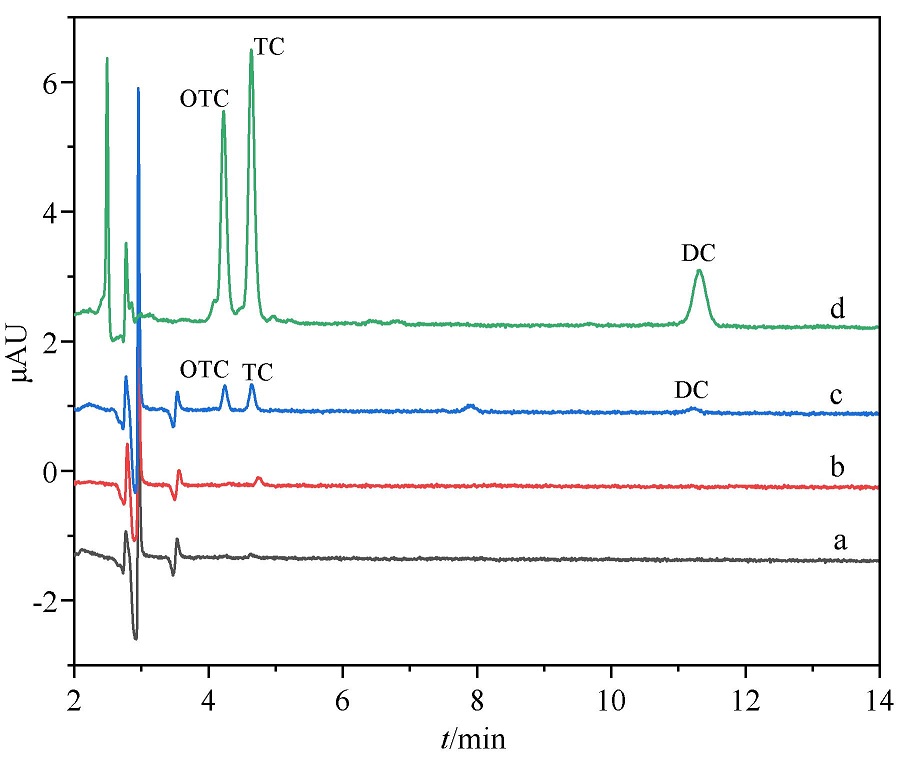
本研究以富电子、结构刚性的咔唑为功能单体,甲醛缩二甲醇(FDA)为交联剂,三氯化铁(FeCl3)为催化剂兼铁源,制备了新型磁性咔唑基超交联聚合物Fe3O4/car-HCP,经系统表征,阐明了其化学结构、形貌、孔道性质与磁性特征。该材料集成了咔唑芳香骨架对TCs的强π-π堆积与氢键作用、超交联网络的高疏水性以及Fe3O4的快速磁响应性,实现了对目标物的多机制协同吸附。将其作为磁性固相萃取(MSPE)吸附剂,结合高效液相色谱-紫外检测(HPLC-UV),建立了同时检测环境水样中土霉素(OTC)、四环素(TC)和强力霉素(DC)的分析方法。通过系统优化,确定最佳萃取条件为吸附剂用量20 mg、萃取时间30 min、萃取温度30 ℃、洗脱剂为乙腈-0.01 mol/L NaOH(体积比为2∶1)、洗脱时间20 min、洗脱体积3 mL。在优化条件下,方法表现出良好的分析性能:OTC、TC和DC的线性范围分别为2.83~200 μg/L、2.77~200 μg/L和9.93~200 μg/L,检出限(LOD,S/N=3)分别为0.83、0.80和2.98 μg/L;定量限(LOQ,S/N=10)分别为2.83、2.77和9.93 μg/L。将方法应用于实际水样(自来水、雨水及景观湖水)分析,在10 μg/L和100 μg/L两个加标水平下,目标物的平均回收率为75.6%~128.5%,相对标准偏差(RSD)为1.3%~9.4%,表明方法准确可靠、基质适用性强。与文献方法相比,本研究制备的新材料在保证高灵敏度与准确度的同时,显著减少了吸附剂用量并简化了操作流程。基于该材料优异的吸附性能和便捷的磁分离特性,本研究建立的分析方法成功实现了环境水样中痕量四环素类抗生素的灵敏检测,证实了其在复杂基质分析中的应用潜力。此外,所提出的“一物两用”合成策略也为设计多功能磁性吸附材料提供了新的思路。

关键词: 磁固相萃取, 咔唑, 超交联聚合物, 四环素类抗生素, 环境水样

Abstract:

This study prepared a novel magnetic carbazole-based hypercrosslinked polymer (Fe3O4/car-HCP). Electron-rich and rigid carbazole served as the functional monomer. Formaldehyde dimethyl acetal (FDA) was used as the crosslinker. Ferric chloride (FeCl3) acted as both catalyst and iron source. Systematic characterization revealed the material’s chemical structure,morphology,pore properties,and magnetic behaviour. Specifically,the material exhibited a high specific surface area and a well-developed porous network. It also showed superparamagnetic properties with sufficient saturation magnetization for rapid magnetic separation. The material offers several advantageous features for analytical extraction. Its carbazole aromatic skeleton provides strong π-π stacking interactions with the aromatic rings of tetracycline antibiotics (TCs). The same skeleton also supplies hydrogen bonding sites,primarily through its nitrogen atom. Both types of interactions exhibit high affinity toward TCs. The hypercrosslinked network confers high hydrophobicity to the material. This property effectively minimizes non-specific adsorption of polar matrix components commonly present in environmental water samples,such as humic acid and inorganic salts. The embedded Fe3O4 nanoparticles enable rapid magnetic responsiveness. This allows convenient and fast separation of the adsorbent from the sample solution using an external magnet,eliminating the need for centrifugation or filtration steps. These structural and physicochemical features work together in a synergistic manner. Consequently,the material achieves multi-mechanistic adsorption of the target analytes,leading to high extraction efficiency. Using this material as a magnetic solid-phase extraction (MSPE) adsorbent,an analytical method was developed. The MSPE procedure was coupled with high performance liquid chromatography-ultraviolet detection (HPLC-UV). The method allows for the simultaneous determination of three TCs in environmental water samples. The three TCs are oxytetracycline (OTC),tetracycline (TC),and doxycycline (DC). Several extraction parameters were systematically optimized to achieve the best performance. The parameters included adsorbent dosage,extraction time,extraction temperature,eluent composition,elution time,and elution volume. The optimal extraction conditions were as follows: The sample was extracted with 20 mg of adsorbent at 30 ℃ for 30 min,and then eluted with 3 mL of acetonitrile/0.01 mol/L NaOH (2∶1,volume ratio) for 20 min. Under these optimized conditions,the method demonstrated satisfactory analytical performance. The linear range was 2.83–200 μg/L for OTC,2.77–200 μg/L for TC,and 9.93–200 μg/L for DC. The limits of detection (LODs),based on signal-to-noise ratio (S/N)=3,ranged from 0.83 μg/L to 2.98 μg/L. The limits of quantification (LOQs,S/N=10) ranged from 2.77 μg/L to 9.93 μg/L. The method was then applied to the analysis of real water samples. Three types of water were tested: tap water,rainwater,and landscape lake water. Recovery tests were conducted at two spiked concentration levels,namely 10 μg/L and 100 μg/L. The average recoveries of the three target analytes ranged from 75.6% to 128.5%. The relative standard deviations,calculated from three replicate measurements,were between 1.3% and 9.4%. These results confirm that the method is accurate,reliable,and applicable to complex aqueous matrices. Compared with previously reported methods for TC analysis,the present approach offers several distinct advantages. It requires significantly less adsorbent. It also simplifies the operational procedure by eliminating time-consuming steps. Importantly,these improvements are achieved without sacrificing sensitivity or accuracy. In summary,this study provides a robust,convenient,and efficient analytical solution for monitoring trace levels of TCs in environmental water. Furthermore,the design and synthesis strategy of this multifunctional magnetic adsorbent offers new insights for developing advanced functional materials for environmental sample preparation.

Key words: magnetic solid-phase extraction (MSPE), carbazole, hypercrosslinked polymer, tetracycline antibiotics, environmental water samples

中图分类号: