
色谱 ›› 2026, Vol. 44 ›› Issue (11): 1389-1399.DOI: 10.3724/SP.J.1123.2026.04009
牛晓, 张洋, 齐升达, 陈宏丽*( )
收稿日期:2026-04-08
出版日期:2026-11-08
发布日期:2026-11-03
通讯作者:
* Tel:0931-8912589,E-mail:hlchen@lzu.edu.cn.
基金资助:
NIU Xiao, ZHANG Yang, QI Shengda, CHEN Hongli*()
Received:2026-04-08
Online:2026-11-08
Published:2026-11-03
Supported by:摘要:
共价有机框架(COFs)材料因其结构可调、孔隙丰富、比表面积大等优势,已成为一类性能优异的色谱固定相。本文采用室温原位生长法在毛细管内壁成功涂敷了一层球状COF(TPB-TP COF),并将其应用于开管毛细管电色谱(OT-CEC)分离分析中。研究结果表明,TPB-TP COF纳米晶体能够牢固地固定于毛细管内壁,运行200次后,涂层表面结构基本保持完整。与未修饰的裸毛细管相比,该涂层柱对4组中性分析物表现出更优异的分离能力与高分辨率,且具备良好的重复性和稳定性。保留行为分析表明,分析物的洗脱顺序与其log Kow值具有一定相关性,说明疏水作用可能是影响分离过程的重要因素;同时,TPB-TP COF中丰富的芳香结构可能通过π-π相互作用对芳香类分析物的保留和选择性产生协同影响。该方法已成功应用于加标黄河水样中邻苯二甲酸酯类化合物的测定,加标回收率为94.9%~108.9%。上述结果表明,TPB-TP COF是一种有效的OT-CEC固定相材料,在中性有机小分子分离分析中具有潜在应用价值。
中图分类号:
牛晓, 张洋, 齐升达, 陈宏丽. 基于原位生长法制备球状共价有机框架涂层并用于开管毛细管电色谱分离中性分析物[J]. 色谱, 2026, 44(11): 1389-1399.
NIU Xiao, ZHANG Yang, QI Shengda, CHEN Hongli. In-situ growth of spherical covalent organic framework coating for the separation of neutral analytes in open-tubular capillary electrochromatography[J]. Chinese Journal of Chromatography, 2026, 44(11): 1389-1399.
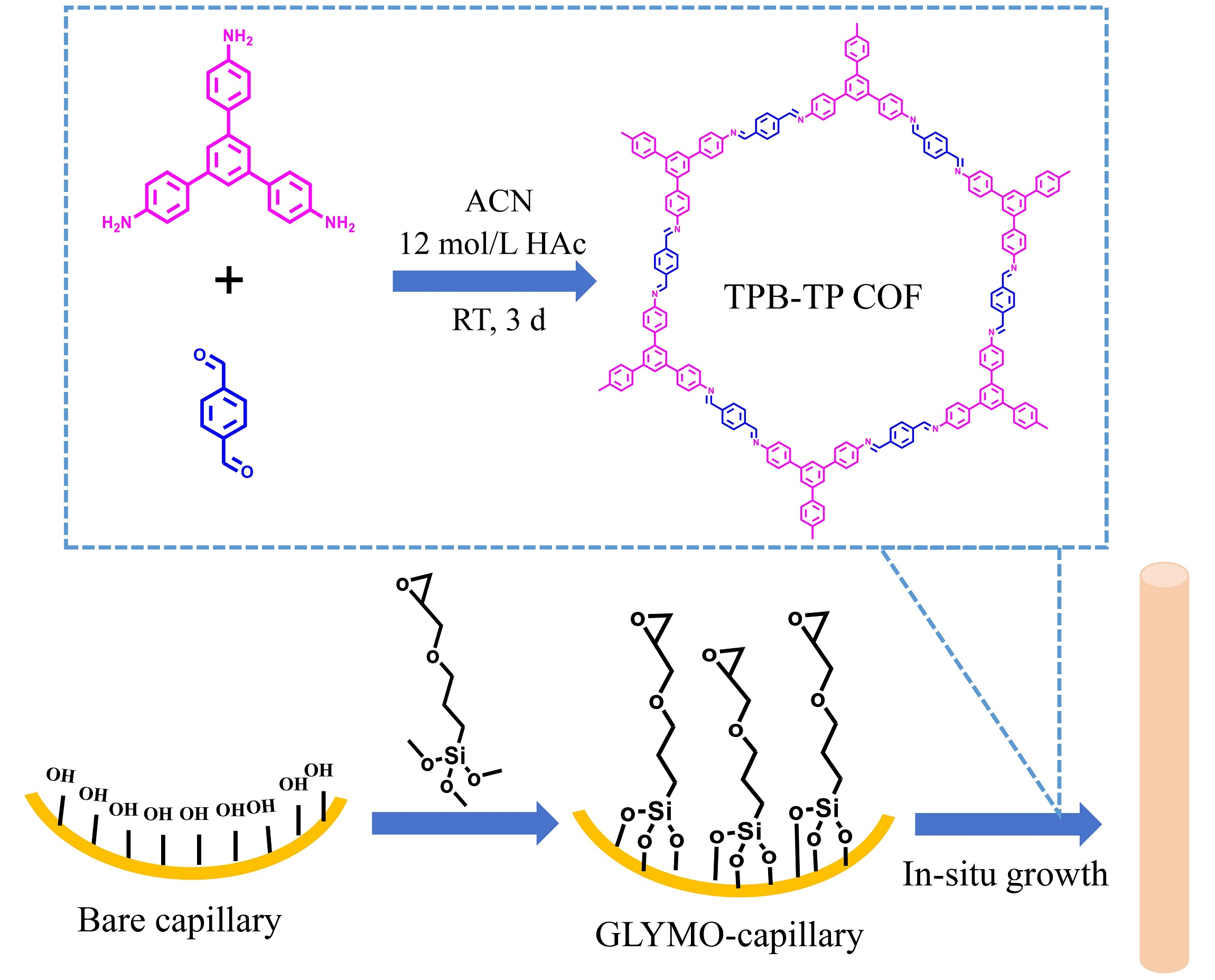
图1 TPB-TP COF涂层毛细管的制备示意图TPB: 1,3,5-tris(4-aminophenyl)benzene; TP: terephthalaldehyde; COF: covalent organic framework; ACN: acetonitrile; HAc: acetic acid; RT: room temperature; GLYMO: 3-glycidyloxypropyltrimethoxysilane.
Fig. 1 Preparation of TPB-TP COF-coated capillaries
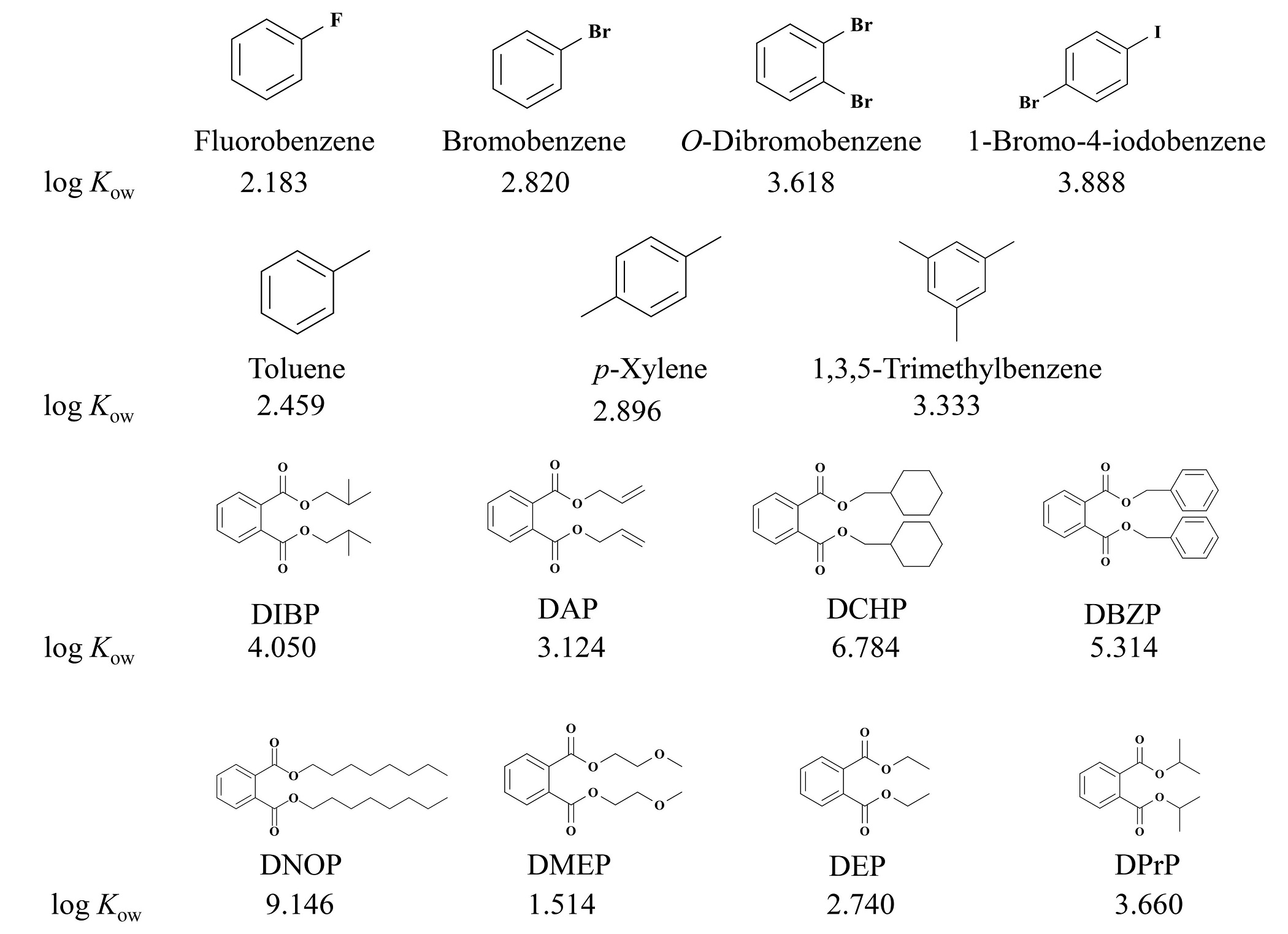
图2 分析物的结构式和log Kow值log Kow: octanol-water partition coefficients; DAP: diallyl phthalate; DIBP: diisobutyl phthalate; DBZP: dibenzyl phthalate; DCHP: dicyclohexyl phthalate; DMEP: bis(2-methoxyethyl)phthalate; DEP: diethyl phthalate; DPrP: diisopropyl phthalate; DNOP: di-n-octyl phthalate.
Fig. 2 Chemical structures and log Kow values of the analytes
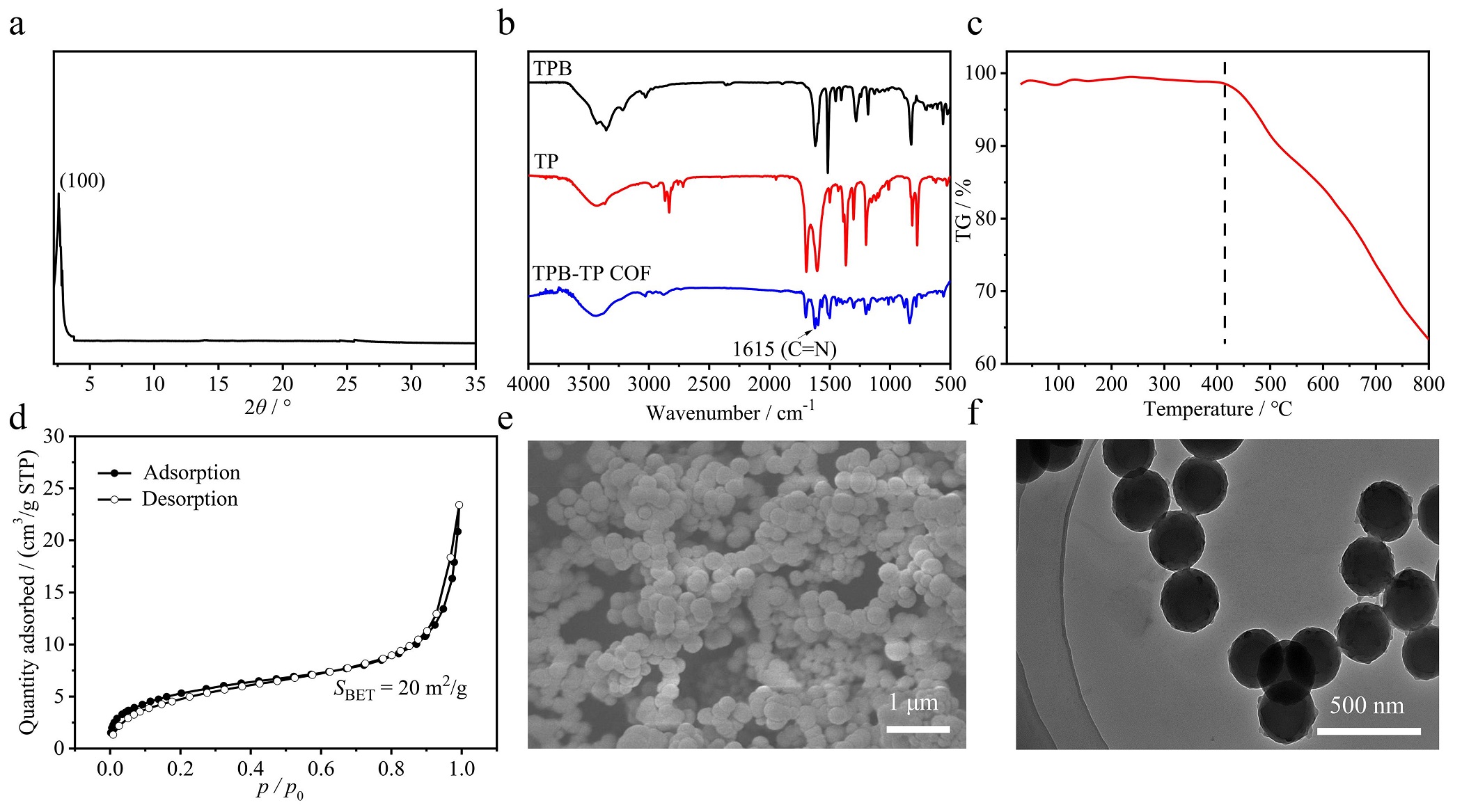
图3 TPB-TP COF的表征:(a)PXRD图谱、(b)FT-IR谱图、(c)热重分析曲线、(d)N2吸附-脱附曲线、(e)SEM和(f)TEM图PXRD: powder X-ray diffraction; FT-IR: Fourier transform infrared spectroscopy; SBET: BET surface area; SEM: scanning electron microscopy; TEM: transmission electron microscopy.
Fig. 3 Characterization of TPB-TP COF: (a) PXRD pattern,(b) FT-IR spectra,(c) thermogravimetric (TG) analysis curve,(d) N2 adsorption-desorption isotherms,(e) SEM and (f) TEM images
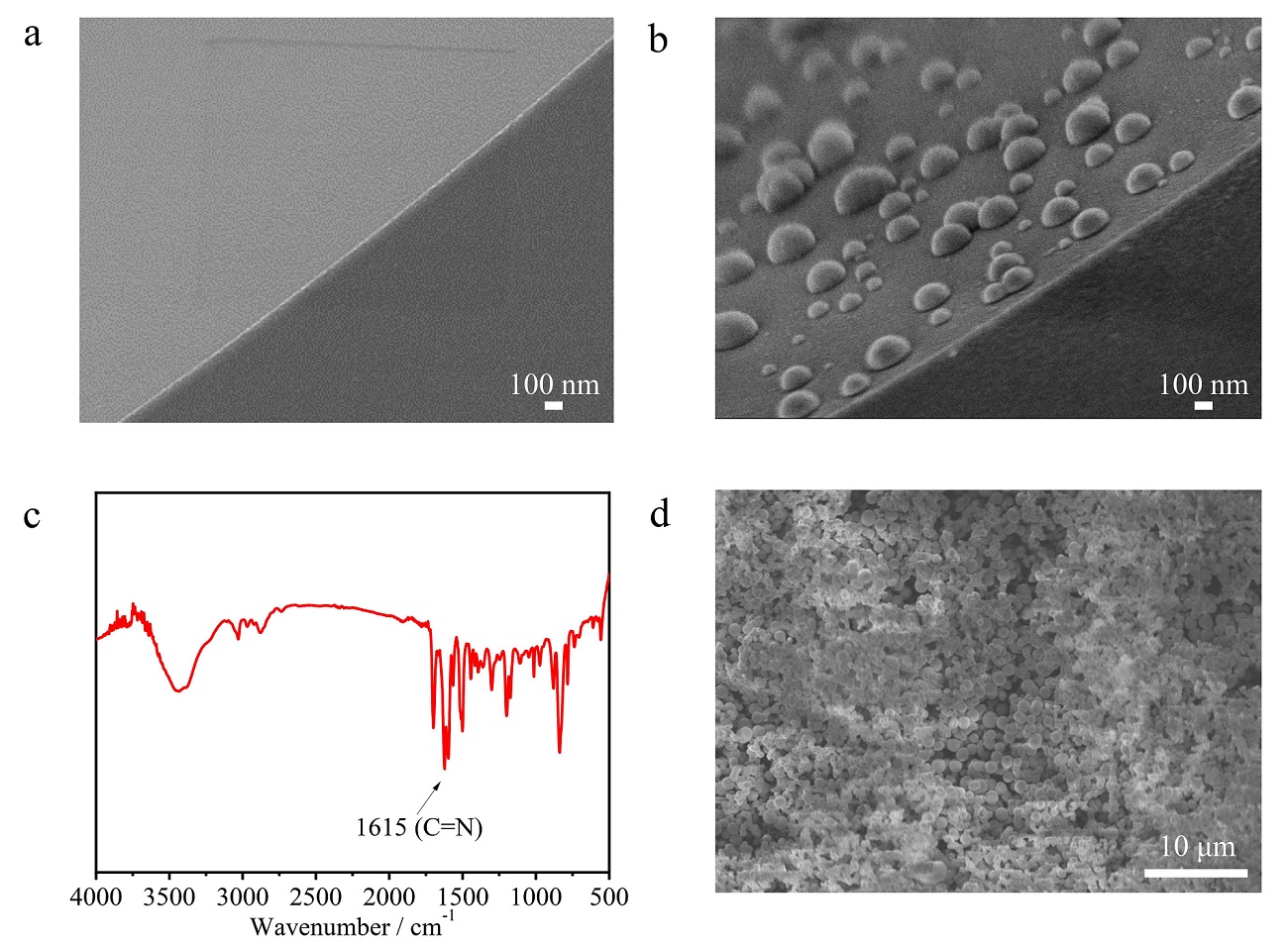
图4 (a)裸毛细管和(b)TPB-TP COF涂层毛细管的SEM图,石英片上原位生长TPB-TP COF的(c)FT-IR谱图和(d)SEM图
Fig. 4 SEM images of (a) bare capillary and (b) TPB-TP COF-coated capillary; (c) FT-IR spectrum and (d) SEM image of TPB-TP COF grown on quartz plate
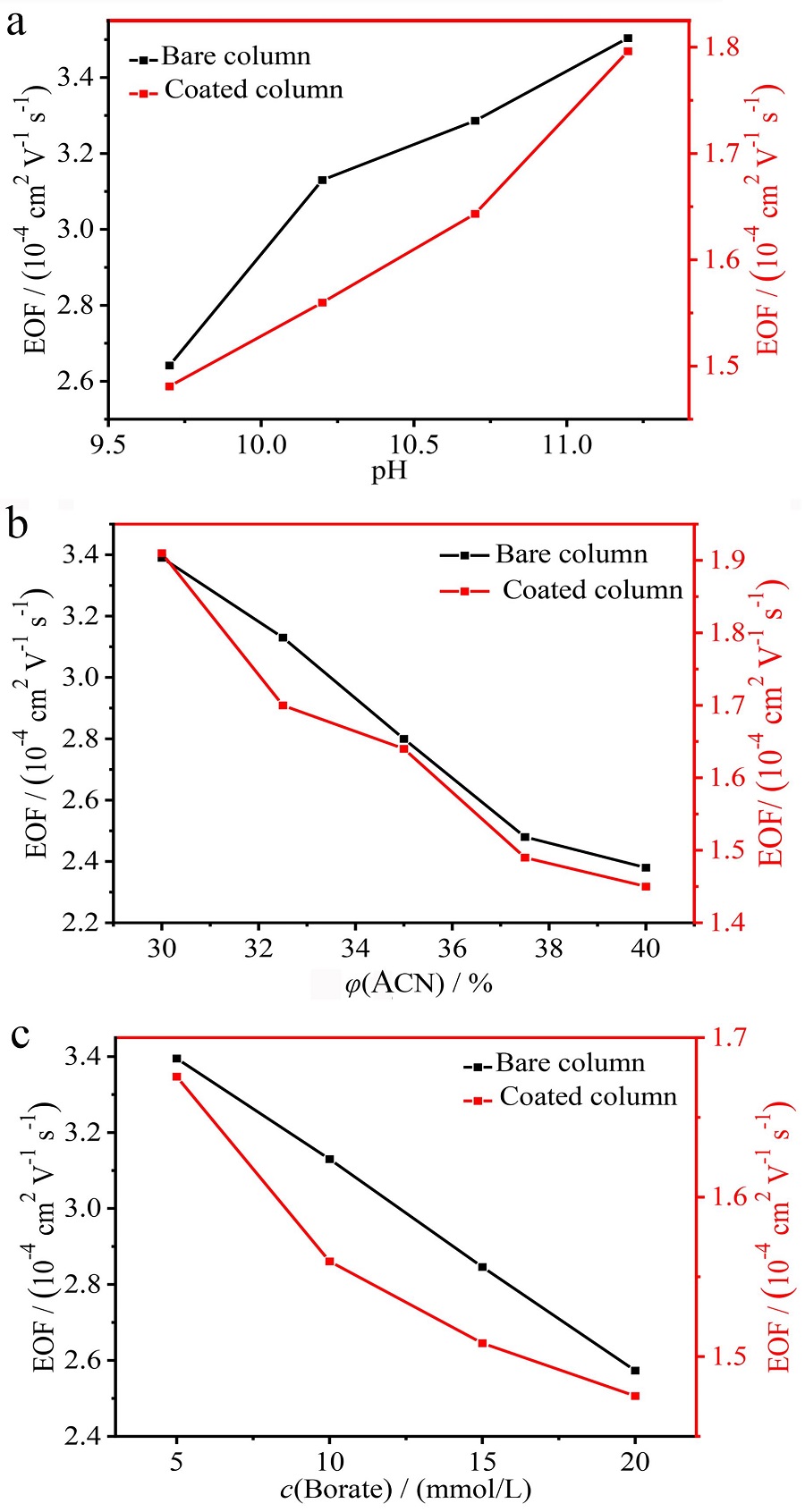
图5 (a)缓冲溶液pH、(b)乙腈体积分数和(c)缓冲溶液浓度对EOF的影响CEC conditions: a. 10 mmol/L borate,35% (volume fraction) ACN,pH 9.70-11.20; b. 10 mmol/L borate,30%-40% (volume fraction) ACN,pH 10.00; c. 5-20 mmol/L borate,35% (volume fraction) ACN,pH 10.00. EOF: electroosmotic flow.
Fig. 5 Influences of (a) buffer pH,(b) acetonitrile content,and (c) buffer concentration on EOF mobility
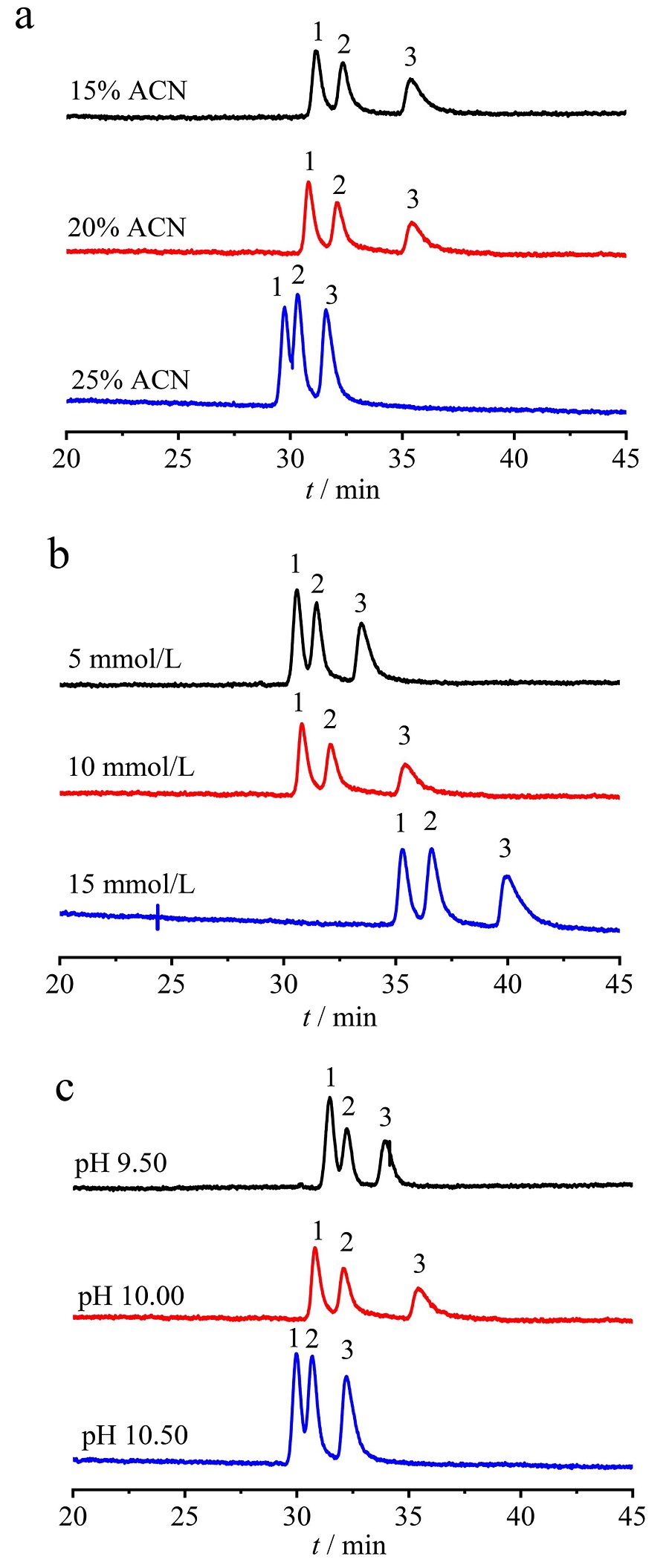
图6 (a)ACN含量、(b)硼砂浓度和(c)缓冲液pH对TPB-TP COF涂层毛细管分离烷基苯的影响OT-CEC conditions: a. 10 mmol/L borate,15%-25% ACN,pH 10.00; b. 5-15 mmol/L borate,20% ACN,pH 10.00; c. 10 mmol/L borate,20% ACN,pH 9.50-10.50.Peak identifications: 1. toluene (10 μg/mL),2. p-xylene (10 μg/mL); 3. 1,3,5-trimethylbenzene (50 μg/mL).
Fig. 6 Influences of (a) ACN content,(b) borate concentration,and (c) buffer pH on the separation of alkyl benzenes by the TPB-TP COF-coated capillary
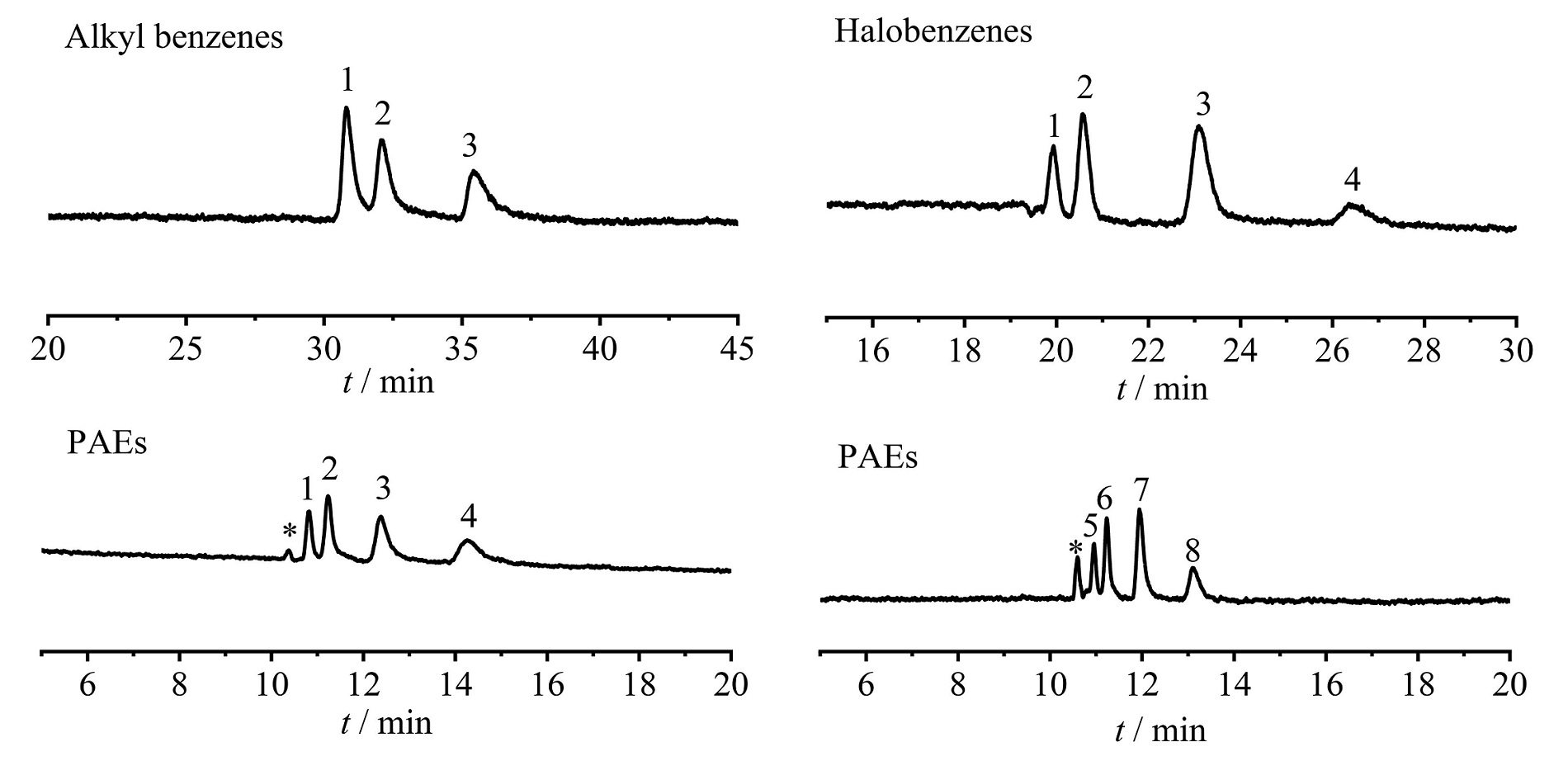
图7 TPB-TP COF涂层毛细管对4组中性分析物的电泳谱图For alkyl benzenes,conditions: 10 mmol/L borate,pH 10.00,20% (volume fraction) ACN; peaks: 1. toluene (10 μg/mL); 2. p-xylene (10 μg/mL); 3. 1,3,5-trimethylbenzene (50 μg/mL). For halobenzenes,conditions: 10 mmol/L borate,pH 10.20,32.5% (volume fraction) ACN; peaks: 1. fluorobenzene (10 μg/mL); 2. bromobenzene (5 μg/mL); 3. o-dibromobenzene (5 μg/mL); 4. 1-bromo-4-iodobenzene (50 μg/mL). For phthalate esters (PAEs) 1-4,10 mmol/L borate,pH 10.00,15% (volume fraction) ACN; peaks: 1. DAP (10 μg/mL); 2. DIBP (25 μg/mL); 3. DBZP (25 μg/mL); 4. DCHP (50 μg/mL). For PAEs 5-8,10 mmol/L borate,pH 10.20,35% (volume fraction) ACN; peaks: 5. DMEP (25 μg/mL); 6. DEP (25 μg/mL); 7. DPrP (25 μg/mL); 8. DNOP (50 μg/mL). * denotes EOF.
Fig. 7 Electropherograms of four groups of analytes on TPB-TP COF-coated capillary
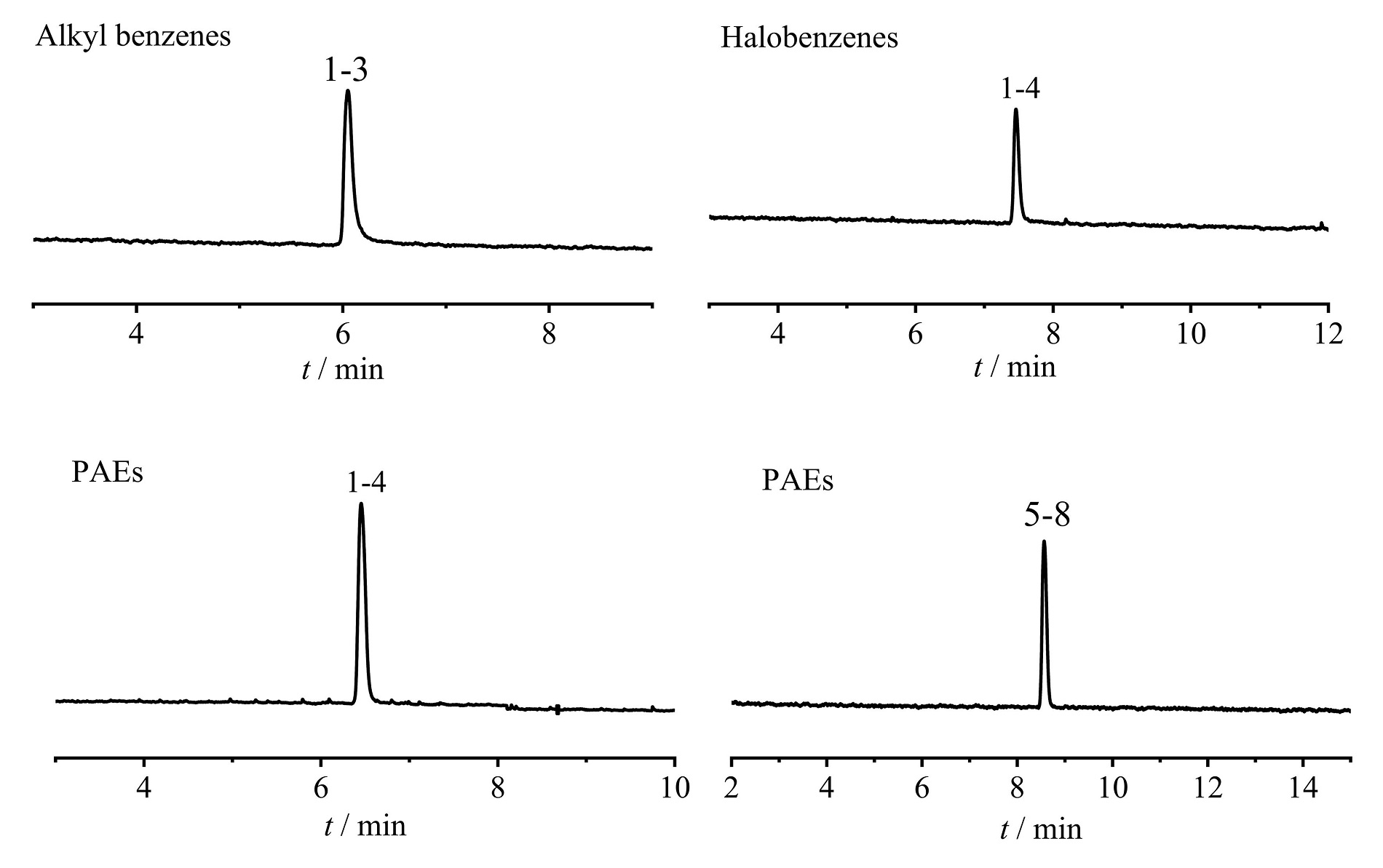
图8 裸毛细管对4组中性分析物的电泳谱图CE conditions and peak identifications are the same as in Fig. 7.
Fig. 8 Electropherograms of the four groups of analytes on bare capillary
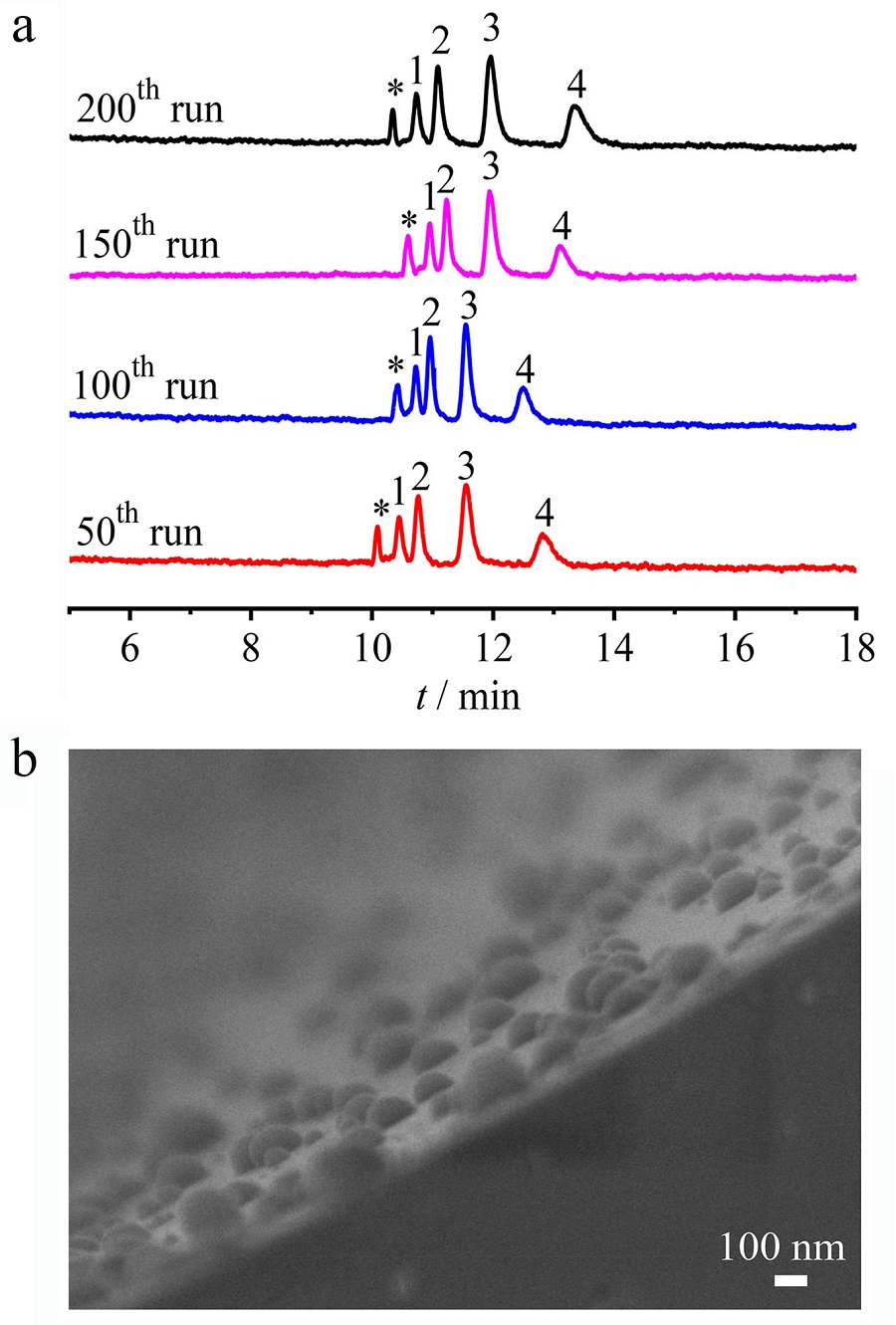
图9 (a) PAEs在TPB-TP COF涂层毛细管上运行不同次数的CE图和(b)运行200次后的TPB-TP COF涂层毛细管的SEM图Conditions: 10 mmol/L borate,pH 10.00,15% ACN.Peaks: 1. DAP (10 μg/mL); 2. DIBP (25 μg/mL); 3. DBZP (25 μg/mL); 4. DCHP (50 μg/mL).
Fig. 9 (a) Electropherograms of PAEs on the TPB-TP COF-coated capillary after different runs and (b) SEM image of the TPB-TP COF-coated capillary after 200 runs
| Analyte | RSDs/% (n=3) | |||||
|---|---|---|---|---|---|---|
| Intra-day | Inter-day | Column-to-column | ||||
| Migration time | Peak area | Migration time | Peak area | Migration time | Peak area | |
| DAP | 1.5 | 5.0 | 2.1 | 8.0 | 3.5 | 5.9 |
| DIBP | 5.5 | 7.3 | 2.0 | 3.7 | 4.8 | 3.1 |
| DBZP | 1.5 | 6.2 | 3.6 | 3.9 | 6.9 | 3.4 |
| DCHP | 4.0 | 8.2 | 3.5 | 9.0 | 3.8 | 9.3 |
| DMEP | 4.5 | 9.7 | 3.5 | 6.9 | 6.9 | 6.6 |
| DEP | 3.7 | 6.0 | 5.4 | 3.9 | 4.9 | 3.8 |
| DPrP | 4.0 | 4.0 | 4.4 | 3.8 | 4.5 | 6.7 |
| DNOP | 4.4 | 5.6 | 4.4 | 5.4 | 4.7 | 4.0 |
表1 TPB-TP COF涂层毛细管重复性和稳定性
Table 1 Repeatability and stability of the TPB-TP COF-coated capillary
| Analyte | RSDs/% (n=3) | |||||
|---|---|---|---|---|---|---|
| Intra-day | Inter-day | Column-to-column | ||||
| Migration time | Peak area | Migration time | Peak area | Migration time | Peak area | |
| DAP | 1.5 | 5.0 | 2.1 | 8.0 | 3.5 | 5.9 |
| DIBP | 5.5 | 7.3 | 2.0 | 3.7 | 4.8 | 3.1 |
| DBZP | 1.5 | 6.2 | 3.6 | 3.9 | 6.9 | 3.4 |
| DCHP | 4.0 | 8.2 | 3.5 | 9.0 | 3.8 | 9.3 |
| DMEP | 4.5 | 9.7 | 3.5 | 6.9 | 6.9 | 6.6 |
| DEP | 3.7 | 6.0 | 5.4 | 3.9 | 4.9 | 3.8 |
| DPrP | 4.0 | 4.0 | 4.4 | 3.8 | 4.5 | 6.7 |
| DNOP | 4.4 | 5.6 | 4.4 | 5.4 | 4.7 | 4.0 |
| Coating material | Coating method | Repeatability (RSDs,n=3)/% | Analytes | Lifetime/runs | Ref. | |
|---|---|---|---|---|---|---|
| Migration time | Peak area | |||||
| Tf-DHzOH | covalent bonding | 0.8-8.7 | 1.3-11.2 | sulfonamides,tetracyclines,amino acids,benzene compounds | >200 | [ |
| N0-COF | post-modification | 0.1-4.9 | 1.3-9.1 | bisphenol A and its analogues | >200 | [ |
| TPB-DMTP COF | in-situ growth | 1.1-2.8 | 1.3-4.9 | herbicides,bisphenols,and benzene bromide analytes | >200 | [ |
| TPB-TP COF | in-situ growth | 1.5-6.9 | 3.1-9.7 | substituted benzenes,halobenzenes,phthalate esters | >200 | this work |
表2 TPB-TP COF涂层毛细管柱与已报道COF涂层毛细管柱的比较
Table 2 Comparison of TPB-TP COF-coated capillary with other COFs coated capillaries
| Coating material | Coating method | Repeatability (RSDs,n=3)/% | Analytes | Lifetime/runs | Ref. | |
|---|---|---|---|---|---|---|
| Migration time | Peak area | |||||
| Tf-DHzOH | covalent bonding | 0.8-8.7 | 1.3-11.2 | sulfonamides,tetracyclines,amino acids,benzene compounds | >200 | [ |
| N0-COF | post-modification | 0.1-4.9 | 1.3-9.1 | bisphenol A and its analogues | >200 | [ |
| TPB-DMTP COF | in-situ growth | 1.1-2.8 | 1.3-4.9 | herbicides,bisphenols,and benzene bromide analytes | >200 | [ |
| TPB-TP COF | in-situ growth | 1.5-6.9 | 3.1-9.7 | substituted benzenes,halobenzenes,phthalate esters | >200 | this work |
| Analyte | Linear regression equation | Linear range/(µg/mL) | R2 | LOD/(µg/mL) | LOQ/(µg/mL) |
|---|---|---|---|---|---|
| DAP | Y=123.08X+32.37 | 2.0-100.0 | 0.9877 | 0.37 | 1.22 |
| DIBP | Y=150.24X+524.58 | 2.0-100.0 | 0.9980 | 0.30 | 1.00 |
| DBZP | Y=195.88X+559.96 | 2.0-100.0 | 0.9895 | 0.23 | 0.77 |
| DCHP | Y=283.81X+194.01 | 5.0-100.0 | 0.9988 | 0.16 | 0.53 |
| DMEP | Y=224.70X+90.76 | 2.0-100.0 | 0.9997 | 0.20 | 0.67 |
| DEP | Y=280.24X+563.58 | 2.0-100.0 | 0.9994 | 0.16 | 0.54 |
| DPrP | Y=320.15X+268.68 | 5.0-100.0 | 0.9995 | 0.14 | 0.47 |
| DNOP | Y=295.18X+878.81 | 5.0-100.0 | 0.9989 | 0.15 | 0.51 |
表3 邻苯二甲酸酯类化合物的线性回归方程、线性范围、R2、检出限和定量限
Table 3 Linear regression equations,linear ranges,correlation coefficients (R2),LODs,and LOQs of phthalate esters
| Analyte | Linear regression equation | Linear range/(µg/mL) | R2 | LOD/(µg/mL) | LOQ/(µg/mL) |
|---|---|---|---|---|---|
| DAP | Y=123.08X+32.37 | 2.0-100.0 | 0.9877 | 0.37 | 1.22 |
| DIBP | Y=150.24X+524.58 | 2.0-100.0 | 0.9980 | 0.30 | 1.00 |
| DBZP | Y=195.88X+559.96 | 2.0-100.0 | 0.9895 | 0.23 | 0.77 |
| DCHP | Y=283.81X+194.01 | 5.0-100.0 | 0.9988 | 0.16 | 0.53 |
| DMEP | Y=224.70X+90.76 | 2.0-100.0 | 0.9997 | 0.20 | 0.67 |
| DEP | Y=280.24X+563.58 | 2.0-100.0 | 0.9994 | 0.16 | 0.54 |
| DPrP | Y=320.15X+268.68 | 5.0-100.0 | 0.9995 | 0.14 | 0.47 |
| DNOP | Y=295.18X+878.81 | 5.0-100.0 | 0.9989 | 0.15 | 0.51 |
| Analyte | Original/(µg/mL) | Spiked/(µg/mL) | Detected/(µg/mL) | Recovery/% | RSD/% |
|---|---|---|---|---|---|
| DAP | ND | 20.00 | 19.54 | 97.7 | 6.8 |
| 50.00 | 49.91 | 99.8 | 9.3 | ||
| 75.00 | 76.68 | 102.2 | 2.8 | ||
| DIBP | ND | 20.00 | 19.54 | 97.7 | 6.4 |
| 50.00 | 47.45 | 94.9 | 5.6 | ||
| 75.00 | 74.81 | 99.7 | 4.9 | ||
| DBZP | ND | 20.00 | 21.37 | 106.9 | 8.1 |
| 50.00 | 49.48 | 99.0 | 11.3 | ||
| 75.00 | 78.44 | 104.6 | 4.1 | ||
| DCHP | ND | 20.00 | 20.32 | 101.6 | 1.1 |
| 50.00 | 49.54 | 99.1 | 4.2 | ||
| 75.00 | 74.23 | 99.0 | 5.3 | ||
| DMEP | ND | 20.00 | 20.86 | 104.3 | 6.4 |
| 50.00 | 54.13 | 108.3 | 6.7 | ||
| 75.00 | 73.76 | 98.3 | 2.1 | ||
| DEP | ND | 20.00 | 21.77 | 108.9 | 5.4 |
| 50.00 | 48.85 | 97.7 | 4.3 | ||
| 75.00 | 78.01 | 104.0 | 1.0 | ||
| DPrP | ND | 20.00 | 21.00 | 105.0 | 5.2 |
| 50.00 | 53.05 | 106.1 | 4.8 | ||
| 75.00 | 78.19 | 104.3 | 1.4 | ||
| DNOP | ND | 20.00 | 20.12 | 100.6 | 2.9 |
| 50.00 | 52.08 | 104.2 | 5.3 | ||
| 75.00 | 77.97 | 104.0 | 2.1 |
表4 3个加标水平下邻苯二甲酸酯类化合物在黄河水样中的加标回收率及RSD(n=3)
Table 4 Recoveries and RSDs of PAEs in Yellow River water sample at three levels (n=3)
| Analyte | Original/(µg/mL) | Spiked/(µg/mL) | Detected/(µg/mL) | Recovery/% | RSD/% |
|---|---|---|---|---|---|
| DAP | ND | 20.00 | 19.54 | 97.7 | 6.8 |
| 50.00 | 49.91 | 99.8 | 9.3 | ||
| 75.00 | 76.68 | 102.2 | 2.8 | ||
| DIBP | ND | 20.00 | 19.54 | 97.7 | 6.4 |
| 50.00 | 47.45 | 94.9 | 5.6 | ||
| 75.00 | 74.81 | 99.7 | 4.9 | ||
| DBZP | ND | 20.00 | 21.37 | 106.9 | 8.1 |
| 50.00 | 49.48 | 99.0 | 11.3 | ||
| 75.00 | 78.44 | 104.6 | 4.1 | ||
| DCHP | ND | 20.00 | 20.32 | 101.6 | 1.1 |
| 50.00 | 49.54 | 99.1 | 4.2 | ||
| 75.00 | 74.23 | 99.0 | 5.3 | ||
| DMEP | ND | 20.00 | 20.86 | 104.3 | 6.4 |
| 50.00 | 54.13 | 108.3 | 6.7 | ||
| 75.00 | 73.76 | 98.3 | 2.1 | ||
| DEP | ND | 20.00 | 21.77 | 108.9 | 5.4 |
| 50.00 | 48.85 | 97.7 | 4.3 | ||
| 75.00 | 78.01 | 104.0 | 1.0 | ||
| DPrP | ND | 20.00 | 21.00 | 105.0 | 5.2 |
| 50.00 | 53.05 | 106.1 | 4.8 | ||
| 75.00 | 78.19 | 104.3 | 1.4 | ||
| DNOP | ND | 20.00 | 20.12 | 100.6 | 2.9 |
| 50.00 | 52.08 | 104.2 | 5.3 | ||
| 75.00 | 77.97 | 104.0 | 2.1 |
|
| [1] | 孙泽艺, 袁光年, 牛媛烨, 马继平. 复合共价有机框架材料用于食品中新污染物分析的样品前处理技术研究进展[J]. 色谱, 2026, 44(7): 731-740. |
| [2] | 李芸萌, 李泓毅, 曹东晓, 唐安娜, 孔德明. “我爱实验室”科研训练:一种阳离子型共价有机框架气凝胶用于有机染料去除[J]. 色谱, 2026, 44(7): 812-820. |
| [3] | 石飞云, 徐浩宇, 黎俊宏, 徐梦媛. 超高效液相色谱-串联质谱法测定人体全血中22种有机磷酸酯及其代谢物和11种邻苯二甲酸酯类代谢物[J]. 色谱, 2026, 44(6): 682-693. |
| [4] | 骆垲兴, 孙颖, 张秋婷, 吴露莎, 宋嘉敏, 钟燕辉, 林子俺. 共价有机框架色谱固定相研究新进展[J]. 色谱, 2026, 44(11): 1346-1353. |
| [5] | 丁璐瑶, 朱淋, 乔国立, 刘忠山, 高瑞霞. 基于醛-胺冷冻聚合反应的亚胺类共价有机框架整体材料的制备[J]. 色谱, 2026, 44(11): 1411-1418. |
| [6] | 李志泉, 饶梓睿, 钱海龙, 严秀平. 异孔共价有机框架气相色谱固定相的制备与应用[J]. 色谱, 2026, 44(10): 1203-1211. |
| [7] | 张双, 孙明霞, 邱洪灯, 陈佳. 共价有机框架在战略性关键金属回收中的应用进展:聚焦稀土与稀散金属[J]. 色谱, 2026, 44(10): 1162-1174. |
| [8] | 黄泽鑫, 汤胜. 基于硅胶基质多孔材料的液相色谱固定相研究进展[J]. 色谱, 2026, 44(10): 1118-1128. |
| [9] | 龙燊, 陈佳宇, 袁晨, 侯贤灯. 手性多孔框架色谱固定相的构筑及应用进展[J]. 色谱, 2026, 44(10): 1105-1117. |
| [10] | 黄晶滢, 闫敬怡, 齐骥, 陈令新, 李金花. 基于金属/共价有机框架分子印迹材料的固相萃取结合色谱/质谱在海岸带新污染物筛查识别中的应用[J]. 色谱, 2025, 43(8): 841-856. |
| [11] | 程颖超, 高祎阳, 李小敏, 陈鲁玉, 杜芳, 郭洁, 孟弋童, 孙敏, 冯娟娟. 基于共价有机框架材料的固相微萃取研究进展[J]. 色谱, 2025, 43(2): 120-130. |
| [12] | 郑德圣, 汤雯淇, 朱建平, 古志远. 基于二维材料的色谱固定相制备及应用[J]. 色谱, 2024, 42(6): 524-532. |
| [13] | 刘锦, 田文锠, 吴帆, 张秋婷, 钟燕辉, 林子俺. 本科生综合实验:基于共价有机框架的核壳型固定相的制备及色谱性能评价[J]. 色谱, 2024, 42(10): 1006-1012. |
| [14] | 周素馨, 况逸馨, 郑娟, 欧阳钢锋. 基于手性有机框架材料制备气相色谱固定相的研究进展[J]. 色谱, 2024, 42(1): 1-12. |
| [15] | 高祎阳, 丁亚丽, 陈鲁玉, 杜芳, 辛绪波, 冯娟娟, 孙明霞, 冯洋, 孙敏. 共价有机框架材料在固相萃取中的最新应用进展[J]. 色谱, 2023, 41(7): 545-553. |
| 阅读次数 | ||||||
|
全文 |
|
|||||
|
摘要 |
|
|||||
