| [1] | Peluso P, Chankvetadze B. Chem Rev, 2022, 122(16): 13235 |
| [2] | Liu Y, Wu Z, Armstrong D W, et al. Nat Rev Chem, 2023, 7(5): 355 |
| [3] | U.S. Food and Drug Administration. Novel Drug Approvals for 2025. (2025-01-02) [2025-01-05]. |
| [4] | McVicker R U, O’Boyle N M. J Med Chem, 2024, 67(4): 2305 |
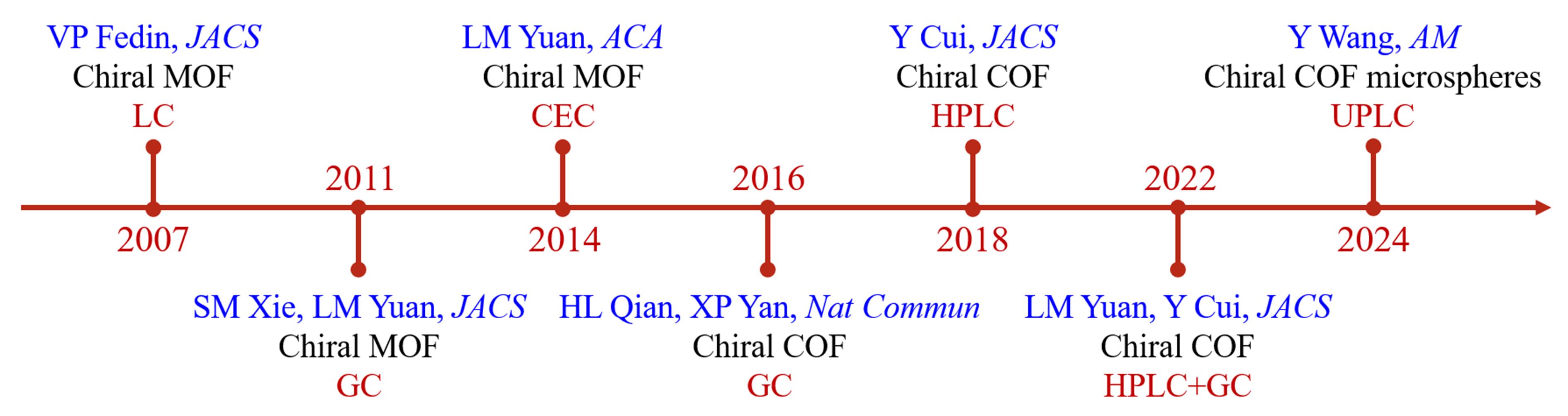
| [5] | Nuzhdin A L, Dybtsev D N, Bryliakov K P, et al. J Am Chem Soc, 2007, 129(43): 12958 |
| [6] | Xie S M, Zhang Z J, Wang Z Y, et al. J Am Chem Soc, 2011, 133(31): 11892 |
| [7] | Fei Z X, Zhang M, Zhang J H, et al. Anal Chim Acta, 2014, 830: 49 |
| [8] | Qian H L, Yang C X, Yan X P. Nat Commun, 2016, 7(1): 12104 |
| [9] | Han X, Huang J, Yuan C, et al. J Am Chem Soc, 2018, 140(3): 892 |
| [10] | Yuan C, Jia W, Yu Z, et al. J Am Chem Soc, 2022, 144(2): 891 |
| [11] | Xu J, Feng G, Ao D, et al. Adv Mater, 2024, 36(33): 2406256 |
| [12] | Cheng Q, Ma Q, Pei H, et al. Coord Chem Rev, 2023, 484: 215120 |
| [13] | Han X, Yuan C, Hou B, et al. Chem Soc Rev, 2020, 49(17): 6248 |
| [14] | Wang L K, Zhou J J, Lan Y B, et al. Angew Chem Int Ed, 2019, 58(28): 9443 |
| [15] | Yang J, Wei S, Zhang T, et al. J Am Chem Soc, 2025, 147(31): 28085 |
| [16] | Zhang S, Zheng Y, An H, et al. Angew Chem Int Ed, 2018, 57(51): 16754 |
| [17] | Xu H, Chen X, Gao J, et al. Chem Commun, 2014, 50(11): 1292 |
| [18] | Han X, Zhang J, Huang J, et al. Nat Commun, 2018, 9(1): 1294 |
| [19] | Chen H, Gu Z G, Zhang J. J Am Chem Soc, 2022, 144(16): 7245 |
| [20] | Hsu K T, Thanasekaran P, Hsu T W, et al. CrystEngComm, 2021, 23(4): 824 |
| [21] | Deng S Q, Mo X J, Cai S L, et al. Inorg Chem, 2019, 58(21): 14660 |
| [22] | Gritti F, Guiochon G. Anal Chem, 2013, 85(6): 3017 |
| [23] | Ma H C, Jiang H P, Yao Z H, et al. Chem Commun, 2024, 60(76): 10580 |
| [24] | Yang M, Zheng Y, Cai Y, et al. Angew Chem Int Ed, 2025, 64(8): e202420269 |
| [25] | Wang Z X, Guo B Y, Chen S Y, et al. J Solid State Chem, 2024, 340: 125028 |
| [26] | Yang H, Liang F C, Tang B, et al. J Solid State Chem, 2025, 346: 125252 |
| [27] | Ni H, Xu W, Xu L, et al. Anal Chim Acta, 2025, 1363: 344186 |
| [28] | Ding H, Zhang Y, Wang Z, et al. J Am Chem Soc, 2025, 147(32):29359 |
| [29] | Ran X, Guo P, Liu C, et al. Molecules, 2023, 28(2): 662 |
| [30] | Zhu Y L, Guo P, Yang Y P, et al. New J Chem, 2023, 47(11): 5413 |
| [31] | Liu C, Guo P, Lu Y R, et al. Microchim Acta, 2023, 190(6): 238 |
| [32] | Zhang Y, Lu Y R, Liu C, et al. J Sep Sci, 2024, 47(15): 2400140 |
| [33] | Zhou H M, Liu C, Zhang Y, et al. Microchim Acta, 2024, 191(8): 445 |
| [34] | Zhao Y Q, Li Y J, He R X, et al. Chem Mater, 2025, 37(18): 7410 |
| [35] | He R X, Wang H, Xiong T J, et al. Microchim Acta, 2025, 192(10): 699 |
| [36] | Liu C, Guo P, Ran X Y, et al. Microchim Acta, 2024, 191(5): 281 |
| [37] | Xiong T J, Liu C, Wang H, et al. Microchem J, 2025, 213: 113634 |
| [38] | Du H, Yu S, Hu Y, et al. Microchem J, 2025, 216: 114733 |
| [39] | Zhang W, Ke Z, Liu Y, et al. Sep Purif Technol, 2025, 369: 133126 |
| [40] | Hu Z, Liao J, Zhou J, et al. Chin Chem Lett, 2025, 36(1): 109985 |
| [41] | Wan M, Zheng Y, Dai X, et al. Chem Mater, 2023, 35(2): 609 |
| [42] | Chen Y, Huang S, Xia L, et al. Anal Chem, 2024, 96(3): 1380 |
| [43] | Ma J, Huang W, Huang X, et al. J Chromatogr A, 2024, 1728: 465014 |
| [44] | Ma A X, Liu C F, Zhu Y L, et al. New J Chem, 2024, 48(21): 9702 |
| [45] | Li Y J, Zhao Y Q, Xiong T J, et al. J Sep Sci, 2025, 48(11): e70322 |
| [46] | Liu H L, Li Y N, Zi M, et al. Chinese Journal of Chromatography, 2023, 41(2): 187 |
| | 刘华林, 李亚楠, 字敏, 等. 色谱, 2023, 41(2): 187 |
| [47] | Lai Y L, Gao S Q, Wang Z, et al. J Chromatogr A, 2024, 1722: 464911 |
| [48] | Yuan C, Wang Z, Xiong W, et al. J Am Chem Soc, 2023, 145(34): 18956 |
| [49] | Mao Z, Chen Z. J Pharm Anal, 2019, 9(4): 227 |
| [50] | Wang G X, Chen Y L, Lü W J, et al. Chinese Journal of Chromatography, 2023, 41(10): 835 |
| | 王国秀, 陈永雷, 吕文娟, 等. 色谱, 2023, 41(10): 835 |
| [51] | Song R K, Liao G, Lin J L, et al. Chinese Journal of Chromatography, 2024, 42(11): 1087 |
| | 宋睿科, 廖淦, 林佳丽, 等. 色谱, 2024, 42(11): 1087 |
| [52] | Zhou M, Hao J, Wu Y, et al. Anal Methods, 2024, 16(32): 5545 |
| [53] | Zhang J, Liu X, Mu Q, et al. Chem-Eur J, 2024, 30(15): e202303827 |
| [54] | Miao P, Zhai Z, Guo C, et al. Talanta, 2025, 294: 128115 |
| [55] | Zheng X, Zhang Q, Ma Q, et al. J Pharm Anal, 2023, 13(4): 421 |
| [56] | Dong Q, Guo X, Qu X, et al. Talanta, 2023, 258: 124415 |
| [57] | Yang M, Lv W, Chen Y, et al. J Chromatogr A, 2024, 1736: 465334 |
| [58] | Ge L, Zhu G, Li X, et al. Anal Chim Acta, 2025, 1368: 344340 |
| [59] | Zhu G, Wu D, Li X, et al. J Chromatogr A, 2025, 1758: 466177 |
| [60] | Miao P, Chen J, Xu G, et al. Microchim Acta, 2024, 191(3): 160 |
| [61] | Qin S, Lei J, Wang D, et al. Anal Methods, 2025, 17(15): 2961 |
| [62] | Yu J, Gao L, Qu X, et al. Chirality, 2025, 37(11): e70059 |
| [63] | Zhang J, Mu Q, Li X, et al. Anal Chim Acta, 2025, 1369: 344351 |
| [64] | Huo H, Guan J, Huang Z, et al. J Sep Sci, 2023, 46(14): 2300117 |
| [65] | Long K, Guan J, Yu J, et al. Microchim Acta, 2024, 191(8): 457 |
| [66] | Ma M, Zhang Y, Huang F, et al. Microchim Acta, 2024, 191(4): 203 |
| [67] | Tan D, Wang T, Hu J, et al. New J Chem, 2023, 47(13): 6378 |
| [68] | Wu J, Li L, Cao L, et al. ACS Appl Mater Interfaces, 2023, 15(22): 27214 |
| [69] | Liao Y, Cao L, Mu Q, et al. Talanta, 2025, 283: 127128 |
| [70] | Miao P, Li Y, Du Y. Microchim Acta, 2023, 190(8): 302 |
| [71] | Miao P, Yan Y, Du S, et al. Anal Chim Acta, 2024, 1330: 343303 |
| [72] | Miao P, Zhu D, Du S, et al. Microchim Acta, 2024, 191(11): 686 |
| [73] | Sun G, Choi D M, Xu H, et al. Microchim Acta, 2023, 190(3): 84 |
| [74] | Fu S, Qin G, Dong J, et al. Natl Sci Rev, 2024, 11(10): nwae256 |
| [75] | Song Q, Yang J, Zheng K, et al. J Am Chem Soc, 2024, 146(11): 7594 |
| [76] | Huang J, Ma Y, Abbasi M, et al. Chirality, 2025, 37(8): e70049 |
| [77] | Yang M F, Zheng K N, Long Y X, et al. Chinese Journal of Chromatography, 2025, 43(4): 335 |
| | 杨梅芳, 郑康妮, 龙怡幸, 等. 色谱, 2025, 43(4): 335 |
| [78] | Núñez-Rico J L, Cabezas-Giménez J, Lillo V, et al. ACS Appl Mater Interfaces, 2023, 15(33): 39594 |

 ), 侯贤灯