色谱 ›› 2026, Vol. 44 ›› Issue (5): 547-554.DOI: 10.3724/SP.J.1123.2025.08023

• 研究论文 • 上一篇    下一篇

全自动固相萃取-超高效液相色谱-串联质谱法同时测定饮用水中全氟化合物、抗生素和农药

梁静, 冯家力, 曾栋, 周丽平, 钟旋, 李轶, 陈东洋()   

  1. 湖南省疾病预防控制中心(湖南省预防医学科学院),湖南 长沙 410153
  • 收稿日期:2025-08-29 出版日期:2026-05-08 发布日期:2026-05-07
  • 通讯作者: 陈东洋 E-mail:dychen2008@126.com.
  • 基金资助:
    湖南省自然科学基金(2021JJ70085);湖南省自然科学基金(2025JJ80673);湖南省卫生健康高层次人才支持计划(20240304107);湖南省卫生健康高层次人才支持计划(20240304043);湖南省卫生健康委科研项目(D202312069311);湖南省卫生健康委科研项目(20254676);湖南省疾病预防控制中心“青荷”青年培育基金项目(QHJJ2023006)

Determination of perfluorinated compounds, antibiotics and pesticides in drinking water by automated solid phase extraction with ultra-performance liquid chromatography-tandem mass spectrometry

LIANG Jing, FENG Jiali, ZENG Dong, ZHOU Liping, ZHONG Xuan, LI Yi, CHEN Dongyang()   

  1. Hunan Provincial Center for Disease Control and Prevention (Hunan Academy of Preventive Medicine),Changsha 410153,China
  • Received:2025-08-29 Online:2026-05-08 Published:2026-05-07
  • Supported by:
    Hunan Provincial Natural Science Foundation(2021JJ70085);Hunan Provincial Natural Science Foundation(2025JJ80673);Hunan Provincial Health High-Level Talent Support Program(20240304107);Hunan Provincial Health High-Level Talent Support Program(20240304043);Research Project of Health Commission of Hunan Province(D202312069311);Research Project of Health Commission of Hunan Province(20254676);“Qinghe” Youth Cultivation Fund Project of Hunan Provincial Center for Disease Control and Prevention(QHJJ2023006)

摘要:

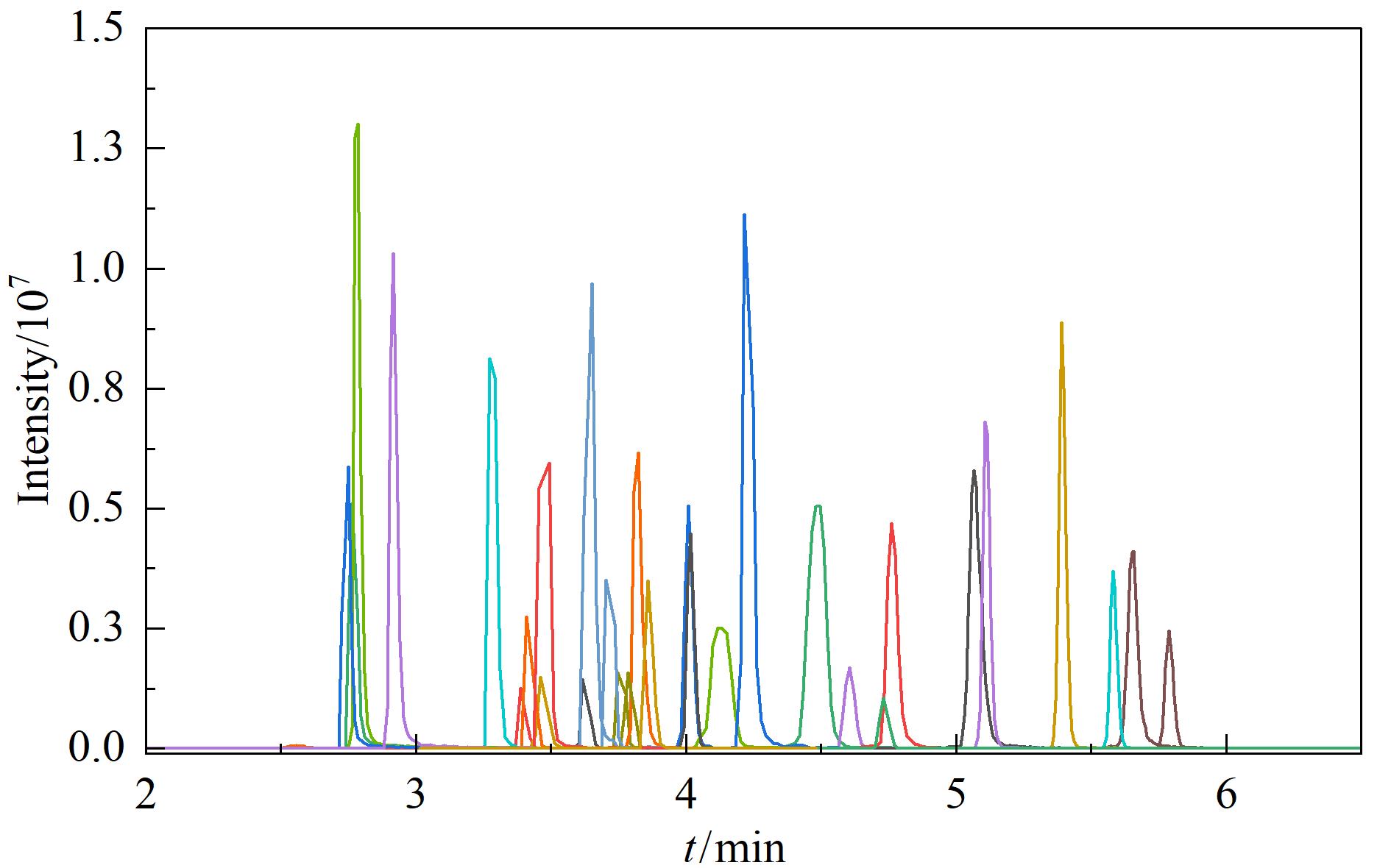
饮用水中新污染物因其生物毒性和环境持久性,对公共健康和生态系统构成潜在威胁,亟需发展高效的监测与防治技术。目前饮用水中新污染物的检测技术主要侧重于对单一类型污染物进行分析,这不仅导致检测成本增加,还无法快速应对水质监测中多种类污染物检测的需求。本研究建立了一种新型的分析方法,基于全自动固相萃取-超高效液相色谱-串联质谱法同时检测饮用水中30种不同特性的污染物,包括全氟化合物、抗生素和农药。采用全自动固相萃取仪对水样进行自动化前处理,经OASIS HLB固相萃取柱富集净化。待测物采用ACQUITY UPLC HSS T3色谱柱(100 mm×2.1 mm,1.7 μm)进行分离,流动相为5 mmol/L乙酸铵水溶液(含0.1%甲酸)-乙腈体系,梯度洗脱,采用电喷雾离子源正/负切换模式分析测定,外标法定量。结果表明,30种化合物在0.10~200.0 μg/L范围内线性关系良好,相关系数(r)大于0.990,检出限为0.01~1.0 ng/L,定量限为0.03~3.0 ng/L,在不同添加水平下(0.20、1.0、10.0 μg/L),回收率为70.2%~120.0%,相对标准偏差(RSD,n=6)为3.2%~9.6%。采用该方法对湖南省9个县区的水样进行检测,检出16种化合物,检出含量为0.1~9.9 ng/L,其中检出率最高的是莠去津,检出含量最高的是氯虫苯甲酰胺。根据GB 5749-2022《生活饮用水卫生标准》对饮用水的管控要求,全氟辛酸、2,4-二氯苯氧乙酸、莠去津、克百威和灭草松的含量远低于国家的限值要求,表明在所研究地区的水源中这些化合物的健康风险较低。该方法高效、快速、成本低,适用于饮用水中全氟化合物、抗生素和农药的同时测定,有望为饮用水中新污染的管控和治理提供有力的技术支撑。

关键词: 全氟化合物, 抗生素, 农药, 超高效液相色谱-串联质谱, 固相萃取,

Abstract:

Emerging organic contaminants in drinking water, characterized by biological toxicity and environmental persistence. Developing effective strategies for monitoring and controlling these contaminants in drinking water has become an urgent need to ensure drinking water safety. However, the current detection technologies for emerging organic contaminants in drinking water mainly focus on analyzing a single type of pollutant, which increases in detection costs and fails to meet the urgent demand for rapid, multi-analyte screening in water quality monitoring. This study established a novel analytical method, which was based on the automatic solid phase extraction coupled with ultra-performance liquid chromatography-tandem mass spectrometry method (SPE-UPLC-MS/MS), enabling the simultaneous detection of 30 contaminants with diverse physicochemical properties in drinking water. The 30 contaminants included perfluorinated compounds (PFCs), antibiotics and pesticides. The water samples were pretreated automatically by an automatic solid phase extraction instrument, and then purified and enriched through an OASIS HLB solid phase extraction column. The 30 contaminants were separated on an ACQUITY UPLC HSS T3 column (100 mm×2.1 mm, 1.7 μm) with a gradient mobile phase consisting of 5 mmol/L ammonium acetate (containing 0.1% formic acid) and acetonitrile. The samples were analyzed and determined by the positive/negative switching mode of the electrospray ionization source, and quantified by the external standard method. The results showed that the 30 compounds had good linear relationships within the mass concentration ranges of 0.10-200.0 μg/L, and the correlation coefficients (r) greater than 0.990. The limits of detection were 0.01-1.0 ng/L, and the limits of quantification were 0.03-3.0 ng/L. The 30 compounds exhibited recoveries in the range of 70.2%-120.0% at three levels (0.20, 1.0, 10.0 μg/L), and the relative standard deviations (RSDs, n=6) were 3.2%-9.6%. Water samples from nine counties and districts in Hunan Province were analyzed using the developed method. The 16 compounds were detected, with the mass concentration range of 0.1-9.9 ng/L. Among these, atrazine was the most frequently detected, whereas the highest concentration observed was chlorantraniliprole. According to the control requirements specified in GB 5749-2022 Standards for Drinking Water Quality, the contents of perfluorooctanoic acid, 2,4-dichlorophenoxyacetic acid, atrazine, carbofuran, and bentazone were significantly lower than the national standard limits, indicating a low health risk associated with these compounds in the source water of the studied regions. This method is efficient, rapid, and cost-effective, which is suitable for the simultaneous determination of PFCs, antibiotics, and pesticides in drinking water. This method provides strong technical support for the control and treatment of new contaminants in drinking water.

Key words: perfluorinated compounds (PFCs), antibiotics, pesticides, ultra-performance liquid chromatography-tandem mass spectrometry (UPLC-MS/MS), solid phase extraction (SPE), water

中图分类号: