
色谱 ›› 2026, Vol. 44 ›› Issue (6): 615-628.DOI: 10.3724/SP.J.1123.2025.06016
李世杰1,2, 李振2, 汤紫霞2, 吕美2, 王利涛1,2,*( )
)
收稿日期:2025-06-17
出版日期:2026-06-08
发布日期:2026-06-03
通讯作者:
*E-mail:wanglilvtao@163.com.
基金资助:
LI Shijie1,2, LI Zhen2, TANG Zixia2, LYU Mei2, WANG Litao1,2,*()
Received:2025-06-17
Online:2026-06-08
Published:2026-06-03
Supported by:摘要:
高效液相色谱(HPLC)是现代分析化学中一种重要的分离分析技术,广泛应用于生物化学、医药和食品等领域。然而,随着样品复杂性的增加,传统单模式色谱难以实现混合物的高效分离。为此,混合模式色谱(MMC)通过整合反相液相色谱(RPLC)、亲水作用色谱(HILIC)及离子交换色谱(IEC)等多种分离机制,结合功能化固定相,实现了对复杂样品的高效分离。本文简要描述了4种混合模式的分离机理,详细总结了固定相化学反应类型、填料结构以及新型固定相材料,系统综述了2020-2024年基于RPLC/IEC、RPLC/HILIC、HILIC/IEC及RPLC/HILIC/IEC 4种混合模式的高效液相色谱固定相的应用,并分析了不同模式在复杂样品分离中的优势与局限性。最后,本文展望了混合模式固定相在高效液相色谱应用中所面临的挑战及未来的发展趋势。
中图分类号:
李世杰, 李振, 汤紫霞, 吕美, 王利涛. 基于混合模式的高效液相色谱固定相研究进展[J]. 色谱, 2026, 44(6): 615-628.
LI Shijie, LI Zhen, TANG Zixia, LYU Mei, WANG Litao. Research progress on high performance liquid chromatography stationary phases based on mixed mode[J]. Chinese Journal of Chromatography, 2026, 44(6): 615-628.
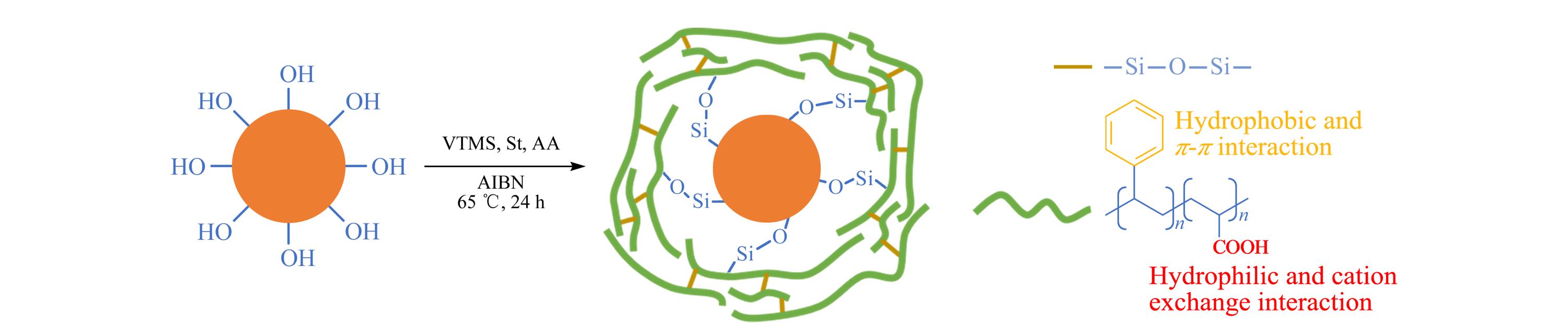
图1 一锅法制备SiO2@P(St-AA)[24]
Fig. 1 One pot preparation method for SiO2@P(St-AA)[24]
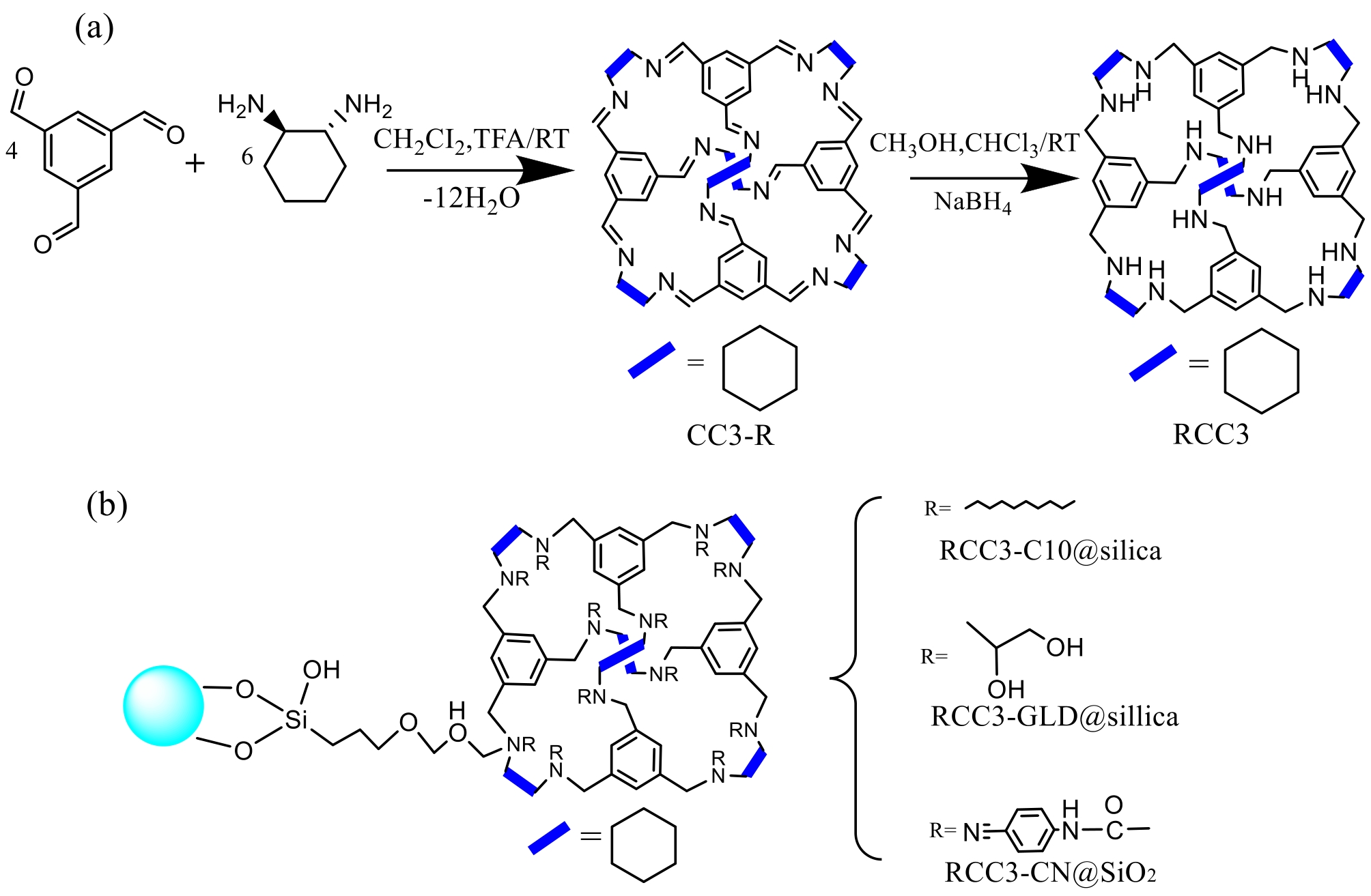
图2 (a) RCC3分子笼制备流程;(b)3种不同分子笼固定相结构示意图[27]
Fig. 2 (a) RCC3 molecular cage preparation process; (b) schematic diagrams of three different types of molecular cage stationary phases[27] TFA: trifluoroacetic acid; RT: room temperature.
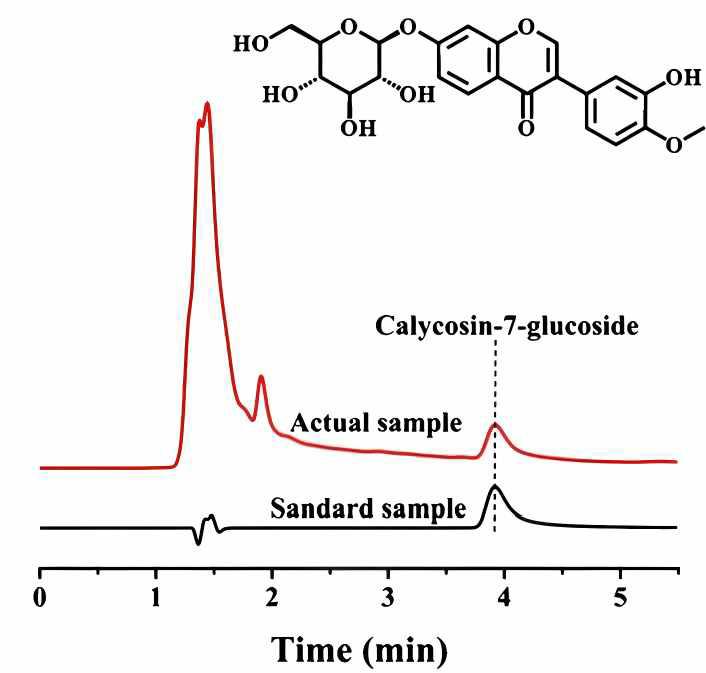
图3 毛蕊异黄酮葡萄糖苷标准品与真实样品分离的色谱图[36]
Fig. 3 Chromatograms of the separation of calycosin-7-glucoside standard from the real sample[36]
| Stationary phase | Functional ligand | Hydrophobic interactions | Ion-exchange interactions | Samples | Ref. |
|---|---|---|---|---|---|
| Silica-PILs | 1-(4-vinylbenzyl) -3-cyanomethyl imidazolium bromide | benzene ring | imidazole cationic substituent | polycyclic aromatic hydrocarbons, alkylbenzene, nonsteroidal anti-inflammatory drugs | [ |
| C18/TMA | ODS, 3-glycidoxypropyltrimethoxysilane, TMA | ODS | quaternary ammonium group | non-polar substance, small molecule base, aromatic acid | [ |
| Sil-PBQA | amino anion exchange groups, benzene rings, and quaternary ammonium salts containing benzyl groups | benzene ring | quaternary ammonium group | nonsteroidal anti-inflammatory drugs | [ |
| Sil-VDI | VDI, thiol functionalized SiO2 | alkyl | imidazole cationic substituent | hydrophobic alkylbenzene, polycyclic aromatic hydrocarbons and benzene derivatives, inorganic anions | [ |
| UI, PMA | alkyl, PMA | imidazole cationic substituent | EED, sulfonamide drugs, foodborne stimulants, and inorganic anions | [ | |
| Cys-silica-Cn, n=2, 8 and 18 | cysteine and vinyl functionalized SiO2, bromoethane, 1-bromooctane, and 1-bromooctadecane | alkyl | quaternary ammonium group, cysteine | 6 alkaline proteins, 5 acidic proteins | [ |
| Sil-peptoids | vinyl modified SiO2, three small peptides | hydrophobic carbon chain | -COOH, -NH2 | acidic, polar and non-polar molecules, nonsteroidal anti-inflammatory drugs | [ |
表1 RPLC/IEC混合模式固定相的信息及分离物质
Table 1 RPLC/IEC mixed-mode stationary phase information and separated substances
| Stationary phase | Functional ligand | Hydrophobic interactions | Ion-exchange interactions | Samples | Ref. |
|---|---|---|---|---|---|
| Silica-PILs | 1-(4-vinylbenzyl) -3-cyanomethyl imidazolium bromide | benzene ring | imidazole cationic substituent | polycyclic aromatic hydrocarbons, alkylbenzene, nonsteroidal anti-inflammatory drugs | [ |
| C18/TMA | ODS, 3-glycidoxypropyltrimethoxysilane, TMA | ODS | quaternary ammonium group | non-polar substance, small molecule base, aromatic acid | [ |
| Sil-PBQA | amino anion exchange groups, benzene rings, and quaternary ammonium salts containing benzyl groups | benzene ring | quaternary ammonium group | nonsteroidal anti-inflammatory drugs | [ |
| Sil-VDI | VDI, thiol functionalized SiO2 | alkyl | imidazole cationic substituent | hydrophobic alkylbenzene, polycyclic aromatic hydrocarbons and benzene derivatives, inorganic anions | [ |
| UI, PMA | alkyl, PMA | imidazole cationic substituent | EED, sulfonamide drugs, foodborne stimulants, and inorganic anions | [ | |
| Cys-silica-Cn, n=2, 8 and 18 | cysteine and vinyl functionalized SiO2, bromoethane, 1-bromooctane, and 1-bromooctadecane | alkyl | quaternary ammonium group, cysteine | 6 alkaline proteins, 5 acidic proteins | [ |
| Sil-peptoids | vinyl modified SiO2, three small peptides | hydrophobic carbon chain | -COOH, -NH2 | acidic, polar and non-polar molecules, nonsteroidal anti-inflammatory drugs | [ |

图4 C18/TMA固定相制备流程[45]
Fig. 4 C18/TMA stationary phase preparation process [45]
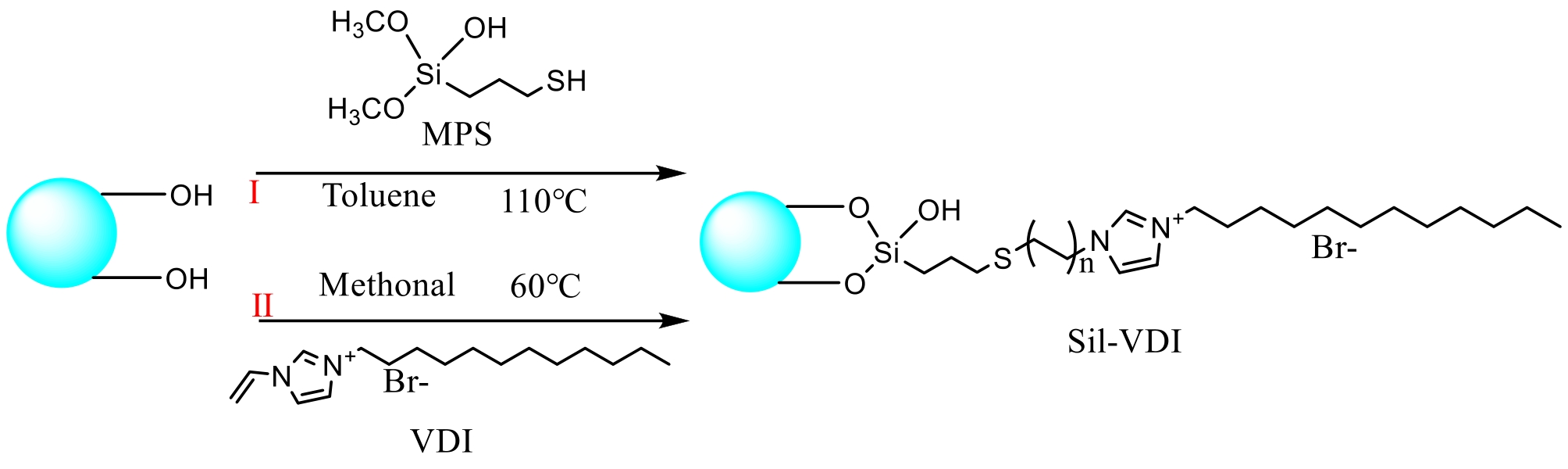
图5 Sil-VDI色谱固定相材料合成示意图[47]
Fig. 5 Schematic demonstration for synthesis of Sil-VDI stationary phase material [47]
| Stationary phase | Functional ligand | Hydrophobic interactions | Hydrophilic interactions | Samples | Ref. |
|---|---|---|---|---|---|
| Sil-AVI-ST | imidazolammonium ionic liquid, stearyl mercaptoacetate, polar ligand | alkyl | imidazole cationic substituent | sulfonamides, vitamins and nucleosides/bases, hydrophobic phthalates, bisphenols, alkylphenols and steroid hormones | [ |
| PEI/Zein@SiO2 | PEI, Zein, SiO2 | Zein | -NH2, -COOH | nucleotides, bases, antibiotics, lavonoids | [ |
| RCC3-C10@silica | RCC3 molecular cage, alkyl functional group | alkyl | -NH2, -OH | alkylbenzene, polyphenylene, phenolic, amino, sulfonamide, nucleoside, flavonoid | [ |
| RCC3-GLD@silica | epoxy propanol, RCC3-R molecular cage | hydrophobic hydrocarbon chain, benzene ring | epoxy propanol group | alkylbenzene, phenols, amines, sulfonamides, nucleosides, amino acids, sugars | [ |
| RCC3-CN@SiO2 | RCC3-R molecular cage, -CN | hydrophobic hydrocarbon chain | -CN | alkylbenzene, aromatic, phenolic, amine, sulfonamide, nucleoside, amino acid, carbohydrate | [ |
| 2D Cu-BDC/IL@silica | 2D MOFs, ILs | benzene ring | -COOH, ILs | alkaloids, sulfonamides and antibiotics | [ |
| d-MOF-919/cys@silica | MOF-919, L-Cys | hydrophobic alkyl chain | -OH, -COOH, -SH, -NH2 | PAHs, BUs, 10 carbohydrates, 8 sulfonamide drugs, 8 nucleoside/base mixtures | [ |
| d-MOF-818/PAM@silica | MOF-818, PAM | hydrophobic alkyl chain | -OH, -CONH | 9 nucleosides and bases, 8 alkaloids, 6 antibiotics, 5 alkylbenzenes | [ |
| TAPT-TP-COF@SiO2 | TAPT, TP | hydrophobic alkyl chain | -OH, -NH2, -CHO | linear alkylbenzene, phthalates, nucleosides, sulfonamides and vitamins | [ |
| PAA/COF@SiO2 | PAA, COFs | hydrophobic alkyl chain | -OH, -NH2, -CHO | aromatic ketone, alkylphenol、phthalate esters, PAHs, nucleoside compounds, alkylbenzene compounds | [ |
| COF-TpPa-1@SiO2 | Tp, Pa-1, | benzene ring | -OH | non polar alkylbenzene homologues, polycyclic aromatic hydrocarbons, polar amines, phenols | [ |
| Sil-P-DESCDs | P-DESCDs, (3-aminopropyl)trimethoxysilane | alkyl | -COOH, -OH, -NH2 | alkylbenzene, polycyclic aromatic hydrocarbons, sulfonamides, aromatic amines, nucleoside bases, and alkaloids | [ |
| CQDs/SiO2 | CQDs, 1,8-diaminooctane | alkyl | -COOH, -OH, -NH2 | 14 nucleosides and bases | [ |
| MON-2COOH@SiO2 | MON, -COOH, | benzene ring | -COOH | sulfonamide drugs, deoxyribonucleosides, alkaloids and endocrine disrupting chemicals | [ |
| MON-2COOH@SiO2-MER | MON, -COOH, SiO2, MER | benzene ring, alkynyl group | -COOH | hydrophobic and hydrophilic probes, sulfonamide drugs, nonsteroidal anti-inflammatory drugs | [ |
| Sil-C18-IL-C4 | C18 | C18 | imidazole, ILs | nucleoside based compounds, probe molecules | [ |
| Sil-amide-C11 Sil-C12-amide | amide and hydrocarbon chain groups, 3-aminopropyl | hydrophobic hydrocarbon chain | -CONH | alkylbenzene and polycyclic aromatic hydrocarbons | [ |
| SiO2@COPBn-glu | COP, SiO2 | benzene ring, alkyl | -COOH | hydrophilic and hydrophobic compounds | [ |
表2 RPLC/HILIC混合模式固定相的信息及分离物质
Table 2 RPLC/HILIC mixed-mode stationary phase information and separated substances
| Stationary phase | Functional ligand | Hydrophobic interactions | Hydrophilic interactions | Samples | Ref. |
|---|---|---|---|---|---|
| Sil-AVI-ST | imidazolammonium ionic liquid, stearyl mercaptoacetate, polar ligand | alkyl | imidazole cationic substituent | sulfonamides, vitamins and nucleosides/bases, hydrophobic phthalates, bisphenols, alkylphenols and steroid hormones | [ |
| PEI/Zein@SiO2 | PEI, Zein, SiO2 | Zein | -NH2, -COOH | nucleotides, bases, antibiotics, lavonoids | [ |
| RCC3-C10@silica | RCC3 molecular cage, alkyl functional group | alkyl | -NH2, -OH | alkylbenzene, polyphenylene, phenolic, amino, sulfonamide, nucleoside, flavonoid | [ |
| RCC3-GLD@silica | epoxy propanol, RCC3-R molecular cage | hydrophobic hydrocarbon chain, benzene ring | epoxy propanol group | alkylbenzene, phenols, amines, sulfonamides, nucleosides, amino acids, sugars | [ |
| RCC3-CN@SiO2 | RCC3-R molecular cage, -CN | hydrophobic hydrocarbon chain | -CN | alkylbenzene, aromatic, phenolic, amine, sulfonamide, nucleoside, amino acid, carbohydrate | [ |
| 2D Cu-BDC/IL@silica | 2D MOFs, ILs | benzene ring | -COOH, ILs | alkaloids, sulfonamides and antibiotics | [ |
| d-MOF-919/cys@silica | MOF-919, L-Cys | hydrophobic alkyl chain | -OH, -COOH, -SH, -NH2 | PAHs, BUs, 10 carbohydrates, 8 sulfonamide drugs, 8 nucleoside/base mixtures | [ |
| d-MOF-818/PAM@silica | MOF-818, PAM | hydrophobic alkyl chain | -OH, -CONH | 9 nucleosides and bases, 8 alkaloids, 6 antibiotics, 5 alkylbenzenes | [ |
| TAPT-TP-COF@SiO2 | TAPT, TP | hydrophobic alkyl chain | -OH, -NH2, -CHO | linear alkylbenzene, phthalates, nucleosides, sulfonamides and vitamins | [ |
| PAA/COF@SiO2 | PAA, COFs | hydrophobic alkyl chain | -OH, -NH2, -CHO | aromatic ketone, alkylphenol、phthalate esters, PAHs, nucleoside compounds, alkylbenzene compounds | [ |
| COF-TpPa-1@SiO2 | Tp, Pa-1, | benzene ring | -OH | non polar alkylbenzene homologues, polycyclic aromatic hydrocarbons, polar amines, phenols | [ |
| Sil-P-DESCDs | P-DESCDs, (3-aminopropyl)trimethoxysilane | alkyl | -COOH, -OH, -NH2 | alkylbenzene, polycyclic aromatic hydrocarbons, sulfonamides, aromatic amines, nucleoside bases, and alkaloids | [ |
| CQDs/SiO2 | CQDs, 1,8-diaminooctane | alkyl | -COOH, -OH, -NH2 | 14 nucleosides and bases | [ |
| MON-2COOH@SiO2 | MON, -COOH, | benzene ring | -COOH | sulfonamide drugs, deoxyribonucleosides, alkaloids and endocrine disrupting chemicals | [ |
| MON-2COOH@SiO2-MER | MON, -COOH, SiO2, MER | benzene ring, alkynyl group | -COOH | hydrophobic and hydrophilic probes, sulfonamide drugs, nonsteroidal anti-inflammatory drugs | [ |
| Sil-C18-IL-C4 | C18 | C18 | imidazole, ILs | nucleoside based compounds, probe molecules | [ |
| Sil-amide-C11 Sil-C12-amide | amide and hydrocarbon chain groups, 3-aminopropyl | hydrophobic hydrocarbon chain | -CONH | alkylbenzene and polycyclic aromatic hydrocarbons | [ |
| SiO2@COPBn-glu | COP, SiO2 | benzene ring, alkyl | -COOH | hydrophilic and hydrophobic compounds | [ |
| Stationary phase | Functional ligand | Hydrophobic interactions | Ion-exchange interactions | Samples | Ref. |
|---|---|---|---|---|---|
| Sil-PolyCOOH | polyethylene maleic anhydride, SiO2-NH2 | -COOH | carboxyl ionization | nucleosides, nucleic acid bases, carbohydrate compounds, quaternary ammonium salts | [ |
| (AMPS)n-ImprSiO2 | CPTMO, V-Im, AMPS | -CONH, sulfonic acid | imidazole, sulfonic acid | sulfonamide drugs, flavonoids, various components in extracts of traditional chinese medicine ligustrum lucidum | [ |
| DCC/SiO2 | DAC, sodium chlorite,SiO2-NH2 | -COOH | -COOH | nucleosides, alkaloids and aniline compounds | [ |
| C22-A3 | long chain alkyl, polyamine groups | -NH2, -CONH | -NH2 | nucleosides, nucleotides, aromatic acid compounds, multiple organic and inorganic anions | [ |
| TPHs-SiO2 | H3L | -CONH, -NH2, -OH | -NH2 | seven nucleosides and nucleotides, five types of aniline compounds | [ |
表3 HILIC/IEC混合模式固定相的信息及分离物质
Table 3 HILIC/IEC mixed-mode stationary phase information and separated substances
| Stationary phase | Functional ligand | Hydrophobic interactions | Ion-exchange interactions | Samples | Ref. |
|---|---|---|---|---|---|
| Sil-PolyCOOH | polyethylene maleic anhydride, SiO2-NH2 | -COOH | carboxyl ionization | nucleosides, nucleic acid bases, carbohydrate compounds, quaternary ammonium salts | [ |
| (AMPS)n-ImprSiO2 | CPTMO, V-Im, AMPS | -CONH, sulfonic acid | imidazole, sulfonic acid | sulfonamide drugs, flavonoids, various components in extracts of traditional chinese medicine ligustrum lucidum | [ |
| DCC/SiO2 | DAC, sodium chlorite,SiO2-NH2 | -COOH | -COOH | nucleosides, alkaloids and aniline compounds | [ |
| C22-A3 | long chain alkyl, polyamine groups | -NH2, -CONH | -NH2 | nucleosides, nucleotides, aromatic acid compounds, multiple organic and inorganic anions | [ |
| TPHs-SiO2 | H3L | -CONH, -NH2, -OH | -NH2 | seven nucleosides and nucleotides, five types of aniline compounds | [ |
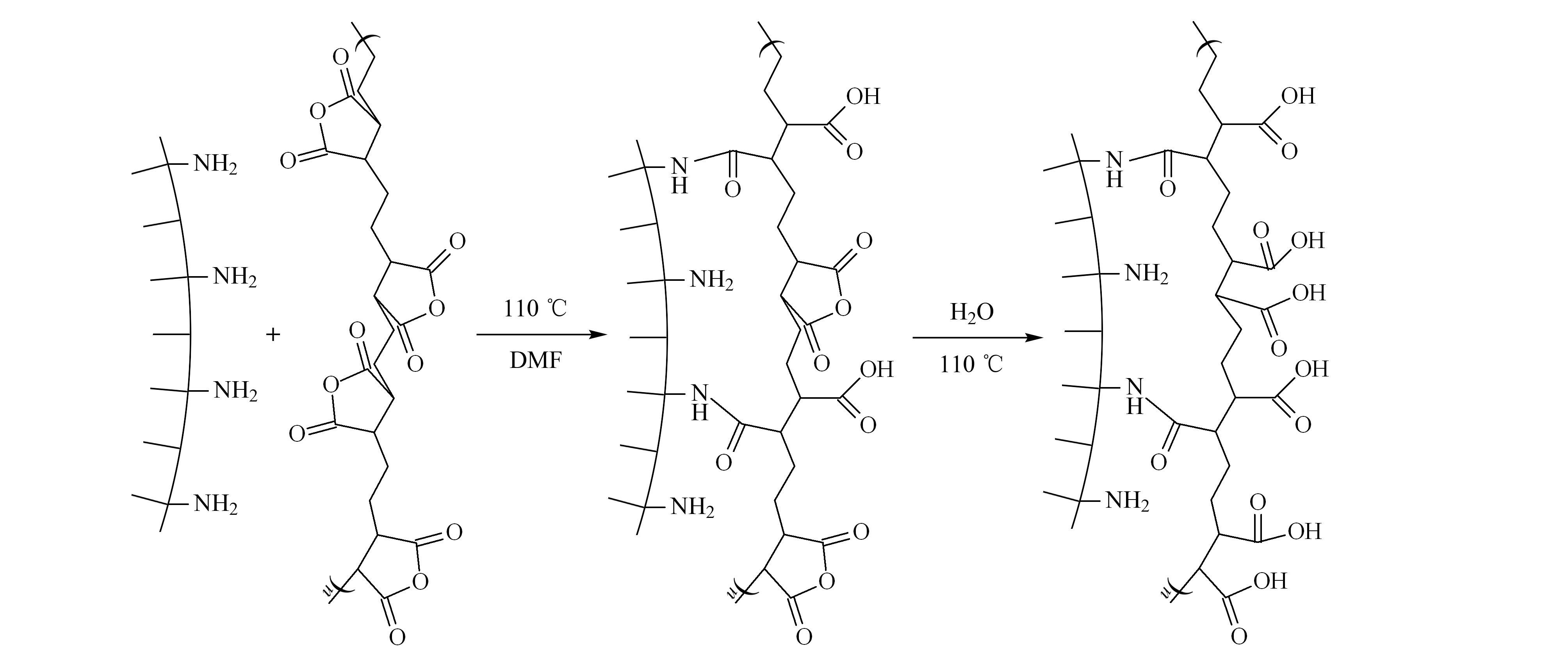
图6 Sil-PolyCOOH固定相合成示意图[53]
Fig. 6 Schematic diagram of Sil-PolyCOOH stationary phase synthesis [53] DMF: N,N-dimethylformamide.
| Stationary phases | Functional ligand | Hydrophobic interactions | Hydrophilic interactions | Ion-exchange interactions | Samples | Ref. |
|---|---|---|---|---|---|---|
| SiO2-MPS-CQDs | CQDs, MPS, SiO2 | alkyl | -OH, -COOH | imidazole cationic substituent | alkylbenzenes, PAHs, nucleoside bases, sulfonamides, anionic compounds | [ |
| Sil-SVC, Sil-SVC-NPA | SVC, NPA | benzene ring | -COOH, -NH2 | -NH2 | hydrophobic analytes, hydrophilic nucleotides, bases and anions | [ |
| SiO2@P(St-AA) | styrene and acrylic acid as polymerization monomers, vinyltrimethoxysilane | benzene ring | -COOH | -COOH | alkylbenzene and polycyclic aromatic hydrocarbons, nucleosides and bases, organic bases and acids | [ |
| SiO2@TpBD-(OH)2 | COPs, Tp, BD-(OH)2 | benzene ring | -COOH, -C=N- | imidazole cationic substituent | benzene homologues, polycyclic aromatic hydrocarbons, bases, acidic organic compounds | [ |
| PIm-Br, coPIm-VBS | SiO2 polymerized imidazole ionic liquid | benzene ring, alkyl | imidazole cationic substituent | -COOH, -SO3H | nucleosides, inorganic ions and organic ions | [ |
| Sil-IM-Br, Sil-IM-SAG | IM-Br, IM-SAG, Sil-MPS | benzene ring, alkyl | -OH | imidazole cationic substituent, sulfonate group | organic chemistry, inorganic ions, vitamin | [ |
| Sil-DCH-Im2 | SiO2 polymerized imidazole ionic liquid | imidazole ring | -NH2, -CONH- | imidazole cationic substituent | hydrophilic substances, hydrophobic substances, acids and inorganic anionic substances | [ |
| Sil-PEI-APH | PEI, APH | benzene ring | -CONH, -OH | -NHR2, -N+R3 | alkylbenzenes, PAHs, nucleosides, flavonoids, aromatic amine | [ |
| Sil-G1-AS, Sil-G2-AS | BDDE, AS, ethylenediamine | octadecylamine chain | -OH, quaternary ammonium ions | quaternary ammonium ions | PAHs, alkylbenzene, nucleoside, vitamin, phenolic, aromatic amine, flavonoids compounds | [ |
| DPE-DIL, BND-DIL | DPE, BND | benzene ring | imidazole ring, -CONH, -OH | imidazole cationic substituent | nucleosides and bases, PAHs, food additives | [ |
表4 RPLC/HILIC/IEC混合模式固定相信息及分离物质
Table 4 RPLC/HILIC/IEC mixed-mode stationary phase information and separated substances
| Stationary phases | Functional ligand | Hydrophobic interactions | Hydrophilic interactions | Ion-exchange interactions | Samples | Ref. |
|---|---|---|---|---|---|---|
| SiO2-MPS-CQDs | CQDs, MPS, SiO2 | alkyl | -OH, -COOH | imidazole cationic substituent | alkylbenzenes, PAHs, nucleoside bases, sulfonamides, anionic compounds | [ |
| Sil-SVC, Sil-SVC-NPA | SVC, NPA | benzene ring | -COOH, -NH2 | -NH2 | hydrophobic analytes, hydrophilic nucleotides, bases and anions | [ |
| SiO2@P(St-AA) | styrene and acrylic acid as polymerization monomers, vinyltrimethoxysilane | benzene ring | -COOH | -COOH | alkylbenzene and polycyclic aromatic hydrocarbons, nucleosides and bases, organic bases and acids | [ |
| SiO2@TpBD-(OH)2 | COPs, Tp, BD-(OH)2 | benzene ring | -COOH, -C=N- | imidazole cationic substituent | benzene homologues, polycyclic aromatic hydrocarbons, bases, acidic organic compounds | [ |
| PIm-Br, coPIm-VBS | SiO2 polymerized imidazole ionic liquid | benzene ring, alkyl | imidazole cationic substituent | -COOH, -SO3H | nucleosides, inorganic ions and organic ions | [ |
| Sil-IM-Br, Sil-IM-SAG | IM-Br, IM-SAG, Sil-MPS | benzene ring, alkyl | -OH | imidazole cationic substituent, sulfonate group | organic chemistry, inorganic ions, vitamin | [ |
| Sil-DCH-Im2 | SiO2 polymerized imidazole ionic liquid | imidazole ring | -NH2, -CONH- | imidazole cationic substituent | hydrophilic substances, hydrophobic substances, acids and inorganic anionic substances | [ |
| Sil-PEI-APH | PEI, APH | benzene ring | -CONH, -OH | -NHR2, -N+R3 | alkylbenzenes, PAHs, nucleosides, flavonoids, aromatic amine | [ |
| Sil-G1-AS, Sil-G2-AS | BDDE, AS, ethylenediamine | octadecylamine chain | -OH, quaternary ammonium ions | quaternary ammonium ions | PAHs, alkylbenzene, nucleoside, vitamin, phenolic, aromatic amine, flavonoids compounds | [ |
| DPE-DIL, BND-DIL | DPE, BND | benzene ring | imidazole ring, -CONH, -OH | imidazole cationic substituent | nucleosides and bases, PAHs, food additives | [ |
|
| [1] | 李光辉, 邓硕, 李勤勤, 张春林, 刘云凤, 蒋斌, 姚倩, 王好, 王伯光. 高效液相色谱-三重四极杆质谱法测定环境空气中40种醛酮类化合物[J]. 色谱, 2026, 44(6): 694-704. |
| [2] | 刘峰, 唐彬彬, 吴丽媛, 宋丽新, 张敏, 贺敏. 高效液相色谱-串联质谱法测定大气细颗粒物中7种轮胎抗氧化剂及其醌类氧化物[J]. 色谱, 2026, 44(6): 658-666. |
| [3] | 刘真, 王玉梅, 潘建斌, 宗凌丽, 宋玉函, 孙小杰, 陈洪渊. QuEChERS净化结合超高效液相色谱-串联质谱法测定精油类化妆品中13种禁用生物碱[J]. 色谱, 2026, 44(6): 667-674. |
| [4] | 石飞云, 徐浩宇, 黎俊宏, 徐梦媛. 超高效液相色谱-串联质谱法测定人体全血中22种有机磷酸酯及其代谢物和11种邻苯二甲酸酯类代谢物[J]. 色谱, 2026, 44(6): 682-693. |
| [5] | 王卓, 赵灿, 叶必雄, 陈永艳. 固相萃取-超高效液相色谱-串联质谱法测定生活饮用水中16种有机紫外吸收剂[J]. 色谱, 2026, 44(6): 650-657. |
| [6] | 赵兴云, 靳疆燕, 刘肖剑, 闫丽娟, 杨思羽, 张振伟, 张莉芸, 吴荣芳. 介孔共价有机骨架核壳固定相的制备及其用于黄芪中黄芪甲苷含量的分析[J]. 色谱, 2026, 44(6): 639-649. |
| [7] | 杨成龙, 李鹏飞, 张莹莹, 汪凌佳, 侯敏敏, 史亚利, 蔡亚岐. 直接进样-超高效液相色谱-三重四极杆质谱法测定水中31种全氟/多氟化合物[J]. 色谱, 2026, 44(5): 533-546. |
| [8] | 杨鹏飞, 冯政博, 方程, 罗亚珂, 费嘉翔, 毛多斌. 超高效液相色谱-四极杆-飞行时间质谱法快速筛查与定量分析烟叶中26种可溶性糖[J]. 色谱, 2026, 44(5): 555-564. |
| [9] | 李晓芳, 王晔, 凡凡, 周伟, 陈斌, 史华进, 蔡国强, 刘英, 何一波. 超高效液相色谱-二极管阵列检测器串联电雾式检测器法测定化妆品中6种美白功效成分[J]. 色谱, 2026, 44(5): 565-574. |
| [10] | 梁静, 冯家力, 曾栋, 周丽平, 钟旋, 李轶, 陈东洋. 全自动固相萃取-超高效液相色谱-串联质谱法同时测定饮用水中全氟化合物、抗生素和农药[J]. 色谱, 2026, 44(5): 547-554. |
| [11] | 矫芮文, 张丹丹, 胡兴媛, 朱婉婷, 李想, 蔡一镝, 任丹丹, 汪秋宽, 武龙, 周慧. 新型多羟基硅胶固定相的制备及其对褐藻胶寡糖的分离应用[J]. 色谱, 2026, 44(4): 373-382. |
| [12] | 孙晶, 张瑜, 刘丰茂, 赵文, 金玥, 张琳, 薛晓锋, 陈蕊, 周画天. 磁分散固相萃取-液相色谱-串联质谱法测定蜂蜜中38种抗生素残留[J]. 色谱, 2026, 44(4): 467-478. |
| [13] | 席彰, 叶懿, 李松璠, 康靖, 刘魏群, 张静, 李道霞. QuEChERS-超高效液相色谱-串联质谱法测定全血中65种合成大麻素[J]. 色谱, 2026, 44(4): 393-402. |
| [14] | 孙慧婧, 张蓓蓓, 黄梦乔, 王荟, 胡冠九, 陈慧敏. 超高效液相色谱-三重四极杆质谱法测定地表水和废水中8种紫外线吸收剂[J]. 色谱, 2026, 44(4): 413-421. |
| [15] | 杨成, 祝伟霞, 刘亚风, 张鸿伟, 魏蔚, 胡锴. 超高效液相色谱-串联质谱法快速测定动物源性食品中卢巴贝隆残留[J]. 色谱, 2026, 44(4): 479-485. |
| 阅读次数 | ||||||
|
全文 |
|
|||||
|
摘要 |
|
|||||
