
色谱 ›› 2026, Vol. 44 ›› Issue (8): 877-888.DOI: 10.3724/SP.J.1123.2025.08020
徐勇兵1,2, 钮宇佳1,2,3, 郭明全1,2,*( )
)
收稿日期:2025-08-28
出版日期:2026-08-08
发布日期:2026-07-30
通讯作者:
*E-mail:guomingquan@nimte.ac.cn.
基金资助:
XU Yongbing1,2, NIU Yujia1,2,3, GUO Mingquan1,2,*()
Received:2025-08-28
Online:2026-08-08
Published:2026-07-30
Supported by:摘要:
药用植物(包括中草药及其复方)是天然活性化合物的丰富来源,这些天然活性成分在人类健康的维护和疾病防治方面发挥着重要作用。然而,药用植物及中草药中的化学成分众多且十分复杂,如何快速筛选并阐释其中的主要活性物质一直是其药效物质基础研究以及新药研发的难题。亲和超滤-液相色谱-质谱(AUF-LC-MS)技术是一种将亲和捕获、超滤分离并结合色谱-质谱联用分析的快速筛选和鉴定天然活性小分子物质的重要方法,具有所需样品少、特异性强、灵敏度高、快速高效、操作简便等诸多优点。该技术通过利用药用植物或中草药提取物与靶标之间的亲和力差异,从复杂的基质中快速筛选并鉴定出活性成分,特别适用于药用植物及中药等复杂提取物。本研究综述了AUF-LC-MS技术的原理、特点以及该技术近10年(2015-2025)在天然活性成分筛选中的应用进展,包括对不同水平的AUF-LC-MS筛选(化合物水平、中药单方水平和中药复方水平)进行了归纳和总结。另外,依据靶点数量的不同,将中药单方水平的AUF-LC-MS筛选分类为单靶点筛选、双靶点筛选和多靶点筛选进一步细化并总结。同时,对该技术与其他不同的天然活性物质筛选方法进行了比较,并对该技术的未来研究方向进行了展望,以期为中药药效物质基础研究以及新药研发提供新的思路。
中图分类号:
徐勇兵, 钮宇佳, 郭明全. 亲和超滤色谱-质谱技术在天然活性物质筛选中的研究进展[J]. 色谱, 2026, 44(8): 877-888.
XU Yongbing, NIU Yujia, GUO Mingquan. Recent advances of affinity ultrafiltration-liquid chromatography-mass spectrometry in screening natural active substances[J]. Chinese Journal of Chromatography, 2026, 44(8): 877-888.
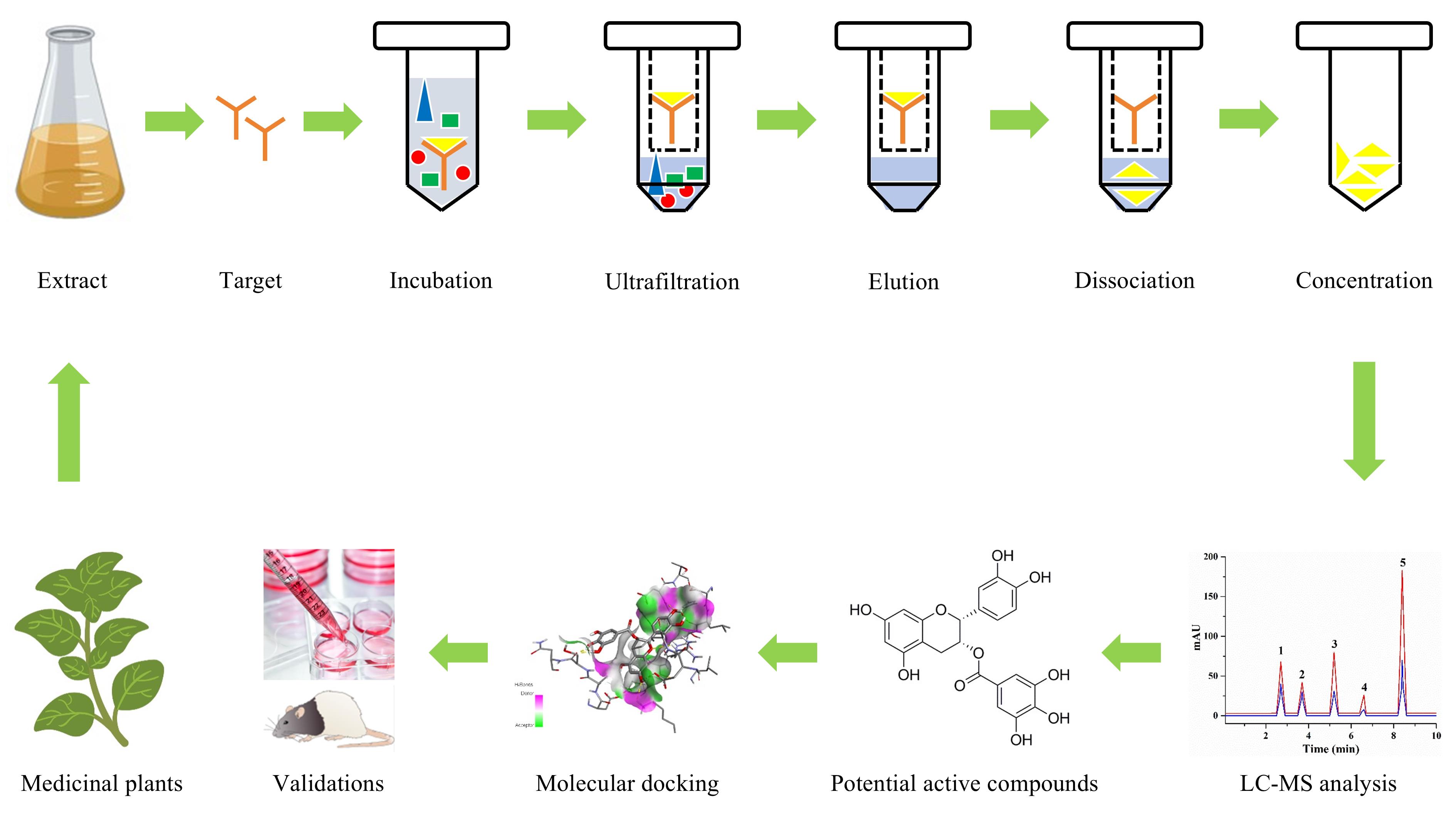
图1 亲和超滤色谱-质谱技术工作原理示意图
Fig. 1 Schematic diagram of the working principle of affinity ultrafiltration-liquid chromatography-mass spectrometry (AUF-LC-MS)
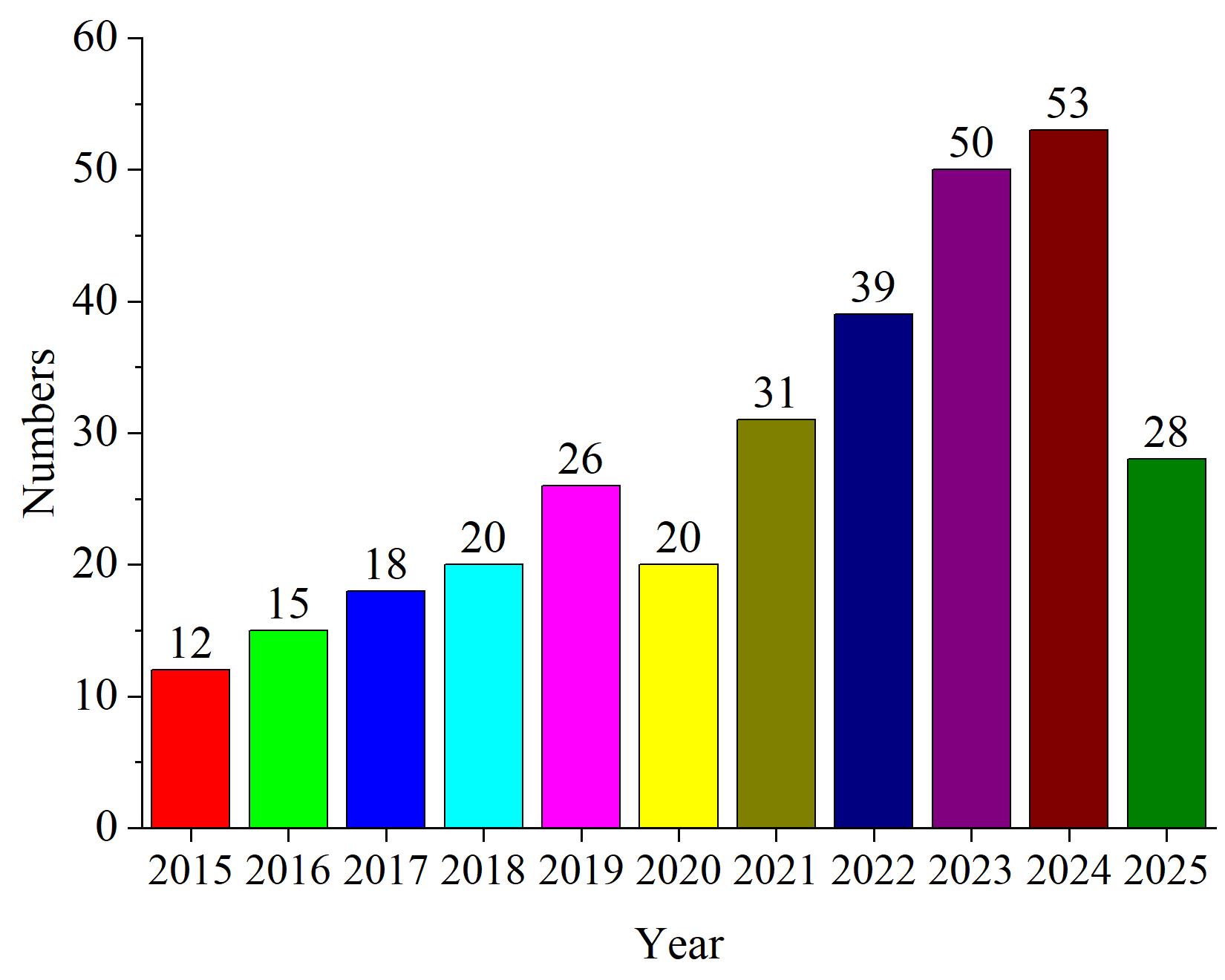
图2 近10年亲和超滤色谱-质谱技术相关文献数量统计图
Fig. 2 Statistical chart of the number of related literature on AUF-LC-MS over the last decade
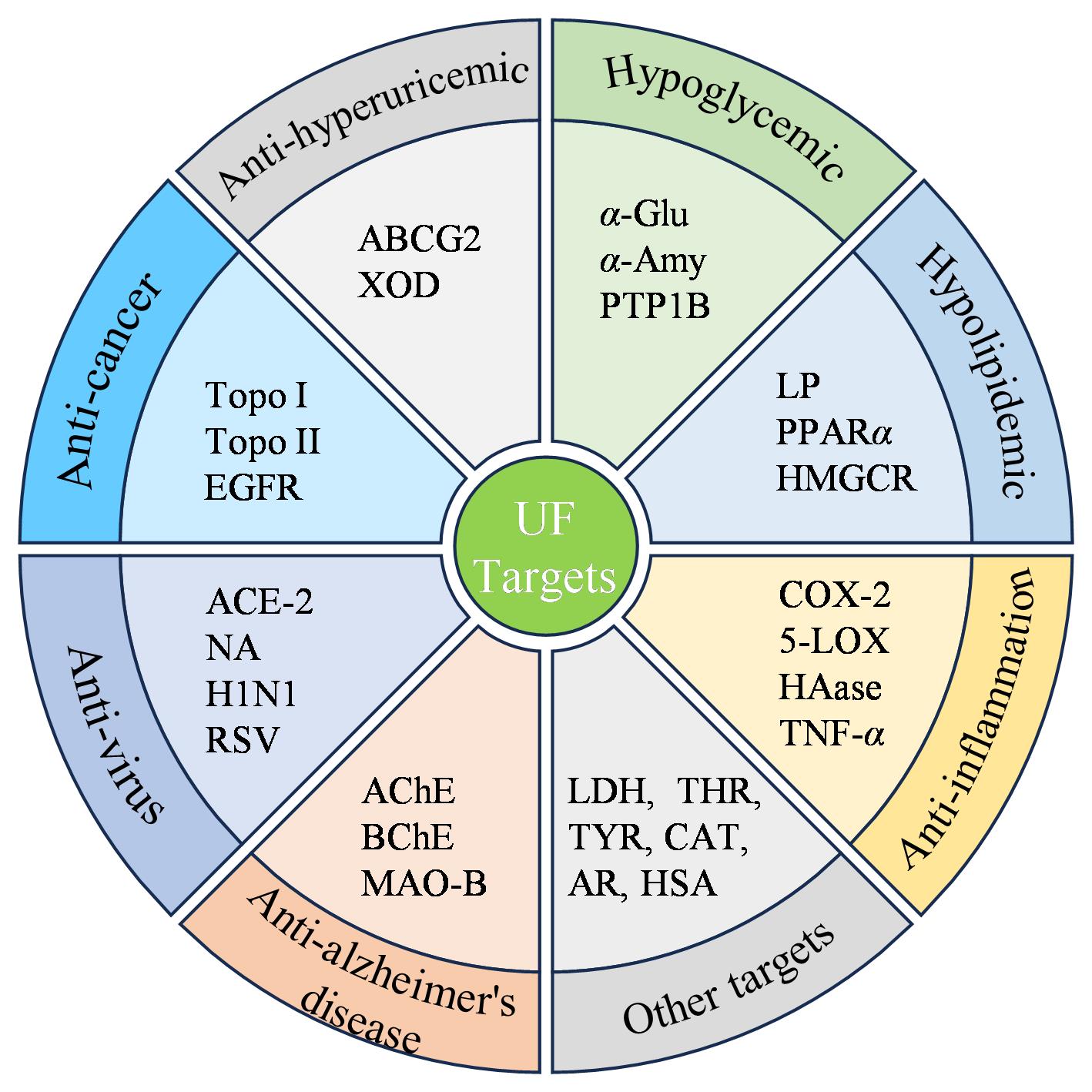
图3 近10年亲和超滤色谱-质谱文章中靶点分类图
Fig. 3 Target classification in published articles on AUF-LC-MS over the last decade Topo I: DNA topoisomerase I; Topo Ⅱ: DNA topoisomerase Ⅱ; ABCG2: ATP binding cassette transporter G2; XOD: xanthine oxidase; α-Glu: α-glucosidase; α-Amy: α-amylase; PTP1B: protein tyrosine phosphatase 1B; LP: lipase; PPARα: peroxisome proliferator-activated receptor alpha; HMGCR: 3-hydroxy-3-methylglutaryl coenzyme A reductase; COX-2: cyclooxygenase-2; 5-LOX: 5-lipoxygenase; HAase: hyaluronidase; TNF-α: tumor necrosis factor-alpha; LDH: lactate dehydrogenase; THR: thrombin; TYR: tyrosinase; CAT: catalase; AR: aldose reductase; HSA: human serum albumin; AChE: acetylcholinesterase; BChE: butylcholinesterase; MAO-B: monoamine oxidase B; ACE2: angiotensin-converting enzyme 2; NA: neuraminidase; H1N1: influenza A virus subtype H1N1; RSV: respiratory syncytial virus.
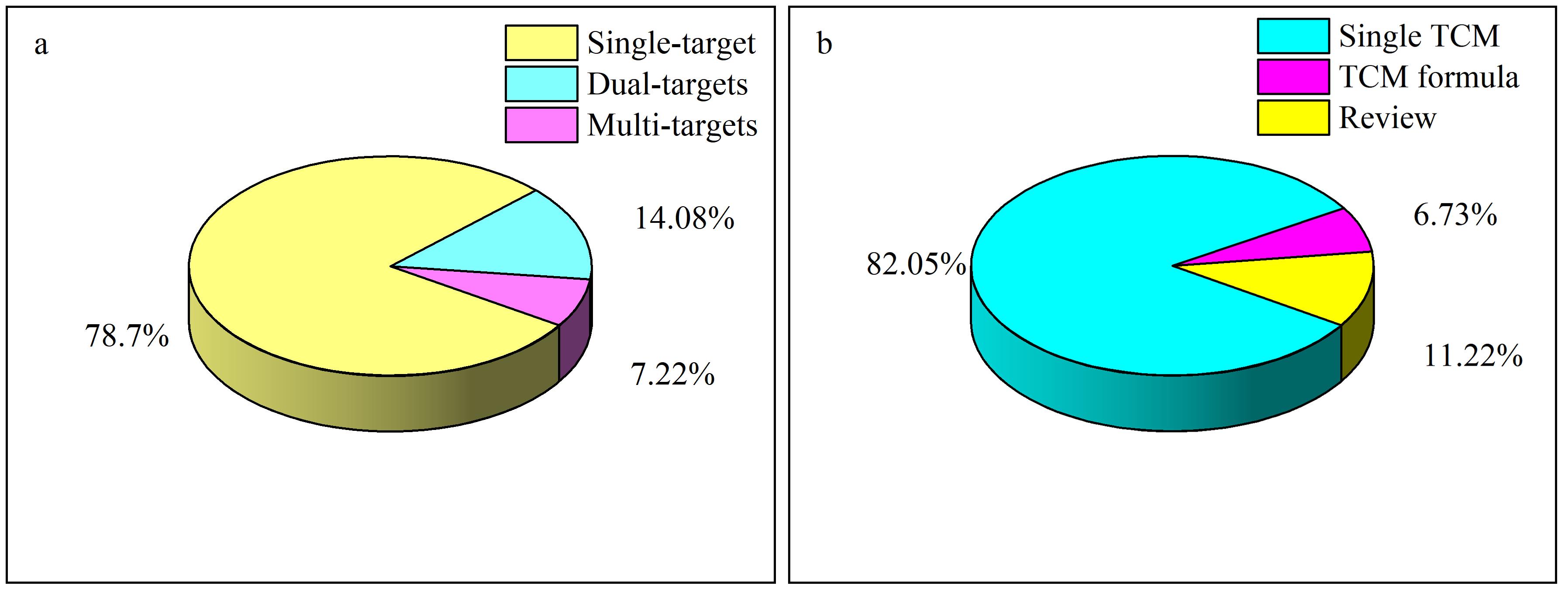
图4 近10年亲和超滤色谱-质谱文章中(a)靶点占比图和(b)中药单复方占比图
Fig. 4 (a) Target proportion and (b) traditional Chinese medicine (TCM) formula proportion in published articles on AUF-LC-MS over the last decade
| Number of compounds | Activity/disease | Target | Active compound | Main verification methods | Ref. |
|---|---|---|---|---|---|
| 10 | depression | PTGS2 | neomangiferin | zebrafish, cell, MD | [ |
| 6 | immunity | Siglec-1 | glycyrrhetinic acid | / | [ |
| 22 | anti-tumor | PD-L1 | β-NAD | cell, MD | [ |
| 6 | antimalarial | HSA | piperaquine | MD | [ |
| 5 | anti-cancer | Tim-3 | atractylenolide I | / | [ |
表1 AUF-LC-MS在化合物水平的筛选
Table 1 AUF-LC-MS screening at the compound level
| Number of compounds | Activity/disease | Target | Active compound | Main verification methods | Ref. |
|---|---|---|---|---|---|
| 10 | depression | PTGS2 | neomangiferin | zebrafish, cell, MD | [ |
| 6 | immunity | Siglec-1 | glycyrrhetinic acid | / | [ |
| 22 | anti-tumor | PD-L1 | β-NAD | cell, MD | [ |
| 6 | antimalarial | HSA | piperaquine | MD | [ |
| 5 | anti-cancer | Tim-3 | atractylenolide I | / | [ |
| Name of herb | Activity/disease | Targets | Main active compounds | Verification methods | Ref. |
|---|---|---|---|---|---|
| Morus alba L. | anti-inflammatory | COX-2, 5-LOX | neochlorogenic acid, rutin | cell, EAT, MD | [ |
| Nauclea officinalis | anti-inflammatory | COX-2, 5-LOX | angustine, angustidine | EAT, MD | [ |
| Dendropanax dentiger | anti-inflammatory | COX-2 | cryptochlorogenic acid | EAT, MD, MDS | [ |
| Curcuma longa | anti-inflammatory | COX-2 | BHPHO | zebrafish, MD | [ |
| Moringa oleifera | anti-inflammatory | COX-2 | quercetin 3-acetyl-glycoside | MD | [ |
| Aquilaria sinensis | hypoglycemic | α-Glu | epicatechin, epigallocatechin gallate | cell, EAT, MD | [ |
| Phyllanthi Fructus | hypoglycemic | α-Glu | hyperoside, gallic acid, corilagin | EAT, MD | [ |
| Diospyros kaki | hypoglycemic | α-Amy, α-Glu | hederagenin, ursolic acid | EAT, MD | [ |
| Rubus corchorifolius | hypoglycemic | α-Amy, α-Glu | cyanidin-3-rutinoside | EAT, MD | [ |
| Clematis tangutica | hypolipidemic | LP | tanguticoside B, rutin | EAT, MD | [ |
| Rheum palmatum | hypolipidemic | LP | procyanidin B5 3,3′-di-O-gallate-di-O-gallate | EAT, MD | [ |
| Polygonum cuspidatum | anti-hyperuricemic | XOD | polydatin, resveratrol | EAT, MD | [ |
| Polyporus umbellatus | anti-hyperuricemic | XOD | polyporusterone A | EAT, MD, MDS | [ |
| Cortex Fraxini | anti-hyperuricemic | ABCG2 | fraxin | MD | [ |
| Bletilla striata | skin-whitening | TYR | coelonin | zebrafish, MD | [ |
| Ampelopsis grossedentata | skin-whitening | TYR | dihydromyricetin | cell, MD | [ |
| Semen Oroxyli | skin-whitening | TYR | oroxin A, baicalein | EAT, MD | [ |
| Gastrodia elata | skin-whitening | TYR | 4,4′-dihydroxybenzylsulfid | EAT | [ |
| Peach Kernel | anticoagulant | THR | L-arginine, cytidine | zebrafish, MD | [ |
| Salvia miltiorrhiza | anticoagulant | THR | salvianolic acid C | EAT, MD | [ |
| Ligusticum chuanxiong | anticoagulant | THR | ferulic acid, chlorogenic acid | EAT, MD | [ |
| Oenothera biennis | diabetes complications | AR | gallic acid, catechin | EAT | [ |
| Caesalpinia spinose | diabetes complications | AR | methyl gallate, pistafolin B | EAT, MD | [ |
| Polygala tenuifolia | anti-stroke | LDH | sibiricose A5, glomeratose A | cell | [ |
| Glycine max L. | anti-stroke | LDH | daidzin, glycitin, genistin | cell | [ |
| Bupleuri Radix | anti-influenza virus | NA | 6″-O-acetylsaikosaponin A | EAT, MD | [ |
| Polygonum cuspidatum | anti-influenza virus | NA | cis-polydatin | EAT, MD | [ |
| Dalbergia odorifera | alzheimer’s disease | AChE | tectorigenin, fisetin, dalbergin | EAT, MD | [ |
| Astragalus membranaceus | alzheimer’s disease | AChE, 5-LOX | calycosin-7-glucoside | MD | [ |
| Radix Paeoniae alba | anti-allergy | HDC | catechin | EAT, MD | [ |
| Glycyrrhiza uralensis | antiviral | H1N1, RSV | glycyrrhizic acid, licochalcone A | cell | [ |
| Scutellaria baicalensis | antiviral | ACE2, DPP-4 | wogonoside, chrysin, oroxylin A | / | [ |
| Moringa oleifera | anti-aging | HAase, Ela, Col | 4-caffeoylquinic acid, vicenin-2 | MD | [ |
| Rodgersia podophylla | antioxidant, anti-hyperuricemic | SOD, XOD | norbergenin, bergenin, catechin | EAT, MD | [ |
| Polygonatum sibiricum | antioxidant, anti-hyperuricemic | SOD, XOD | N-cis-p-coumaroyltyramine | MD | [ |
| Moringa oleifera | hypoglycemic, hypolipidemic | α-Glu, LP | kaempferol 3-acetyl-glycoside | MD | [ |
| Cyclocarya paliurus | hypoglycemic, hypolipidemic | α-Glu, LP | chlorogenic acid, quercetin | MD | [ |
| Xylopia aethiopica | hypoglycemic, hypolipidemic | α-Glu, LP | liriodenine, oxonantenine | cell, EAT | [ |
| Morus alba L. | hypoglycemic, hypolipidemic | α-Glu, LP | chlorogenic acid | EAT, MD | [ |
| Azadirachta indica | antiparasitic | AChE, LDH | carnosol | EAT, MD | [ |
| Hagenia abyssinica | antiparasitic | AChE, LDH, GR | corilagin, brevifolin, quercetin | EAT, MD | [ |
| Andrographis paniculata | anti-inflammatory, antiviral | COX-2, IL-6, ACE2 | andrographolide | MD | [ |
| Rhamnus davurica | anti-inflammatory, anti-tumor | COX-2, Topo I | vitexin, apigenin, kaempferol | EAT, cell | [ |
表2 AUF-LC-MS在单方水平的筛选
Table 2 AUF-LC-MS screening at a single TCM level
| Name of herb | Activity/disease | Targets | Main active compounds | Verification methods | Ref. |
|---|---|---|---|---|---|
| Morus alba L. | anti-inflammatory | COX-2, 5-LOX | neochlorogenic acid, rutin | cell, EAT, MD | [ |
| Nauclea officinalis | anti-inflammatory | COX-2, 5-LOX | angustine, angustidine | EAT, MD | [ |
| Dendropanax dentiger | anti-inflammatory | COX-2 | cryptochlorogenic acid | EAT, MD, MDS | [ |
| Curcuma longa | anti-inflammatory | COX-2 | BHPHO | zebrafish, MD | [ |
| Moringa oleifera | anti-inflammatory | COX-2 | quercetin 3-acetyl-glycoside | MD | [ |
| Aquilaria sinensis | hypoglycemic | α-Glu | epicatechin, epigallocatechin gallate | cell, EAT, MD | [ |
| Phyllanthi Fructus | hypoglycemic | α-Glu | hyperoside, gallic acid, corilagin | EAT, MD | [ |
| Diospyros kaki | hypoglycemic | α-Amy, α-Glu | hederagenin, ursolic acid | EAT, MD | [ |
| Rubus corchorifolius | hypoglycemic | α-Amy, α-Glu | cyanidin-3-rutinoside | EAT, MD | [ |
| Clematis tangutica | hypolipidemic | LP | tanguticoside B, rutin | EAT, MD | [ |
| Rheum palmatum | hypolipidemic | LP | procyanidin B5 3,3′-di-O-gallate-di-O-gallate | EAT, MD | [ |
| Polygonum cuspidatum | anti-hyperuricemic | XOD | polydatin, resveratrol | EAT, MD | [ |
| Polyporus umbellatus | anti-hyperuricemic | XOD | polyporusterone A | EAT, MD, MDS | [ |
| Cortex Fraxini | anti-hyperuricemic | ABCG2 | fraxin | MD | [ |
| Bletilla striata | skin-whitening | TYR | coelonin | zebrafish, MD | [ |
| Ampelopsis grossedentata | skin-whitening | TYR | dihydromyricetin | cell, MD | [ |
| Semen Oroxyli | skin-whitening | TYR | oroxin A, baicalein | EAT, MD | [ |
| Gastrodia elata | skin-whitening | TYR | 4,4′-dihydroxybenzylsulfid | EAT | [ |
| Peach Kernel | anticoagulant | THR | L-arginine, cytidine | zebrafish, MD | [ |
| Salvia miltiorrhiza | anticoagulant | THR | salvianolic acid C | EAT, MD | [ |
| Ligusticum chuanxiong | anticoagulant | THR | ferulic acid, chlorogenic acid | EAT, MD | [ |
| Oenothera biennis | diabetes complications | AR | gallic acid, catechin | EAT | [ |
| Caesalpinia spinose | diabetes complications | AR | methyl gallate, pistafolin B | EAT, MD | [ |
| Polygala tenuifolia | anti-stroke | LDH | sibiricose A5, glomeratose A | cell | [ |
| Glycine max L. | anti-stroke | LDH | daidzin, glycitin, genistin | cell | [ |
| Bupleuri Radix | anti-influenza virus | NA | 6″-O-acetylsaikosaponin A | EAT, MD | [ |
| Polygonum cuspidatum | anti-influenza virus | NA | cis-polydatin | EAT, MD | [ |
| Dalbergia odorifera | alzheimer’s disease | AChE | tectorigenin, fisetin, dalbergin | EAT, MD | [ |
| Astragalus membranaceus | alzheimer’s disease | AChE, 5-LOX | calycosin-7-glucoside | MD | [ |
| Radix Paeoniae alba | anti-allergy | HDC | catechin | EAT, MD | [ |
| Glycyrrhiza uralensis | antiviral | H1N1, RSV | glycyrrhizic acid, licochalcone A | cell | [ |
| Scutellaria baicalensis | antiviral | ACE2, DPP-4 | wogonoside, chrysin, oroxylin A | / | [ |
| Moringa oleifera | anti-aging | HAase, Ela, Col | 4-caffeoylquinic acid, vicenin-2 | MD | [ |
| Rodgersia podophylla | antioxidant, anti-hyperuricemic | SOD, XOD | norbergenin, bergenin, catechin | EAT, MD | [ |
| Polygonatum sibiricum | antioxidant, anti-hyperuricemic | SOD, XOD | N-cis-p-coumaroyltyramine | MD | [ |
| Moringa oleifera | hypoglycemic, hypolipidemic | α-Glu, LP | kaempferol 3-acetyl-glycoside | MD | [ |
| Cyclocarya paliurus | hypoglycemic, hypolipidemic | α-Glu, LP | chlorogenic acid, quercetin | MD | [ |
| Xylopia aethiopica | hypoglycemic, hypolipidemic | α-Glu, LP | liriodenine, oxonantenine | cell, EAT | [ |
| Morus alba L. | hypoglycemic, hypolipidemic | α-Glu, LP | chlorogenic acid | EAT, MD | [ |
| Azadirachta indica | antiparasitic | AChE, LDH | carnosol | EAT, MD | [ |
| Hagenia abyssinica | antiparasitic | AChE, LDH, GR | corilagin, brevifolin, quercetin | EAT, MD | [ |
| Andrographis paniculata | anti-inflammatory, antiviral | COX-2, IL-6, ACE2 | andrographolide | MD | [ |
| Rhamnus davurica | anti-inflammatory, anti-tumor | COX-2, Topo I | vitexin, apigenin, kaempferol | EAT, cell | [ |
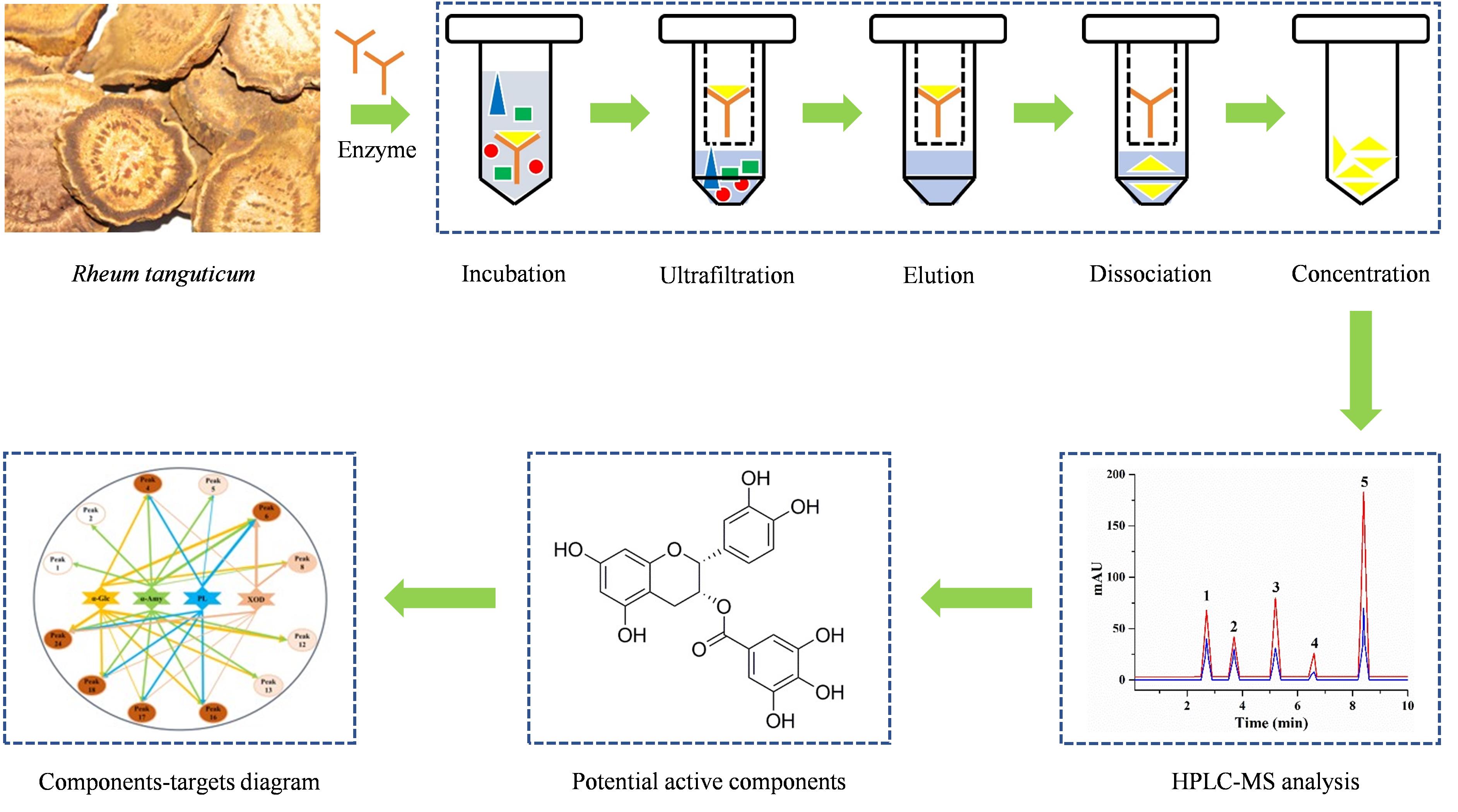
图5 大黄降糖、降脂和降高尿酸活性成分筛选的AUF-LC-MS研究示意图
Fig. 5 Schematic workflow of the AUF-LC-MS study on the hypoglycemic, hypolipidemic, and anti-hyperuricemic compounds in Rheum tanguticum
| Name of compound recipe | Activity/disease | Targets | Main active compounds | Main verification methods | Ref. |
|---|---|---|---|---|---|
| TaoHeChengQi decoction | chronic renal failure | PHD2, RIPK3 | amygdalin, rhein | cell, SPR, CETSA | [ |
| Xuefu Zhuyu decoction | anticoagulant | THR | amygdalin, isoliquiritin | zebrafish, MD | [ |
| Shaoyao Gancao Fuzi decoction | rheumatoid arthritis | TNF-α | paeoniflorin, formononetin | cell, MD, MDS | [ |
| Sanhuang decoction | T2DM, obesity | α-Glu, α-Amy, PL | epicatechin-3-O-gallate | EAT, MD | [ |
| Zuogui pill | cancer bone metastasis | RANKL | luteolin | MD, CETSA | [ |
| TongFengTangSan | hyperuricemia | XOD | 1,3,6-trigalloylglucose | cell, EAT, MD | [ |
| Fufang Qiling granules | hyperuricemia | XOD | taxifolin, epicatechin, ferulic acid | SPR, MD | [ |
| Shenqi Jiangtang granule | diabetes complications | AR | ginsenoside Rd, gomisin J | EAT, MD | [ |
| Danggui-shaoyao-san | nephrotic syndrome | uPA, PLA | 1,2,3,4,6-O-pentagalloylglucose | EAT, MD | [ |
| Zi-shen pill | anti-inflammatory | 5-LOX | anemarrhenasaponin I | EAT, MD | [ |
表3 AUF-LC-MS在复方水平的筛选
Table 3 AUF-LC-MS screening at the TCM formula level
| Name of compound recipe | Activity/disease | Targets | Main active compounds | Main verification methods | Ref. |
|---|---|---|---|---|---|
| TaoHeChengQi decoction | chronic renal failure | PHD2, RIPK3 | amygdalin, rhein | cell, SPR, CETSA | [ |
| Xuefu Zhuyu decoction | anticoagulant | THR | amygdalin, isoliquiritin | zebrafish, MD | [ |
| Shaoyao Gancao Fuzi decoction | rheumatoid arthritis | TNF-α | paeoniflorin, formononetin | cell, MD, MDS | [ |
| Sanhuang decoction | T2DM, obesity | α-Glu, α-Amy, PL | epicatechin-3-O-gallate | EAT, MD | [ |
| Zuogui pill | cancer bone metastasis | RANKL | luteolin | MD, CETSA | [ |
| TongFengTangSan | hyperuricemia | XOD | 1,3,6-trigalloylglucose | cell, EAT, MD | [ |
| Fufang Qiling granules | hyperuricemia | XOD | taxifolin, epicatechin, ferulic acid | SPR, MD | [ |
| Shenqi Jiangtang granule | diabetes complications | AR | ginsenoside Rd, gomisin J | EAT, MD | [ |
| Danggui-shaoyao-san | nephrotic syndrome | uPA, PLA | 1,2,3,4,6-O-pentagalloylglucose | EAT, MD | [ |
| Zi-shen pill | anti-inflammatory | 5-LOX | anemarrhenasaponin I | EAT, MD | [ |
| Screening methods | Advantages | Disadvantages |
|---|---|---|
| Traditional phytochemical separation methods | obtaining active compounds and verifying their activities | high cost, low efficiency |
| Cell membrane chromatography | high-throughput, high sensitivity, automation | false positive cases, complex operation |
| Capillary electrophoresis | high separation efficiency, fast analysis speed, simple operation, and low sample and reagent consumption | complex operation, insufficient popularity |
| Organoids methods | no ethical issues, approximating real human conditions | no standardized organoid construction system |
| Spectrum-effect relationship | reflecting the overall efficacy of traditional Chinese medicine and the impact of component changes on efficacy | statistical methods dependency |
| Molecular docking | low cost, fast calculation speed, flexibility | false positive cases |
| Network pharmacology | low cost, integrating multi-omics data | database dependency |
表4 不同天然活性成分筛选方法的比较
Table 4 Comparison of various screening methods for natural active ingredients
| Screening methods | Advantages | Disadvantages |
|---|---|---|
| Traditional phytochemical separation methods | obtaining active compounds and verifying their activities | high cost, low efficiency |
| Cell membrane chromatography | high-throughput, high sensitivity, automation | false positive cases, complex operation |
| Capillary electrophoresis | high separation efficiency, fast analysis speed, simple operation, and low sample and reagent consumption | complex operation, insufficient popularity |
| Organoids methods | no ethical issues, approximating real human conditions | no standardized organoid construction system |
| Spectrum-effect relationship | reflecting the overall efficacy of traditional Chinese medicine and the impact of component changes on efficacy | statistical methods dependency |
| Molecular docking | low cost, fast calculation speed, flexibility | false positive cases |
| Network pharmacology | low cost, integrating multi-omics data | database dependency |
|
| [1] | 赵孟欣, 王泽岚, 孟哲, 李吉光, 李和平, 刘万毅. 温和条件下柱前标记-高效液相色谱-质谱法测定枸杞多糖中单糖组成[J]. 色谱, 2019, 37(11): 1162-1172. |
| [2] | 高雯, 宋慧鹏, 杨华, 李萍. 在线二维液相色谱技术在中药研究中的应用进展[J]. 色谱, 2017, 35(1): 121-128. |
| [3] | 牛增元, 罗忻, 叶曦雯, 王卉卉, 李晶莹. 高效液相色谱-质谱法测定电子电气产品塑料部件中偶氮染料释放的致癌芳香胺[J]. 色谱, 2014, 32(1): 34-39. |
| [4] | 苗虹,邹建宏,范赛,甘乐文,赵云峰,吴永宁,*. 高效液相色谱-离子阱质谱法测定尿液中β2-受体激动剂及β-受体阻断剂[J]. 色谱, 2010, 28(6): 572-578. |
| [5] | 杨鹏*,王岩,廖艳艳. 高效液相色谱-质谱法测定发酵液中的喷司他丁[J]. 色谱, 2010, 28(3): 316-318. |
| [6] | 聂建荣*, 朱铭立, 连槿, 潘云山, 邓香连, 胡翠萍. 高效液相色谱-串联质谱法检测动物尿液中的15种β-受体激动剂[J]. 色谱, 2010, 28(08): 759-764. |
| [7] | 许海棠,黄丽涵,徐远金,. 高效液相色谱-质谱法同时测定清热解毒口服液中的5种有效成分[J]. 色谱, 2008, 26(5): 599-602. |
| [8] | 袁晓艳,高明哲,王锴,肖红斌,谭成玉,杜昱光. 高效液相色谱-质谱法分析菊芋叶中的绿原酸类化合物 [J]. 色谱, 2008, 26(3): 335-338. |
| [9] | 夏瑞,车宝泉,张喆. 液相色谱-质谱法同时鉴别中药制剂中的15种糖皮质激素 [J]. 色谱, 2007, 25(6): 926-929. |
| [10] | 骆和东,贾玉珠,朱宝平. 固相萃取-超过滤-液相色谱/质谱联用法测定织纹螺中的河豚毒素 [J]. 色谱, 2007, 25(6): 917-921. |
| [11] | 赵先恩,索有瑞,丁晨旭,朱芳,孙菁,赵文臣,孙学军,尤进茂,. 荧光衍生试剂1-[2-(对甲苯磺酸酯)乙基]-2-苯基咪唑[4,5-f]9,10-菲的合成及其在长链脂肪酸分析中的应用[J]. 色谱, 2006, 24(5): 456-461. |
| [12] | 徐远金,许桂苹. 高效液相色谱-质谱法测定性保健品中脱水吗啡、西地那非、前列地尔 [J]. 色谱, 2005, 23(6): 633-635. |
| [13] | 王朝虹,叶敏,邢俊波,何毅,果德安. 高效液相色谱-质谱法测定乌头碱在急性中毒大鼠体内的分布[J]. 色谱, 2005, 23(3): 316-316. |
| [14] | 薛艳,袁汉成,赵贵平. 反相高效液相色谱-质谱法测定喷气燃料中抗氧剂含量[J]. 色谱, 2004, 22(6): 661-661. |
| [15] | 汪海林,邹汉法,孔亮,倪坚毅,张玉奎. 分子生物色谱用于中药活性成分筛选及质量控制方法的研究[J]. 色谱, 1999, 17(2): 123-127. |
| 阅读次数 | ||||||
|
全文 |
|
|||||
|
摘要 |
|
|||||
