
色谱 ›› 2026, Vol. 44 ›› Issue (4): 373-382.DOI: 10.3724/SP.J.1123.2025.03006
矫芮文1, 张丹丹1, 胡兴媛1, 朱婉婷1, 李想1,2,3, 蔡一镝1,2,3, 任丹丹1,2,3, 汪秋宽1,2,3, 武龙1,2,3,*( ), 周慧1,2,3,*()
收稿日期:2025-03-06
出版日期:2026-04-08
发布日期:2026-04-13
通讯作者:
* Tel:0411-84763135,E-mail:zhouhui@dlou.edu.cn(周慧);
Tel:0411-84763135,E-mail:wulong@dlou.edu.cn(武龙).基金资助:
JIAO Ruiwen1, ZHANG Dandan1, HU Xingyuan1, ZHU Wanting1, LI Xiang1,2,3, CAI Yidi1,2,3, REN Dandan1,2,3, WANG Qiukuan1,2,3, WU Long1,2,3,*(), ZHOU Hui1,2,3,*()
Received:2025-03-06
Online:2026-04-08
Published:2026-04-13
Supported by:摘要:
超支化聚甘油(hyperbranched polyglycerols,HPG)是一种具有高度支化结构的聚合物,分子呈三维球状,拥有大量的端羟基。采用HPG在二氧化硅表面聚合制备了一种多羟基硅胶亲水色谱固定相(HPG-Sil 3)。元素分析、红外光谱、热重分析、氮气吸附脱附等温线测定等表征结果表明HPG成功接枝在硅胶表面。以胸腺嘧啶、尿嘧啶、次黄嘌呤和腺苷为标准分析物,考察了乙腈含量、缓冲盐浓度和pH值等因素对溶质保留因子的影响,探讨了固定相的保留机理。结果表明HPG-Sil固定相符合亲水色谱机理,是一种亲水模式色谱柱。将HPG-Sil固定相应用于褐藻胶寡糖分离发现,HPG-Sil固定相具有良好的亲水分离效果和稳定性,在极性化合物色谱分离领域具有较高的应用潜力。
中图分类号:
矫芮文, 张丹丹, 胡兴媛, 朱婉婷, 李想, 蔡一镝, 任丹丹, 汪秋宽, 武龙, 周慧. 新型多羟基硅胶固定相的制备及其对褐藻胶寡糖的分离应用[J]. 色谱, 2026, 44(4): 373-382.
JIAO Ruiwen, ZHANG Dandan, HU Xingyuan, ZHU Wanting, LI Xiang, CAI Yidi, REN Dandan, WANG Qiukuan, WU Long, ZHOU Hui. Preparation of a novel polyhydroxy silica stationary phase and application in the separation of alginate oligosaccharides[J]. Chinese Journal of Chromatography, 2026, 44(4): 373-382.
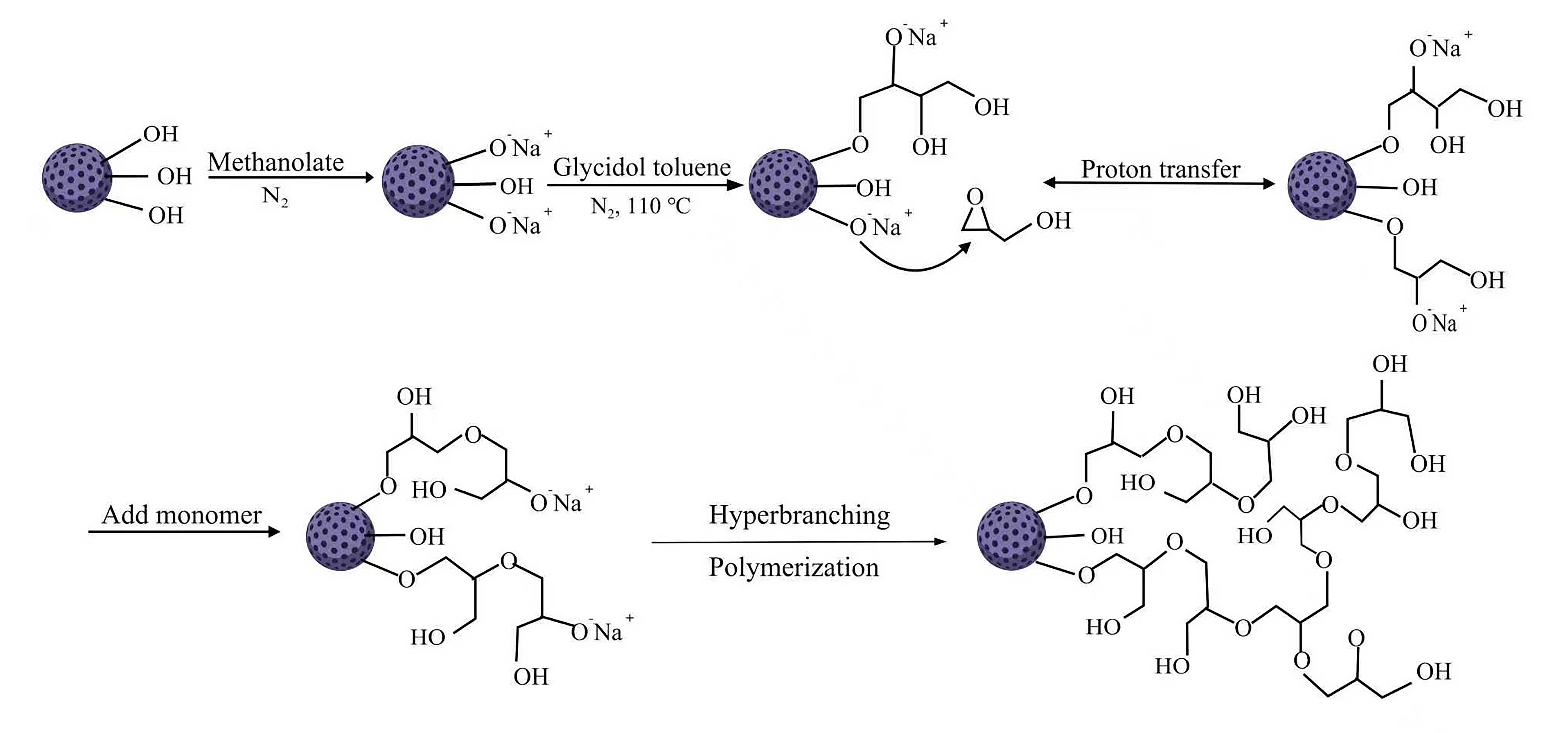
图1 HPG-Sil的合成路线
Fig. 1 Synthesis route of HPG-Sil
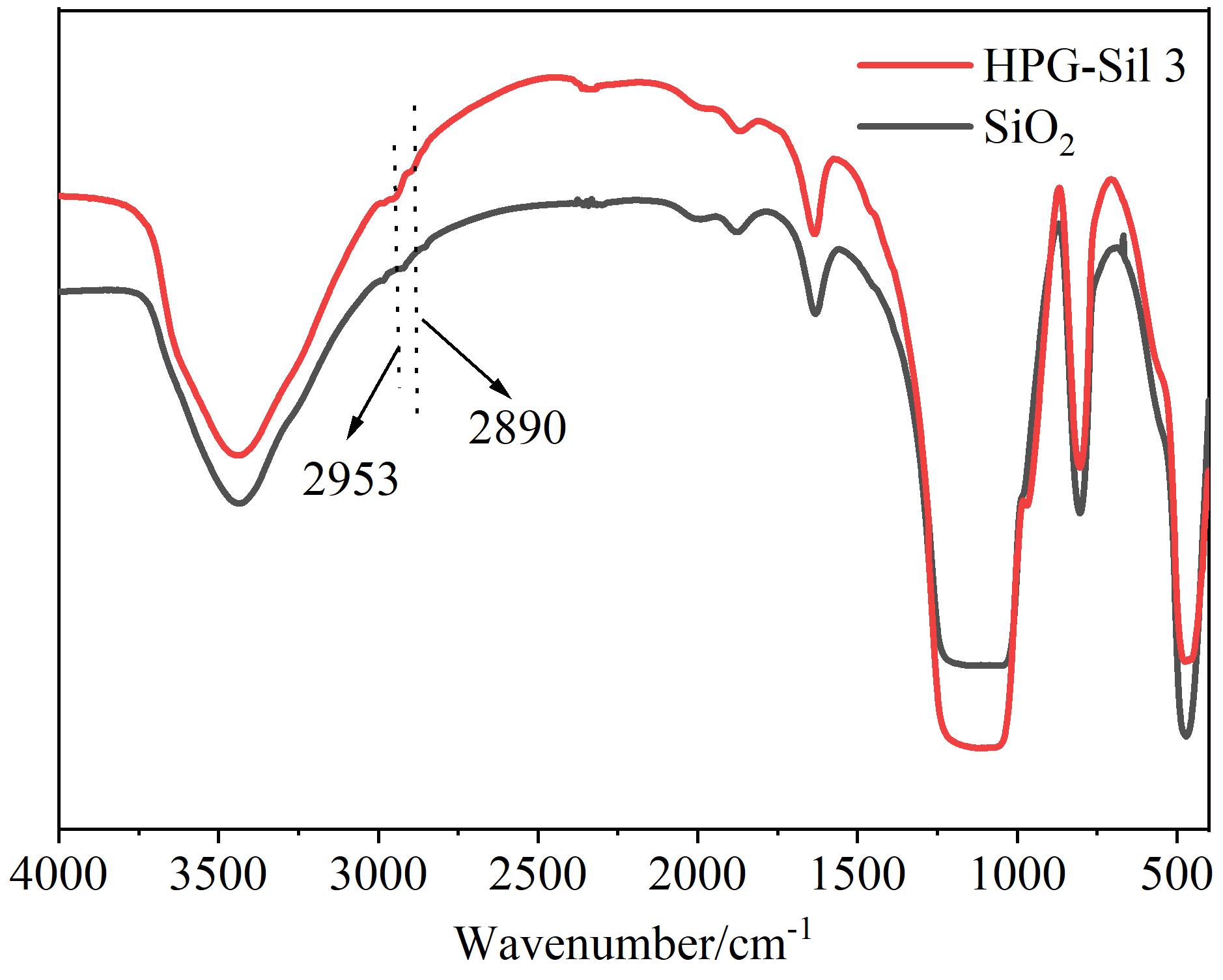
图2 SiO2和HPG-Sil 3的红外光谱图
Fig. 2 FTIR spectra of SiO2 and HPG-Sil 3
| Analyte | Elemental contents/% | Surface coverage/(μmol/m2) | |
|---|---|---|---|
| C | H | ||
| SiO2 | 0.25 | 0.367 | / |
| HPG-Sil 1 | 2.22 | 0.598 | 1.41 |
| HPG-Sil 3 | 4.9 | 0.673 | 3.30 |
表1 SiO2和接枝不同层数HPG-Sil固定相的元素分析
Table 1 Elemental analysis results of SiO2 and silicon spheres grafted with different layers of HPG-Sil
| Analyte | Elemental contents/% | Surface coverage/(μmol/m2) | |
|---|---|---|---|
| C | H | ||
| SiO2 | 0.25 | 0.367 | / |
| HPG-Sil 1 | 2.22 | 0.598 | 1.41 |
| HPG-Sil 3 | 4.9 | 0.673 | 3.30 |
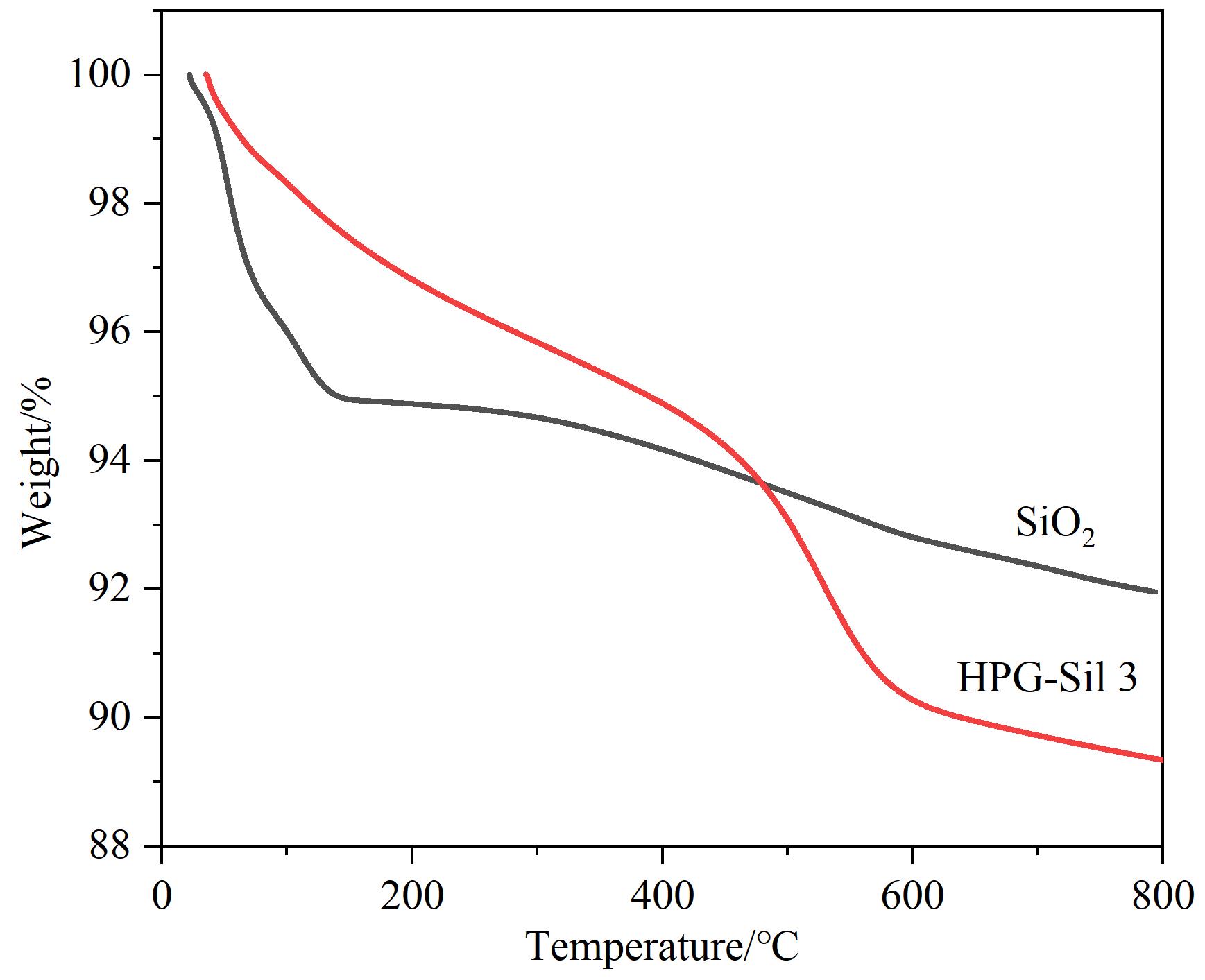
图3 SiO2和HPG-Sil 3的热失重曲线
Fig. 3 TGA curves of SiO2 and HPG-Sil 3
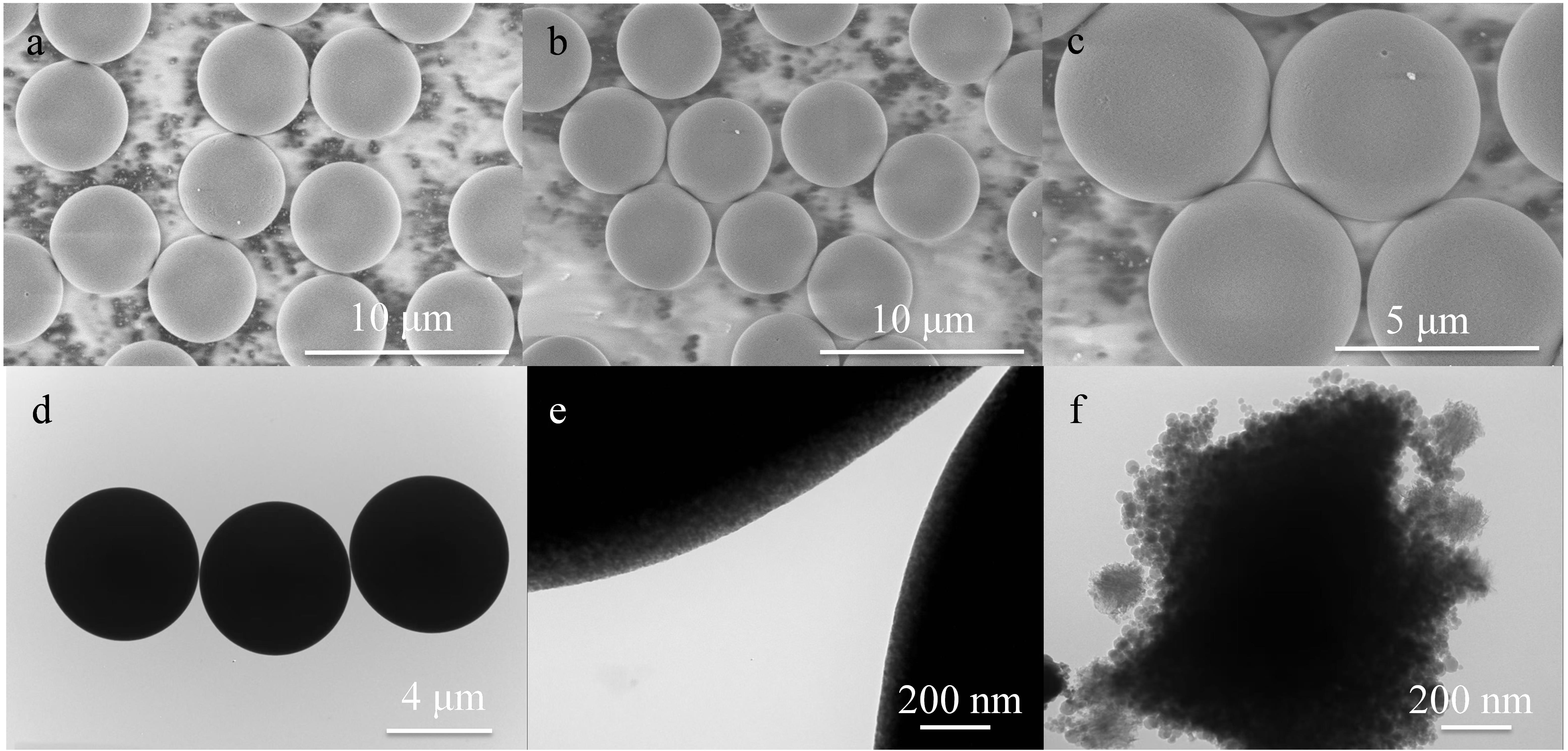
图4 (a)SiO2、(b,c)HPG-Sil 3的SEM图以及(d)SiO2、(e,f)HPG-Sil 3的TEM图
Fig. 4 SEM images of (a) SiO2 and (b, c) HPG-Sil 3, and TEM images of (d) SiO2 and (e, f) HPG-Sil 3
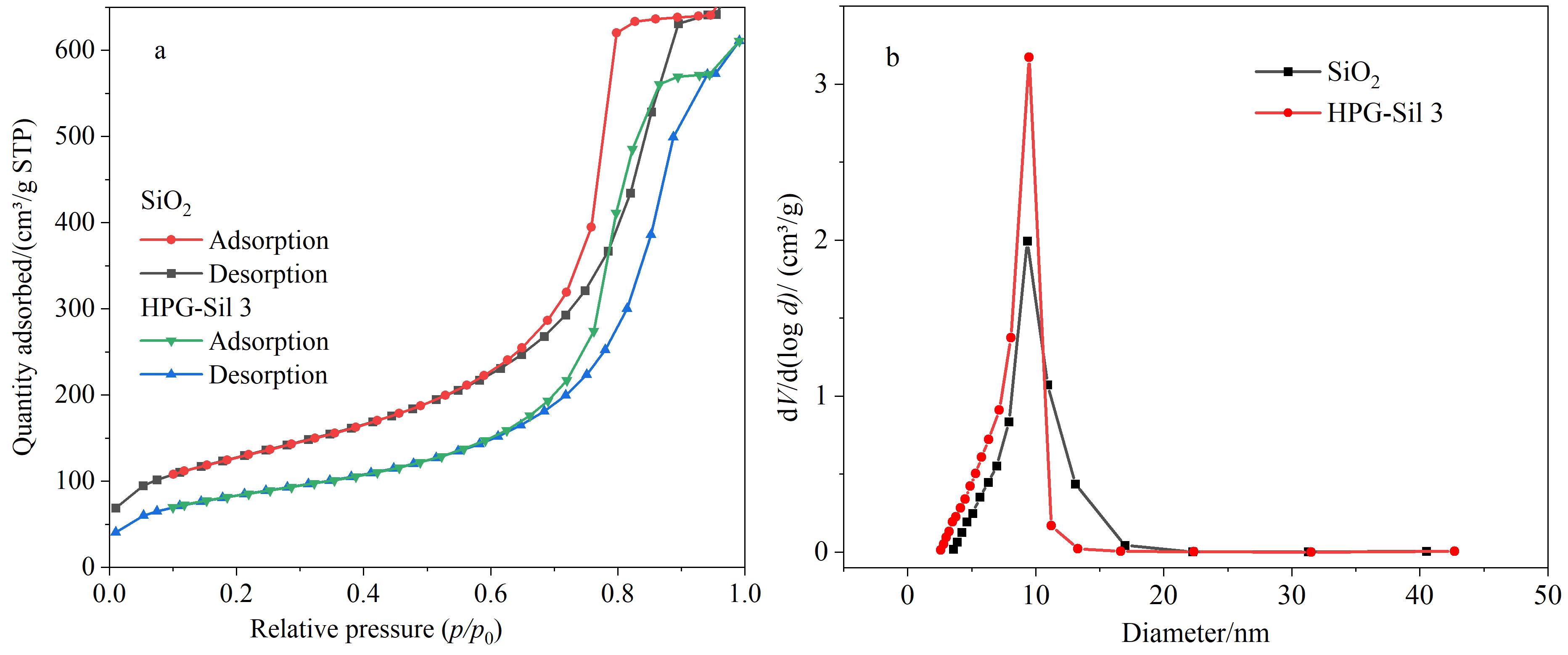
图5 (a)SiO2和HPG-Sil 3的氮气吸附-脱附等温线图以及(b)SiO2和HPG-Sil 3的孔径分布图
Fig. 5 (a) N2 adsorption-desorption isotherms of SiO2 and HPG-Sil 3, and (b) pore distribution of bare silica and HPG-Sil 3
| Analyte | Specific surface area/(m²/g) | Pore volume/(cm³/g) | Pore diameter/nm |
|---|---|---|---|
| SiO2 | 458.41 | 1.07 | 12.57 |
| HPG-Sil 3 | 301.13 | 0.95 | 9.33 |
表2 SiO2和HPG-Sil 3固定相的比表面积、孔体积和孔径
Table 2 Surface areas, pore volumes and pore diameters of SiO2 and HPG-Sil 3 stationary phase
| Analyte | Specific surface area/(m²/g) | Pore volume/(cm³/g) | Pore diameter/nm |
|---|---|---|---|
| SiO2 | 458.41 | 1.07 | 12.57 |
| HPG-Sil 3 | 301.13 | 0.95 | 9.33 |
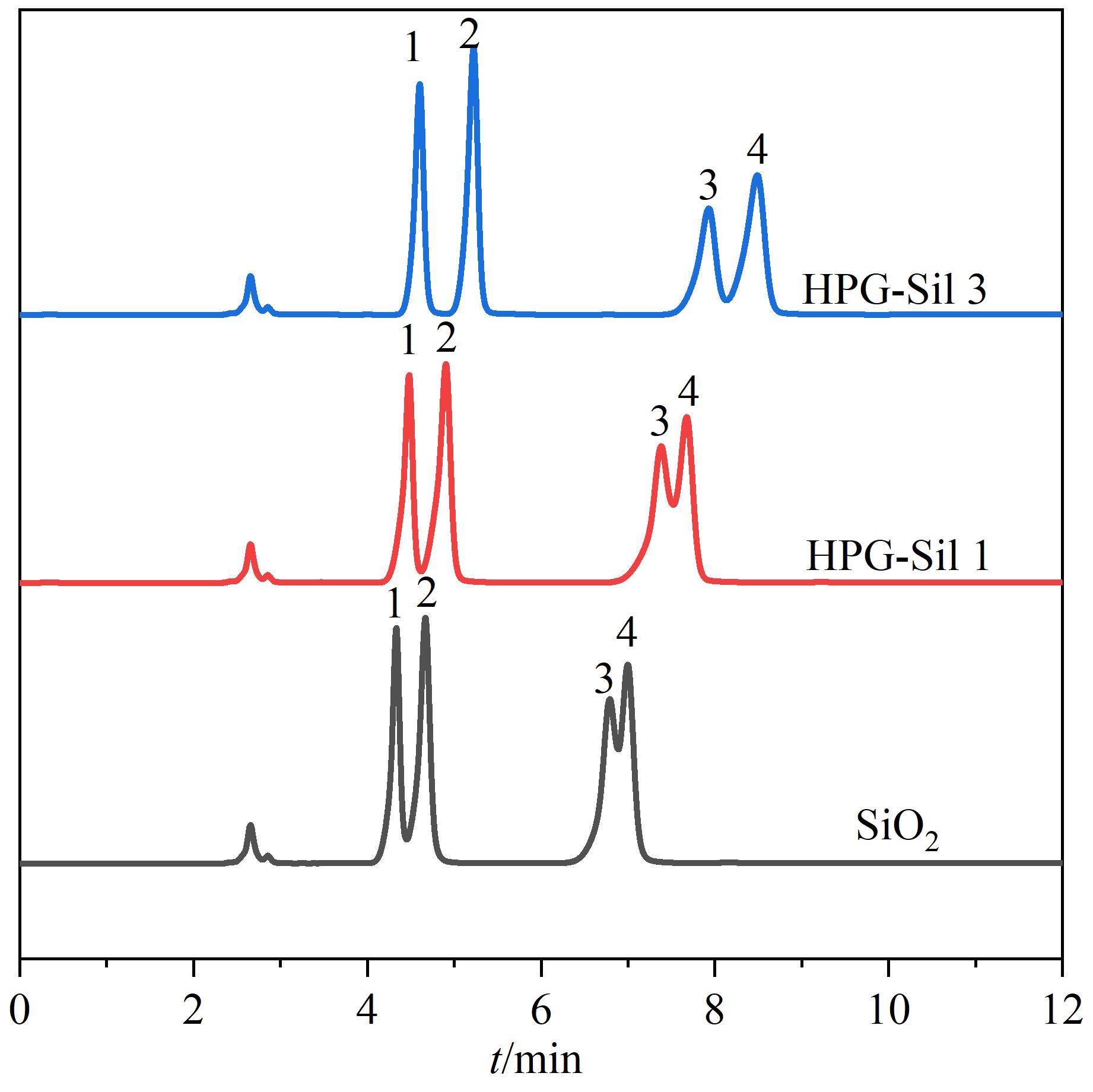
图6 采用不同固定相色谱柱时分析物的色谱图
Fig. 6 Chromatograms of analytes using different stationary phase chromatographic columnsMobile phase: acetonitrile-water (85∶15, V/V); flow rate: 0.6 mL/min; column temperature: 35 ℃; buffer salt concentration: 40 mmol/L; pH: 7.5; detection wavelength: 254 nm.Peak identifications: 1. thymine; 2. uracil; 3. hypoxanthine; 4. adenosine.
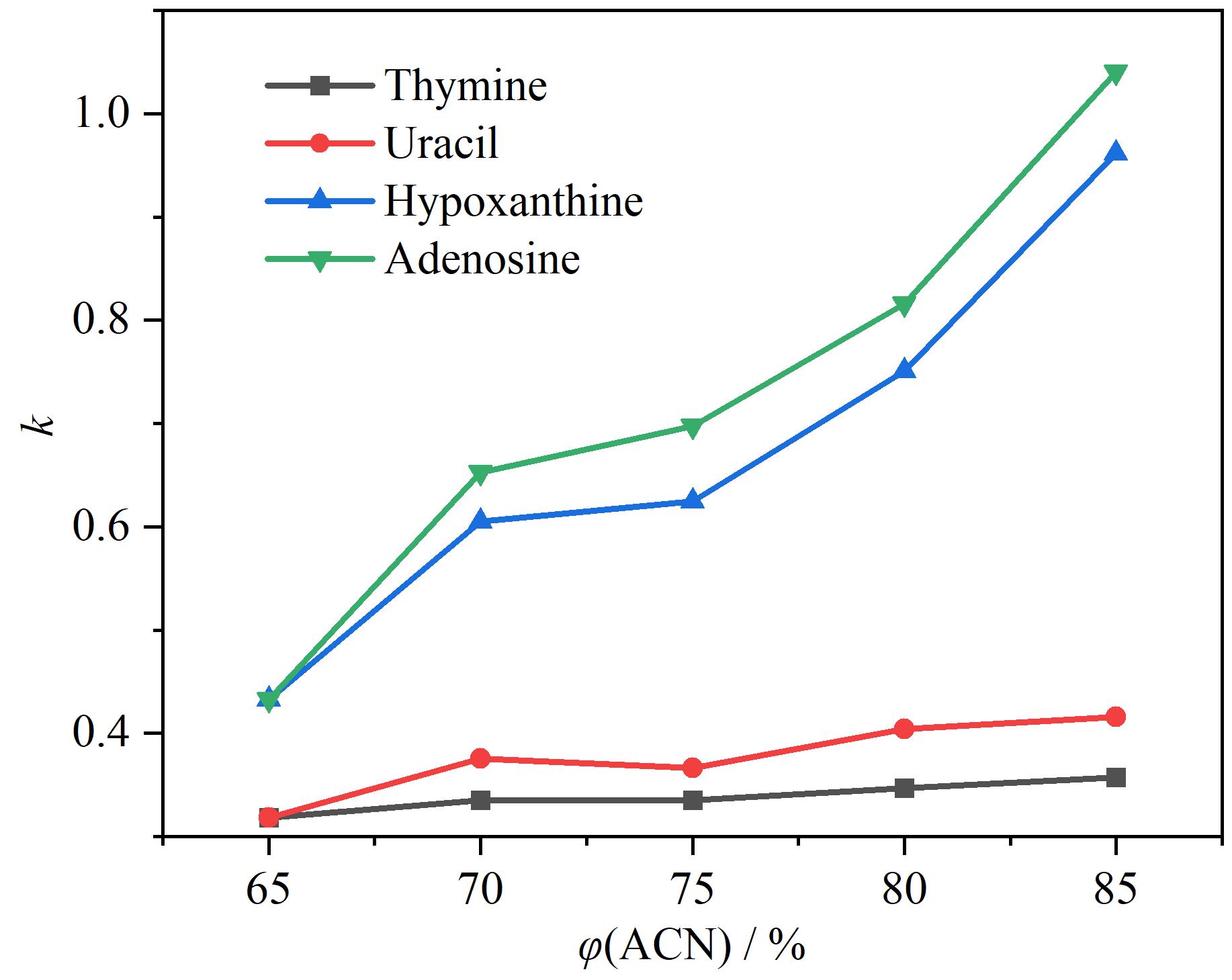
图7 乙腈体积分数对分析物在HPG-Sil 3固定相上保留因子的影响
Fig. 7 Effect of acetonitrile volume fraction on the retention factors (k) of analytes on the HPG-Sil 3 stationary phases
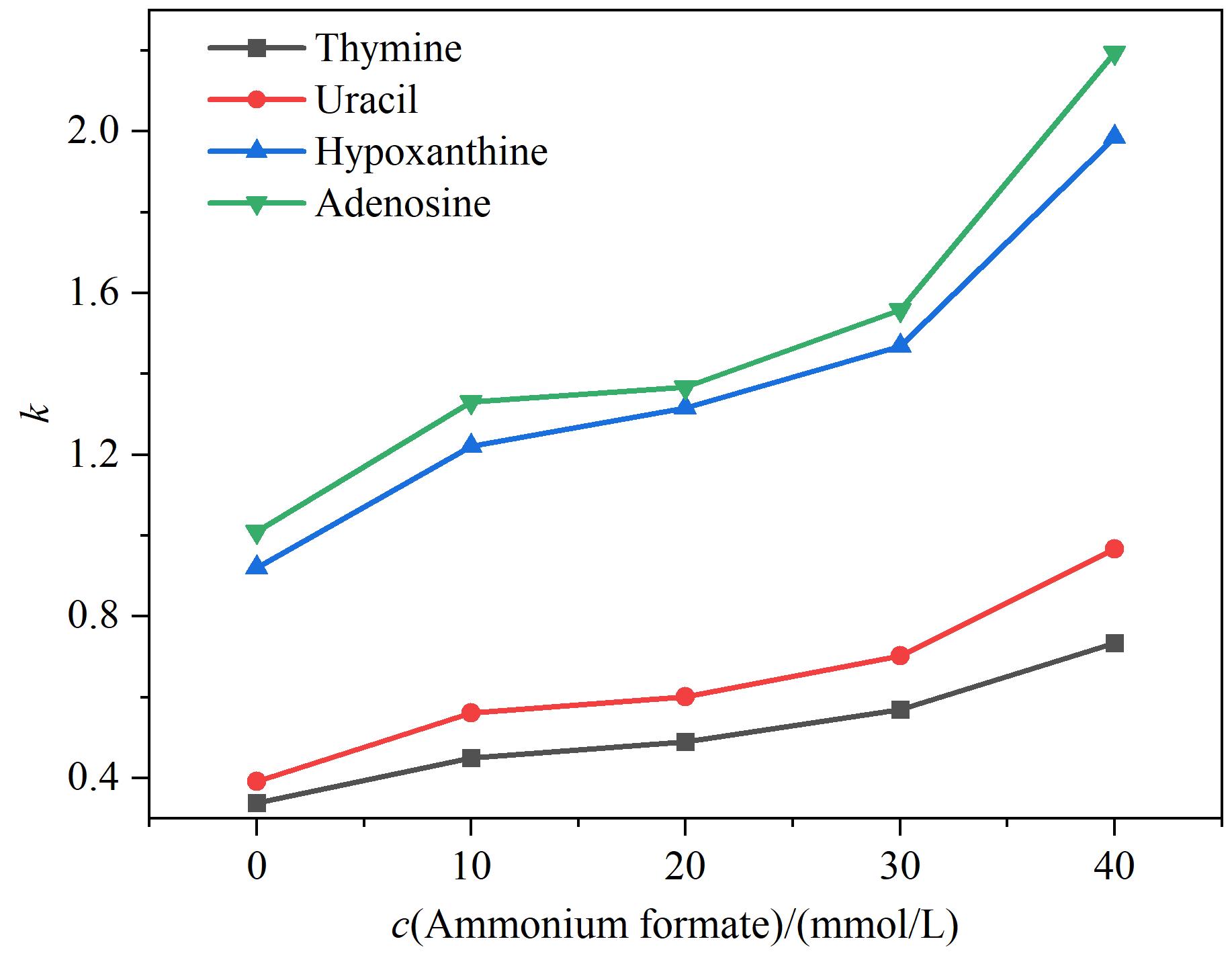
图8 流动相中甲酸铵浓度对分析物在HPG-Sil 3固定相上k的影响
Fig. 8 Effect of ammonium formate concentration in the mobile phase on k of the analytes on the HPG-Sil 3 stationary phase
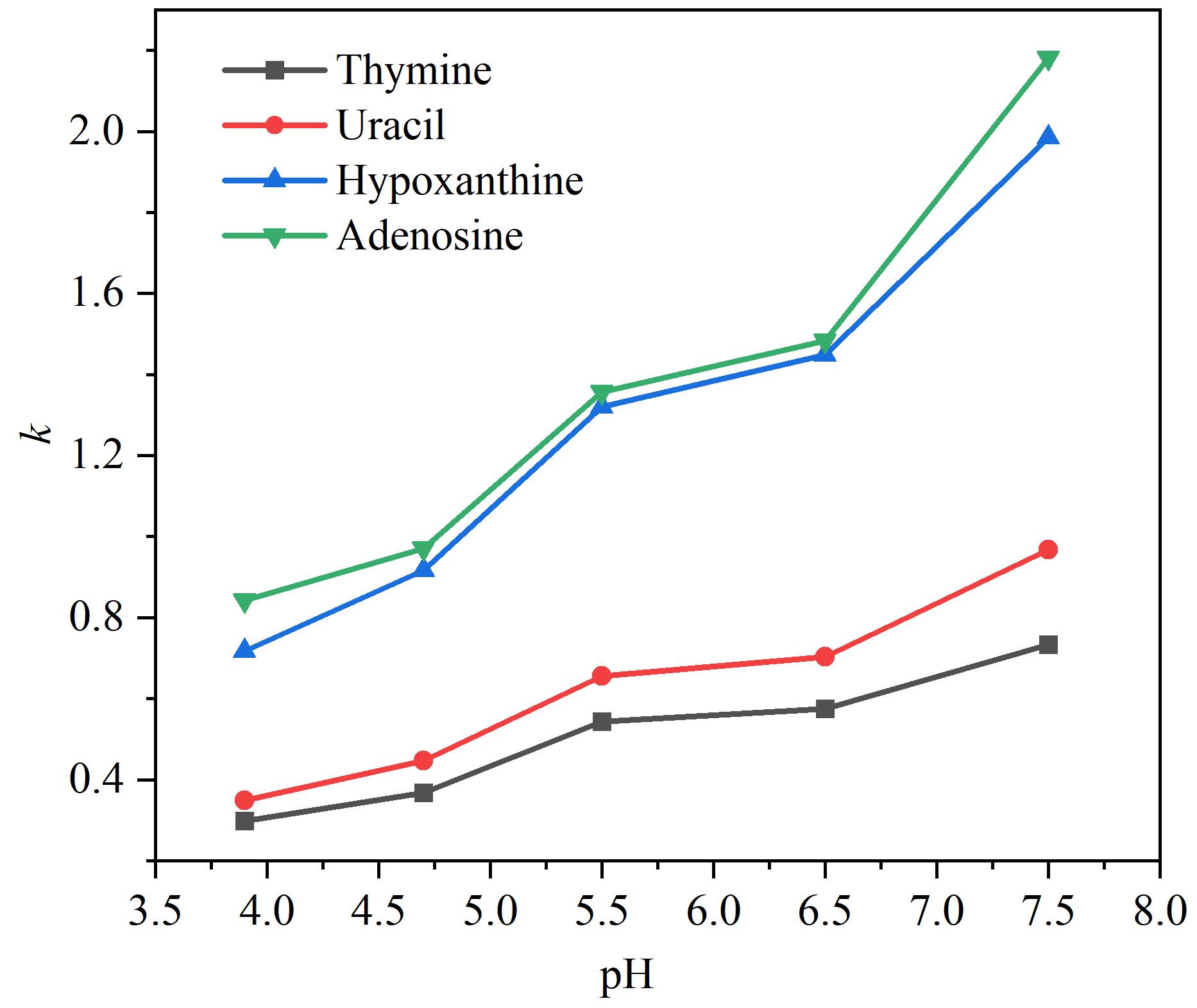
图9 流动相缓冲液pH对分析物在HPG-Sil 3固定相上k的影响
Fig. 9 Effect of the mobile phase buffer pH on k of the analytes on the HPG-Sil 3 stationary phase
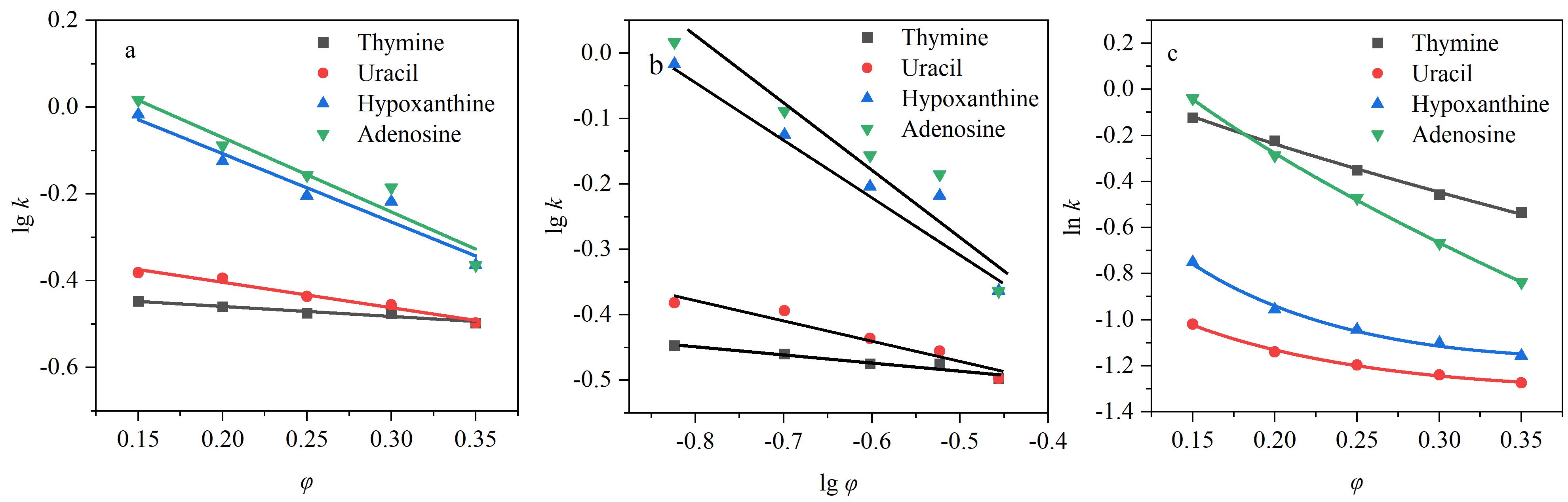
图10 HPG-Sil 3固定相在亲水模式下的保留及分配评价
Fig. 10 Retention and distribution evaluation of HPG-Sil 3 stationary phase in hydrophilic mode mechanism investigationa. plot of distribution model; b. adsorption model; c. multi-factors retention model.
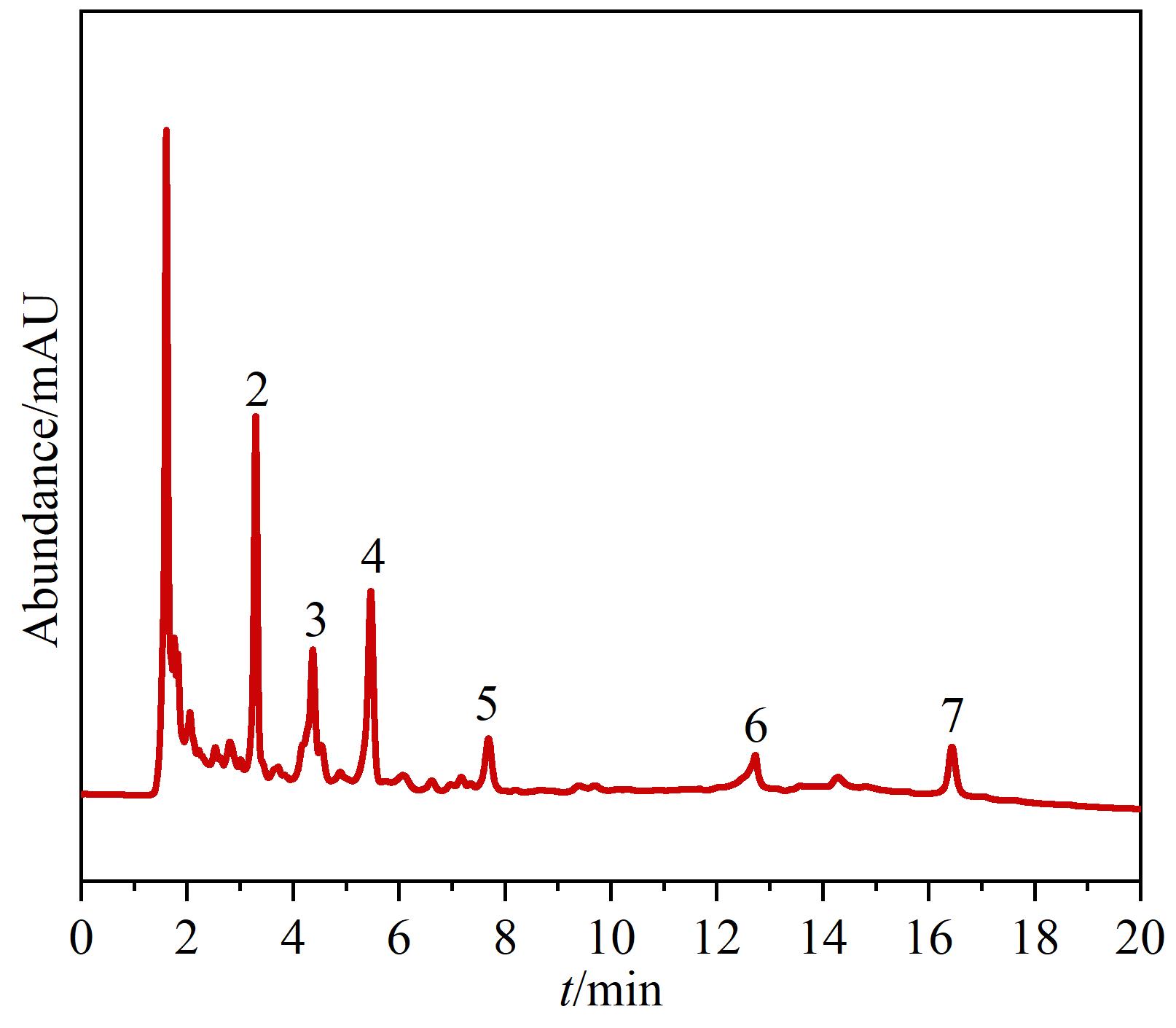
图11 优化条件后HPG-Sil 3固定相分离褐藻胶寡糖的色谱图
Fig. 11 Chromatogram of alginate oligosaccharides separated by HPG-Sil 3 stationary phase under optimized conditionsNumbers indicated the degree of polymerization.
|
| [1] | 任彩霞, 王晓敏, 盛万里, 韩祎陟, 张春艳, 郑书展. 固相支撑液液萃取结合超高效液相色谱-串联质谱快速检测牧草中10种麦角生物碱毒素[J]. 色谱, 2026, 44(4): 403-412. |
| [2] | 杨成, 祝伟霞, 刘亚风, 张鸿伟, 魏蔚, 胡锴. 超高效液相色谱-串联质谱法快速测定动物源性食品中卢巴贝隆残留[J]. 色谱, 2026, 44(4): 479-485. |
| [3] | 张文敏, 刘冠城, 方敏, 郭军凌, 张兰. 磁性氟化共价三嗪骨架材料用于高效萃取全氟化合物[J]. 色谱, 2026, 44(4): 383-392. |
| [4] | 孙沈正, 李瑶瑶, 高燕, 李康聪, 陈智, 李秀琴, 张庆合. 基于机器学习的全氟及多氟化合物电离效率预测模型开发及其在半定量分析中的应用[J]. 色谱, 2026, 44(4): 444-452. |
| [5] | 徐锐洺, 吴友谊, 顾智灏, 魏唯, 陆星宇, 夏紫菡. 基于低共熔溶剂和改进针式滤头的液膜微萃取结合高效液相色谱法测定牛奶中磺胺与氟喹诺酮残留[J]. 色谱, 2026, 44(4): 422-431. |
| [6] | 张博暄, 何钦文, 韩宝苍, 马存地, 罗竹君, 孟祥周. 全氟及多氟烷基物质非靶向识别中液相色谱-高分辨率质谱数据处理方法评价[J]. 色谱, 2026, 44(4): 432-443. |
| [7] | 段金伟, 马蕾, 赵倩, 仵倩倩, 辛博宇, 杨佳桦, 李垚, 王其召. 基于琼脂糖凝胶电泳的二进制加密综合实验[J]. 色谱, 2026, 44(4): 486-495. |
| [8] | 汪睿, 李英杰, 王佳华, 马长文, 蒋家奎. 热脱附-气流调制全二维气相色谱-飞行时间质谱测定环境大气中中等挥发性有机物[J]. 色谱, 2026, 44(4): 453-466. |
| [9] | 孙晶, 张瑜, 刘丰茂, 赵文, 金玥, 张琳, 薛晓锋, 陈蕊, 周画天. 磁分散固相萃取-液相色谱-串联质谱法测定蜂蜜中38种抗生素残留[J]. 色谱, 2026, 44(4): 467-478. |
| [10] | 席彰, 叶懿, 李松璠, 康靖, 刘魏群, 张静, 李道霞. QuEChERS-超高效液相色谱-串联质谱法测定全血中65种合成大麻素[J]. 色谱, 2026, 44(4): 393-402. |
| [11] | 孙慧婧, 张蓓蓓, 黄梦乔, 王荟, 胡冠九, 陈慧敏. 超高效液相色谱-三重四极杆质谱法测定地表水和废水中8种紫外线吸收剂[J]. 色谱, 2026, 44(4): 413-421. |
| [12] | 石洁, 王默, 薛桥臻, 张顺利, 胡炎伟. 融合液相色谱-串联质谱技术与室间质量评价的临床检验专业本科毕业设计教学实践[J]. 色谱, 2026, 44(3): 363-370. |
| [13] | 朱颖, 马晓丽, 禹松林, 邱玲. 超高效液相色谱-串联质谱法快速测定血浆中维奈克拉药物[J]. 色谱, 2026, 44(3): 357-362. |
| [14] | 李炳杵, 李冰慧, 陈芷阳, 李子阳, 尹美玲, 吕星, 项忠元, 龙琪琛, 胡敏. 3种液相色谱-串联质谱法检测脂溶性维生素的性能确认和一致性评价[J]. 色谱, 2026, 44(3): 267-275. |
| [15] | 李汶煜, 刘朝阳, 董军, 杨睿悦, 李红霞, 陈文祥, 王思明. 人血清中30种磷脂酰胆碱与溶血磷脂酰胆碱同系物的液相色谱-串联质谱测定及其与冠心病的关联分析[J]. 色谱, 2026, 44(3): 234-247. |
| 阅读次数 | ||||||
|
全文 |
|
|||||
|
摘要 |
|
|||||
