
色谱 ›› 2026, Vol. 44 ›› Issue (8): 946-959.DOI: 10.3724/SP.J.1123.2026.04013
章慧, 吴慧敏, 何群, 秦天雪, 郭素英, 李雯静, 江蓉, 孙光映( )
)
收稿日期:2026-04-12
出版日期:2026-08-08
发布日期:2026-07-30
通讯作者:
*E-mail:sunguangying@hsu.edu.cn.
基金资助:
ZHANG Hui, WU Huimin, HE Qun, QIN Tianxue, GUO Suying, LI Wenjing, JIANG Rong, SUN Guangying()
Received:2026-04-12
Online:2026-08-08
Published:2026-07-30
Supported by:摘要:
复杂天然产物在液相色谱分离过程中,高载样量与良好分离效果通常难以兼顾。为了解决该技术瓶颈,本工作以低共熔溶剂(deep eutectic solvents, DESs)为流动相添加剂,系统探究其对不同类型化合物在C18柱上色谱行为规律的影响,包括保留值、过载峰形及吸附容量,并分别验证其在黄连、金银花及山茱萸提取物中分离小檗碱、绿原酸、莫诺苷的应用潜力。结果表明,对于可离子化化合物,在流动相中添加DESs能起到压缩色谱峰宽和提高分辨率的效果。其中,对碱性化合物而言,这种提升主要来自DESs中的氢键受体如氯化胆碱对固定相残留硅羟基的屏蔽。而酸性化合物分离的改善则取决于离子对的形成,这与流动相的pH及缓冲盐浓度高度相关。过载和吸附行为实验结果还表明,DESs能有效减弱酸性化合物在固定相吸附过程中溶质-溶质相互作用。对天然产物中的中性化合物而言,在流动相中添加DESs可通过调控离子型共洗脱杂质的色谱行为,间接实现分离优化。本研究为DESs作为流动相添加剂在天然产物制备分离优化中的应用提供了理论依据与技术参考。
中图分类号:
章慧, 吴慧敏, 何群, 秦天雪, 郭素英, 李雯静, 江蓉, 孙光映. 低共熔溶剂改性反相液相色谱法用于天然产物分离[J]. 色谱, 2026, 44(8): 946-959.
ZHANG Hui, WU Huimin, HE Qun, QIN Tianxue, GUO Suying, LI Wenjing, JIANG Rong, SUN Guangying. Deep eutectic solvents modified reversed-phase liquid chromatography for the separation of natural products[J]. Chinese Journal of Chromatography, 2026, 44(8): 946-959.
| DES | Hydrogen bond acceptor (HBA) | Hydrogen bond donor (HBD) | Molar ratio of HBA to HBD | Preparation amounts/g |
|---|---|---|---|---|
| DES-A | choline chloride (ChCl) | urea | 1∶2 | 11.17+9.60 |
| DES-B | tetramethylammonium chloride | ethylene glycol | 1∶3 | 8.77+14.90 |
| DES-C | ChCl | citric acid | 1∶1 | 11.17+15.37 |
| DES-D | ChCl | glycerol | 1∶2 | 11.17+14.73 |
| DES-E | tetraethylammonium chloride | ethylene glycol | 1∶3 | 13.26+14.90 |
表1 5种DESs的组成
Table 1 Compositions of five deep eutectic solvents (DESs)
| DES | Hydrogen bond acceptor (HBA) | Hydrogen bond donor (HBD) | Molar ratio of HBA to HBD | Preparation amounts/g |
|---|---|---|---|---|
| DES-A | choline chloride (ChCl) | urea | 1∶2 | 11.17+9.60 |
| DES-B | tetramethylammonium chloride | ethylene glycol | 1∶3 | 8.77+14.90 |
| DES-C | ChCl | citric acid | 1∶1 | 11.17+15.37 |
| DES-D | ChCl | glycerol | 1∶2 | 11.17+14.73 |
| DES-E | tetraethylammonium chloride | ethylene glycol | 1∶3 | 13.26+14.90 |
| No. | Compound | Contents/(mg/mL) | Injection volumes/μL | Solvent for working solution | Mobile phase composition | Detection wavelength/nm |
|---|---|---|---|---|---|---|
| Determination of the effect of DESs on the retention factors of nortriptyline HCl and benzoic acid on the analytical column | ||||||
| 1 | nortriptyline HCl | 0.1 | 5 | H2O | ACN-13.8 mmol/L phosphate buffer (PB, pH 2.5, CDES-A=20.78 mg/mL) (40∶60. All such ratios are volume ratios, and the same applies hereafter.) | 230 |
| 2 | nortriptyline HCl | 0.1 | 5 | H2O | ACN-13.8 mmol/L PB (pH 2.5, CDES-B=23.66 mg/mL) (40∶60) | 230 |
| 3 | nortriptyline HCl | 0.1 | 5 | H2O | ACN-13.8 mmol/L PB (pH 2.5, CDES-C=26.54 mg/mL) (40∶60) | 230 |
| 4 | nortriptyline HCl | 0.1 | 5 | H2O | ACN-13.8 mmol/L PB (pH 2.5, CDES-D=25.90 mg/mL) (40∶60) | 230 |
| 5 | nortriptyline HCl | 0.1 | 5 | H2O | ACN-13.8 mmol/L PB (pH 2.5, CDES-E=28.15 mg/mL) (40∶60) | 230 |
| 6 | nortriptyline HCl | 0.1 | 5 | H2O | ACN-13.8 mmol/L PB (pH 2.5, CChCl=11.17 mg/mL) (40∶60) | 230 |
| 7 | benzoic acid | 0.042 | 50 | methanol-H2O (50∶50) | ACN-9.2 mmol/L PB (pH 6.5, CDES-A=20.78 mg/mL) (5∶95) | 230 |
| 8 | benzoic acid | 0.042 | 50 | methanol-H2O (50∶50) | ACN-9.2 mmol/L PB (pH 6.5, CDES-B=23.66 mg/mL) (5∶95) | 230 |
| 9 | benzoic acid | 0.042 | 50 | methanol-H2O (50∶50) | ACN-9.2 mmol/L PB (pH 6.5, CDES-C=26.54 mg/mL) (5∶95) | 230 |
| 10 | benzoic acid | 0.042 | 50 | methanol-H2O (50∶50) | ACN-9.2 mmol/L PB (pH 6.5, CDES-D=25.90 mg/mL) (5∶95) | 230 |
| 11 | benzoic acid | 0.042 | 50 | methanol-H2O (50∶50) | ACN-9.2 mmol/L PB (pH 6.5, CDES-E=28.15 mg/mL) (5∶95) | 230 |
| 12 | benzoic acid | 0.042 | 50 | methanol-H2O (50∶50) | ACN-9.2 mmol/L PB (pH 6.5, CChCl=11.17 mg/mL) (5∶95) | 230 |
| Investigation of the effect of ChCl on the retention factor of nortriptyline HCl at different pH | ||||||
| 13 | nortriptyline HCl | 0.1 | 5 | H2O | ACN-25.4 mmol/L PB (pH 2.5) (40∶60) | 230 |
| 14 | nortriptyline HCl | 0.1 | 5 | H2O | ACN-25.4 mmol/L PB (pH 2.5, cChCl=60 mmol/L) (40∶60) | 230 |
| 15 | nortriptyline HCl | 0.1 | 5 | H2O | ACN-20.3 mmol/L PB (pH 4.2) (40∶60) | 230 |
| 16 | nortriptyline HCl | 0.1 | 5 | H2O | ACN-20.3 mmol/L PB (pH 4.2, cChCl=60 mmol/L) (40∶60) | 230 |
| 17 | nortriptyline HCl | 0.1 | 5 | H2O | ACN-20.0 mmol/L PB (pH 5.5) (40∶60) | 230 |
| 18 | nortriptyline HCl | 0.1 | 5 | H2O | ACN-20.0 mmol/L PB (pH 5.5, cChCl=60 mmol/L) (40∶60) | 230 |
| 19 | nortriptyline HCl | 0.1 | 5 | H2O | ACN-18.2 mmol/L PB (pH 6.5) (40∶60) | 230 |
| 20 | nortriptyline HCl | 0.1 | 5 | H2O | ACN-18.2 mmol/L PB (pH 6.5, cChCl=60 mmol/L) (40∶60) | 230 |
| Investigation of the effect of ChCl or KCl concentration on the overloading behavior of nortriptyline HCl on analytical column | ||||||
| 21 | nortriptyline HCl | 1 | 100 | H2O | ACN-13.8 mmol/L PB (pH 2.5, cChCl=0-80 mmol/L) (40∶60) | 290 |
| 22 | nortriptyline HCl | 1 | 100 | H2O | ACN-13.8 mmol/L PB (pH 2.5, cKCl=0-80 mmol/L) (40∶60) | 290 |
| Investigation of the effect of DES-A, DES-C, and DES-D on the overloading behavior of nortriptyline HCl on analytical column | ||||||
| 23 | nortriptyline HCl | 1 | 100 | H2O | ACN-13.8 mmol/L PB (pH 2.5, CDES-A=20.78 mg/mL) (40∶60) | 290 |
| 24 | nortriptyline HCl | 1 | 100 | H2O | ACN-13.8 mmol/L PB (pH 2.5, CDES-C=26.54 mg/mL) (40∶60) | 290 |
| 25 | nortriptyline HCl | 1 | 100 | H2O | ACN-13.8 mmol/L PB (pH 2.5, CDES-D=25.90 mg/mL) (40∶60) | 290 |
| Investigation of the effect of ChCl on the chromatographic behavior of berberine HCl on analytical column | ||||||
| 26 | berberine HCl | 1 | 5, 20, 40, 60, 100 | H2O | ACN-13.8 mmol/L PB (pH 2.5) (35∶65) | 290 |
| 27 | berberine HCl | 1 | 5, 20, 40, 60, 100 | H2O | ACN-13.8 mmol/L PB (pH 2.5, cChCl=80 mmol/L) (35∶65) | 290 |
| 28 | berberine HCl | 1 | 5, 20, 40, 60, 100 | H2O | ACN-9.2 mmol/L PB (pH 6.5) (35∶65) | 290 |
| Investigation of the effect of ChCl addition on the overloading behavior of benzoic acid on analytical column under different pH | ||||||
| 29 | benzoic acid | 5 | 50 | methanol-H2O (50∶50) | ACN-40.0 mmol/L H3PO4 (pH 2.0) (34∶66) | 275 |
| 30 | benzoic acid | 5 | 50 | methanol-H2O (50∶50) | ACN-40.0 mmol/L H3PO4 (pH 2.0, cChCl=60 mmol/L ) (34∶66) | 275 |
| 31 | benzoic acid | 5 | 50 | methanol-H2O (50∶50) | ACN-20.3 mmol/L PB (pH 4.2) (29∶71) | 275 |
| 32 | benzoic acid | 5 | 50 | methanol-H2O (50∶50) | ACN-20.3 mmol/L PB (pH 4.2, cChCl=60 mmol/L) (29∶71) | 275 |
| 33 | benzoic acid | 5 | 50 | methanol-H2O (50∶50) | ACN-20.0 mmol/L PB (pH 5.5) (11.5∶88.5) | 275 |
| 34 | benzoic acid | 5 | 50 | methanol-H2O (50∶50) | ACN-20.0 mmol/L PB (pH 5.5, cChCl=60 mmol/L) (11.5∶88.5) | 275 |
| 35 | benzoic acid | 5 | 50 | methanol-H2O (50∶50) | ACN-18.2 mmol/L PB (pH 6.5) (5∶95) | 275 |
| 36 | benzoic acid | 5 | 50 | methanol-H2O (50∶50) | ACN-18.2 mmol/L PB (pH 6.5, cChCl=60 mmol/L) (5∶95) | 275 |
| Investigation of the effect of ChCl or KCl on the overloading behavior of benzoic acid on analytical column | ||||||
| 37 | benzoic acid | 0.042, 0.25, 1, 10 | 50 | methanol-H2O (50∶50) | ACN- 9.2 mmol/L PB (pH 6.5) (5∶95) | 290 |
| 38 | benzoic acid | 0.042, 0.25, 1, 10 | 50 | methanol-H2O (50∶50) | ACN- 9.2 mmol/L PB (pH 6.5, cChCl=80 mmol/L) (5∶95) | 290 |
| 39 | benzoic acid | 0.042, 0.25, 1, 10 | 50 | methanol-H2O (50∶50) | ACN- 9.2 mmol/L PB (pH 6.5, cKCl=80 mmol/L) (5∶95) | 290 |
| Investigation of the effect of ChCl or KCl on the overloading behavior of potassium benzoate on analytical column | ||||||
| 40 | potassium benzoate | 13.118,6.559,3.936,2.624,1.312,0.656,0.328,0.164,0.054 | 50 | H2O | ACN-8.1 mmol/L PB (pH 7.0) (5∶95) | 270 |
| 41 | potassium benzoate | 13.118,6.559,3.936,2.624,1.312,0.656,0.328,0.164,0.054 | 50 | H2O | ACN-8.1 mmol/L PB (pH 7.0, cKCl=80 mmol/L) (5∶95) | 270 |
| 42 | potassium benzoate | 13.118,6.559,3.936,2.624,1.312,0.656,0.328,0.164,0.054 | 50 | H2O | ACN-8.1 mmol/L PB (pH 7.0, cChCl=80 mmol/L) (5∶95) | 270 |
| Investigation of the effect of ChCl on the overloading behavior of potassium chlorogenate on analytical column | ||||||
| 43 | potassium chlorogenate | 1.11 | 5, 20, 40, 60, 100 | H2O | ACN-9.2 mmol/L PB (pH 6.5) (5∶95) | 370 |
| 44 | potassium chlorogenate | 1.11 | 5, 20, 40, 60, 100 | H2O | ACN-9.2 mmol/L PB (pH 6.5, cChCl=80 mmol/L) (5∶95) | 370 |
| Investigation of the effect of ChCl on the overloading behavior of morroniside on analytical column | ||||||
| 45 | morroniside | 10 | 40, 80, 100 | methanol-9.2 mmol/L PB (pH 6.5) (25∶75) | methanol-9.2 mmol/L PB (pH 6.5) (25∶75) | 270 |
| 46 | morroniside | 10 | 40, 80, 100 | methanol-9.2 mmol/L PB (pH 6.5) (25∶75) | methanol-9.2 mmol/L PB (pH 6.5, cChCl=80 mmol/L) (25∶75) | 270 |
表2 各化合物在分析型C18柱上的分离条件
Table 2 Separation conditions for each compound on the analytical C18 column
| No. | Compound | Contents/(mg/mL) | Injection volumes/μL | Solvent for working solution | Mobile phase composition | Detection wavelength/nm |
|---|---|---|---|---|---|---|
| Determination of the effect of DESs on the retention factors of nortriptyline HCl and benzoic acid on the analytical column | ||||||
| 1 | nortriptyline HCl | 0.1 | 5 | H2O | ACN-13.8 mmol/L phosphate buffer (PB, pH 2.5, CDES-A=20.78 mg/mL) (40∶60. All such ratios are volume ratios, and the same applies hereafter.) | 230 |
| 2 | nortriptyline HCl | 0.1 | 5 | H2O | ACN-13.8 mmol/L PB (pH 2.5, CDES-B=23.66 mg/mL) (40∶60) | 230 |
| 3 | nortriptyline HCl | 0.1 | 5 | H2O | ACN-13.8 mmol/L PB (pH 2.5, CDES-C=26.54 mg/mL) (40∶60) | 230 |
| 4 | nortriptyline HCl | 0.1 | 5 | H2O | ACN-13.8 mmol/L PB (pH 2.5, CDES-D=25.90 mg/mL) (40∶60) | 230 |
| 5 | nortriptyline HCl | 0.1 | 5 | H2O | ACN-13.8 mmol/L PB (pH 2.5, CDES-E=28.15 mg/mL) (40∶60) | 230 |
| 6 | nortriptyline HCl | 0.1 | 5 | H2O | ACN-13.8 mmol/L PB (pH 2.5, CChCl=11.17 mg/mL) (40∶60) | 230 |
| 7 | benzoic acid | 0.042 | 50 | methanol-H2O (50∶50) | ACN-9.2 mmol/L PB (pH 6.5, CDES-A=20.78 mg/mL) (5∶95) | 230 |
| 8 | benzoic acid | 0.042 | 50 | methanol-H2O (50∶50) | ACN-9.2 mmol/L PB (pH 6.5, CDES-B=23.66 mg/mL) (5∶95) | 230 |
| 9 | benzoic acid | 0.042 | 50 | methanol-H2O (50∶50) | ACN-9.2 mmol/L PB (pH 6.5, CDES-C=26.54 mg/mL) (5∶95) | 230 |
| 10 | benzoic acid | 0.042 | 50 | methanol-H2O (50∶50) | ACN-9.2 mmol/L PB (pH 6.5, CDES-D=25.90 mg/mL) (5∶95) | 230 |
| 11 | benzoic acid | 0.042 | 50 | methanol-H2O (50∶50) | ACN-9.2 mmol/L PB (pH 6.5, CDES-E=28.15 mg/mL) (5∶95) | 230 |
| 12 | benzoic acid | 0.042 | 50 | methanol-H2O (50∶50) | ACN-9.2 mmol/L PB (pH 6.5, CChCl=11.17 mg/mL) (5∶95) | 230 |
| Investigation of the effect of ChCl on the retention factor of nortriptyline HCl at different pH | ||||||
| 13 | nortriptyline HCl | 0.1 | 5 | H2O | ACN-25.4 mmol/L PB (pH 2.5) (40∶60) | 230 |
| 14 | nortriptyline HCl | 0.1 | 5 | H2O | ACN-25.4 mmol/L PB (pH 2.5, cChCl=60 mmol/L) (40∶60) | 230 |
| 15 | nortriptyline HCl | 0.1 | 5 | H2O | ACN-20.3 mmol/L PB (pH 4.2) (40∶60) | 230 |
| 16 | nortriptyline HCl | 0.1 | 5 | H2O | ACN-20.3 mmol/L PB (pH 4.2, cChCl=60 mmol/L) (40∶60) | 230 |
| 17 | nortriptyline HCl | 0.1 | 5 | H2O | ACN-20.0 mmol/L PB (pH 5.5) (40∶60) | 230 |
| 18 | nortriptyline HCl | 0.1 | 5 | H2O | ACN-20.0 mmol/L PB (pH 5.5, cChCl=60 mmol/L) (40∶60) | 230 |
| 19 | nortriptyline HCl | 0.1 | 5 | H2O | ACN-18.2 mmol/L PB (pH 6.5) (40∶60) | 230 |
| 20 | nortriptyline HCl | 0.1 | 5 | H2O | ACN-18.2 mmol/L PB (pH 6.5, cChCl=60 mmol/L) (40∶60) | 230 |
| Investigation of the effect of ChCl or KCl concentration on the overloading behavior of nortriptyline HCl on analytical column | ||||||
| 21 | nortriptyline HCl | 1 | 100 | H2O | ACN-13.8 mmol/L PB (pH 2.5, cChCl=0-80 mmol/L) (40∶60) | 290 |
| 22 | nortriptyline HCl | 1 | 100 | H2O | ACN-13.8 mmol/L PB (pH 2.5, cKCl=0-80 mmol/L) (40∶60) | 290 |
| Investigation of the effect of DES-A, DES-C, and DES-D on the overloading behavior of nortriptyline HCl on analytical column | ||||||
| 23 | nortriptyline HCl | 1 | 100 | H2O | ACN-13.8 mmol/L PB (pH 2.5, CDES-A=20.78 mg/mL) (40∶60) | 290 |
| 24 | nortriptyline HCl | 1 | 100 | H2O | ACN-13.8 mmol/L PB (pH 2.5, CDES-C=26.54 mg/mL) (40∶60) | 290 |
| 25 | nortriptyline HCl | 1 | 100 | H2O | ACN-13.8 mmol/L PB (pH 2.5, CDES-D=25.90 mg/mL) (40∶60) | 290 |
| Investigation of the effect of ChCl on the chromatographic behavior of berberine HCl on analytical column | ||||||
| 26 | berberine HCl | 1 | 5, 20, 40, 60, 100 | H2O | ACN-13.8 mmol/L PB (pH 2.5) (35∶65) | 290 |
| 27 | berberine HCl | 1 | 5, 20, 40, 60, 100 | H2O | ACN-13.8 mmol/L PB (pH 2.5, cChCl=80 mmol/L) (35∶65) | 290 |
| 28 | berberine HCl | 1 | 5, 20, 40, 60, 100 | H2O | ACN-9.2 mmol/L PB (pH 6.5) (35∶65) | 290 |
| Investigation of the effect of ChCl addition on the overloading behavior of benzoic acid on analytical column under different pH | ||||||
| 29 | benzoic acid | 5 | 50 | methanol-H2O (50∶50) | ACN-40.0 mmol/L H3PO4 (pH 2.0) (34∶66) | 275 |
| 30 | benzoic acid | 5 | 50 | methanol-H2O (50∶50) | ACN-40.0 mmol/L H3PO4 (pH 2.0, cChCl=60 mmol/L ) (34∶66) | 275 |
| 31 | benzoic acid | 5 | 50 | methanol-H2O (50∶50) | ACN-20.3 mmol/L PB (pH 4.2) (29∶71) | 275 |
| 32 | benzoic acid | 5 | 50 | methanol-H2O (50∶50) | ACN-20.3 mmol/L PB (pH 4.2, cChCl=60 mmol/L) (29∶71) | 275 |
| 33 | benzoic acid | 5 | 50 | methanol-H2O (50∶50) | ACN-20.0 mmol/L PB (pH 5.5) (11.5∶88.5) | 275 |
| 34 | benzoic acid | 5 | 50 | methanol-H2O (50∶50) | ACN-20.0 mmol/L PB (pH 5.5, cChCl=60 mmol/L) (11.5∶88.5) | 275 |
| 35 | benzoic acid | 5 | 50 | methanol-H2O (50∶50) | ACN-18.2 mmol/L PB (pH 6.5) (5∶95) | 275 |
| 36 | benzoic acid | 5 | 50 | methanol-H2O (50∶50) | ACN-18.2 mmol/L PB (pH 6.5, cChCl=60 mmol/L) (5∶95) | 275 |
| Investigation of the effect of ChCl or KCl on the overloading behavior of benzoic acid on analytical column | ||||||
| 37 | benzoic acid | 0.042, 0.25, 1, 10 | 50 | methanol-H2O (50∶50) | ACN- 9.2 mmol/L PB (pH 6.5) (5∶95) | 290 |
| 38 | benzoic acid | 0.042, 0.25, 1, 10 | 50 | methanol-H2O (50∶50) | ACN- 9.2 mmol/L PB (pH 6.5, cChCl=80 mmol/L) (5∶95) | 290 |
| 39 | benzoic acid | 0.042, 0.25, 1, 10 | 50 | methanol-H2O (50∶50) | ACN- 9.2 mmol/L PB (pH 6.5, cKCl=80 mmol/L) (5∶95) | 290 |
| Investigation of the effect of ChCl or KCl on the overloading behavior of potassium benzoate on analytical column | ||||||
| 40 | potassium benzoate | 13.118,6.559,3.936,2.624,1.312,0.656,0.328,0.164,0.054 | 50 | H2O | ACN-8.1 mmol/L PB (pH 7.0) (5∶95) | 270 |
| 41 | potassium benzoate | 13.118,6.559,3.936,2.624,1.312,0.656,0.328,0.164,0.054 | 50 | H2O | ACN-8.1 mmol/L PB (pH 7.0, cKCl=80 mmol/L) (5∶95) | 270 |
| 42 | potassium benzoate | 13.118,6.559,3.936,2.624,1.312,0.656,0.328,0.164,0.054 | 50 | H2O | ACN-8.1 mmol/L PB (pH 7.0, cChCl=80 mmol/L) (5∶95) | 270 |
| Investigation of the effect of ChCl on the overloading behavior of potassium chlorogenate on analytical column | ||||||
| 43 | potassium chlorogenate | 1.11 | 5, 20, 40, 60, 100 | H2O | ACN-9.2 mmol/L PB (pH 6.5) (5∶95) | 370 |
| 44 | potassium chlorogenate | 1.11 | 5, 20, 40, 60, 100 | H2O | ACN-9.2 mmol/L PB (pH 6.5, cChCl=80 mmol/L) (5∶95) | 370 |
| Investigation of the effect of ChCl on the overloading behavior of morroniside on analytical column | ||||||
| 45 | morroniside | 10 | 40, 80, 100 | methanol-9.2 mmol/L PB (pH 6.5) (25∶75) | methanol-9.2 mmol/L PB (pH 6.5) (25∶75) | 270 |
| 46 | morroniside | 10 | 40, 80, 100 | methanol-9.2 mmol/L PB (pH 6.5) (25∶75) | methanol-9.2 mmol/L PB (pH 6.5, cChCl=80 mmol/L) (25∶75) | 270 |
| No. | Sample | Content/(mg/mL) | Injection volume/μL | Solvent for working solution | Mobile phase composition | Detection wavelengths/nm |
|---|---|---|---|---|---|---|
| 1 | Coptis chinensisextracts | 100 | 100 | methanol-H2O (50∶50) | ACN-9.2 mmol/L PB (pH 6.5) (35∶65) | 290 |
| 2 | Coptis chinensisextracts | 100 | 100 | methanol-H2O (50∶50) | ACN-9.2 mmol/L PB (pH 6.5, cChCl=80 mmol/L) (35∶65) | 290 |
| 3 | Lonicera Japonica extracts | 100 | 50 | aqueous KOH solution | ACN-9.2 mmol/L PB (pH 6.5) (5∶95) | 350 |
| 4 | Lonicera Japonica extracts | 100 | 50 | aqueous KOH solution | ACN-9.2 mmol/L PB (pH 6.5, cChCl=80 mmol/L) (5∶95) | 350 |
| 5 | Cornus officinalis extracts | 100 | 100 | mobile phase | methanol-9.2 mmol/L PB (pH 6.5) (25∶75) | 254/270 |
| 6 | Cornus officinalis extracts | 100 | 100 | mobile phase | methanol-9.2 mmol/L PB (pH 6.5, cChCl=80 mmol/L) (25∶75) | 254/270 |
表3 各植物提取物在半制备型C18柱上的分离条件
Table 3 Separation conditions for various plant extracts on a semi-preparative C18 column
| No. | Sample | Content/(mg/mL) | Injection volume/μL | Solvent for working solution | Mobile phase composition | Detection wavelengths/nm |
|---|---|---|---|---|---|---|
| 1 | Coptis chinensisextracts | 100 | 100 | methanol-H2O (50∶50) | ACN-9.2 mmol/L PB (pH 6.5) (35∶65) | 290 |
| 2 | Coptis chinensisextracts | 100 | 100 | methanol-H2O (50∶50) | ACN-9.2 mmol/L PB (pH 6.5, cChCl=80 mmol/L) (35∶65) | 290 |
| 3 | Lonicera Japonica extracts | 100 | 50 | aqueous KOH solution | ACN-9.2 mmol/L PB (pH 6.5) (5∶95) | 350 |
| 4 | Lonicera Japonica extracts | 100 | 50 | aqueous KOH solution | ACN-9.2 mmol/L PB (pH 6.5, cChCl=80 mmol/L) (5∶95) | 350 |
| 5 | Cornus officinalis extracts | 100 | 100 | mobile phase | methanol-9.2 mmol/L PB (pH 6.5) (25∶75) | 254/270 |
| 6 | Cornus officinalis extracts | 100 | 100 | mobile phase | methanol-9.2 mmol/L PB (pH 6.5, cChCl=80 mmol/L) (25∶75) | 254/270 |
| DES | k | |
|---|---|---|
| Nortriptyline HCl* | Benzoic acid** | |
| DES-A | 3.18 | 3.14 |
| DES-B | 2.96 | 3.03 |
| DES-C | 3.17 | >6.00 |
| DES-D | 3.01 | 3.17 |
| DES-E | 2.33 | 6.05 |
| ChCl | 3.12 | 3.23 |
表4 DESs作为添加剂对盐酸去甲替林和苯甲酸保留因子的影响(C18柱)
Table 4 Effects of DESs as additives on retention factors (C18 column) of nortriptyline HCl and benzoic acid
| DES | k | |
|---|---|---|
| Nortriptyline HCl* | Benzoic acid** | |
| DES-A | 3.18 | 3.14 |
| DES-B | 2.96 | 3.03 |
| DES-C | 3.17 | >6.00 |
| DES-D | 3.01 | 3.17 |
| DES-E | 2.33 | 6.05 |
| ChCl | 3.12 | 3.23 |
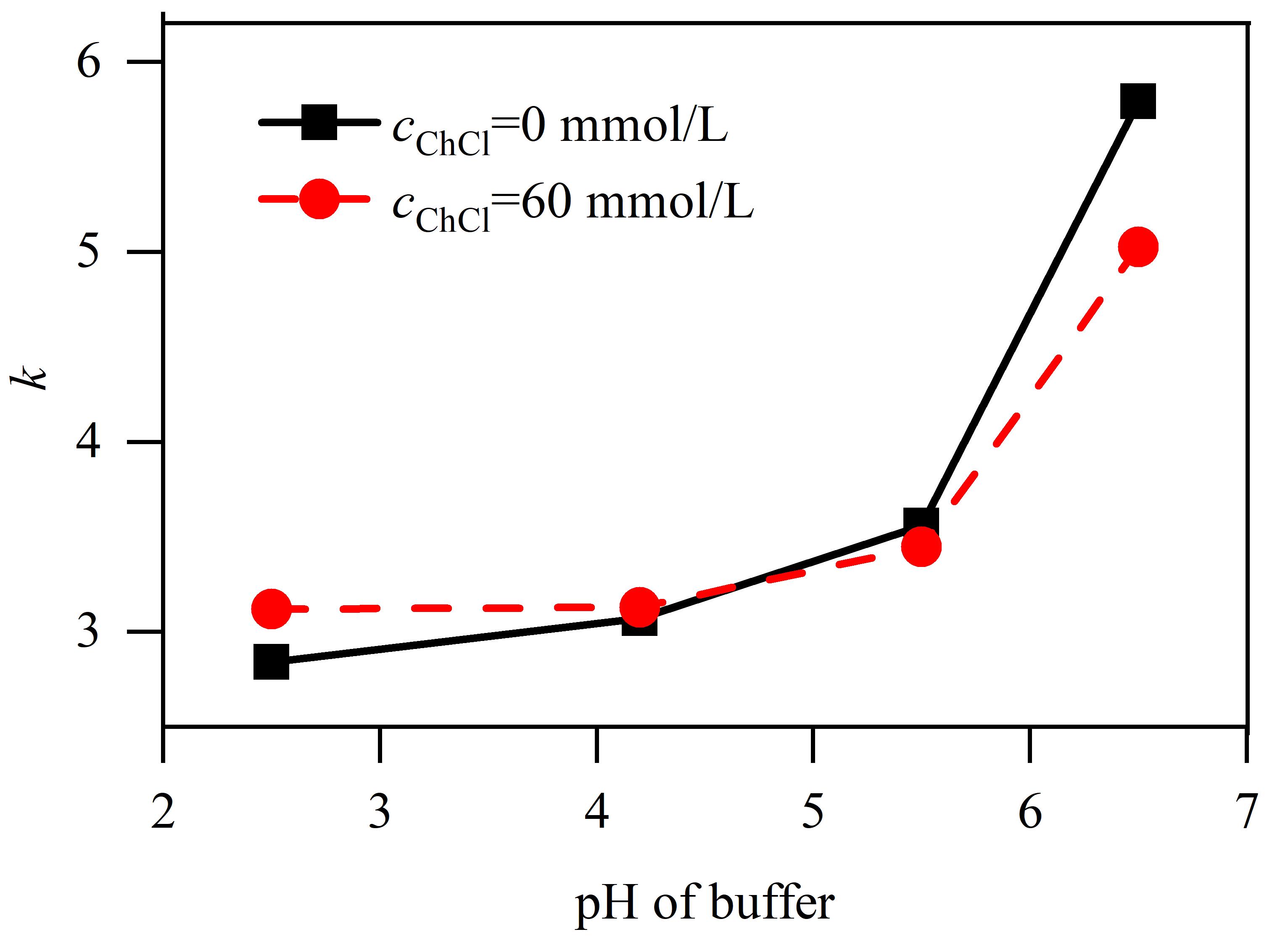
图1 不同pH下在流动相中添加ChCl对盐酸去甲替林在C18色谱柱上保留因子的影响
Fig. 1 Effect of the addition of ChCl in the mobile phase on the retention factor of nortriptyline hydrochloride on a C18 column at different pHLoading amount: 0.5 μg; mobile phase: for dark solid line, ACN-PB (40∶60); for red dashed line, ACN-PB with ChCl (cChCl=60 mmol/L) (40∶60).
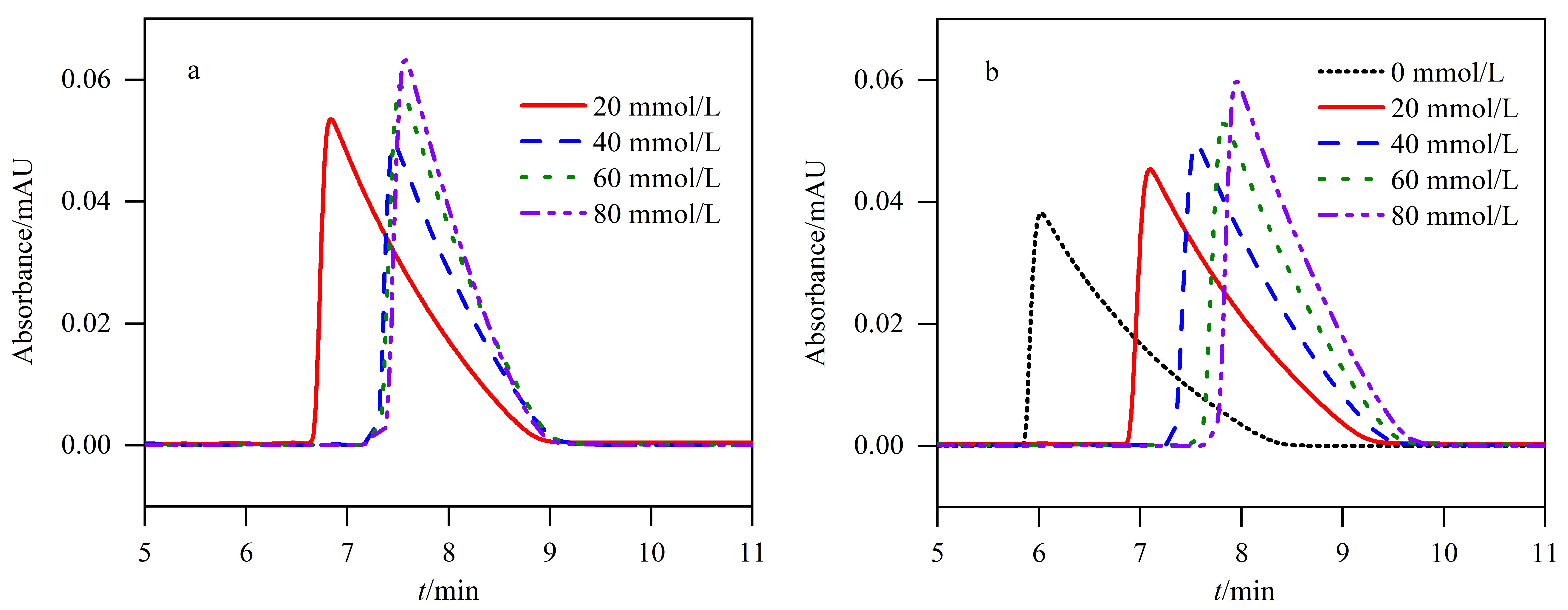
图2 (a)氯化胆碱和(b)氯化钾添加浓度对盐酸去甲替林在分析柱上过载行为的影响
Fig. 2 Effects of concentrations of (a) ChCl and (b) KCl on the overloading behavior of nortriptyline HCl on the analytical columnLoading amount: 0.1 mg; mobile phase: ACN-13.8 mmol/L PB (pH 2.5) (40∶60).
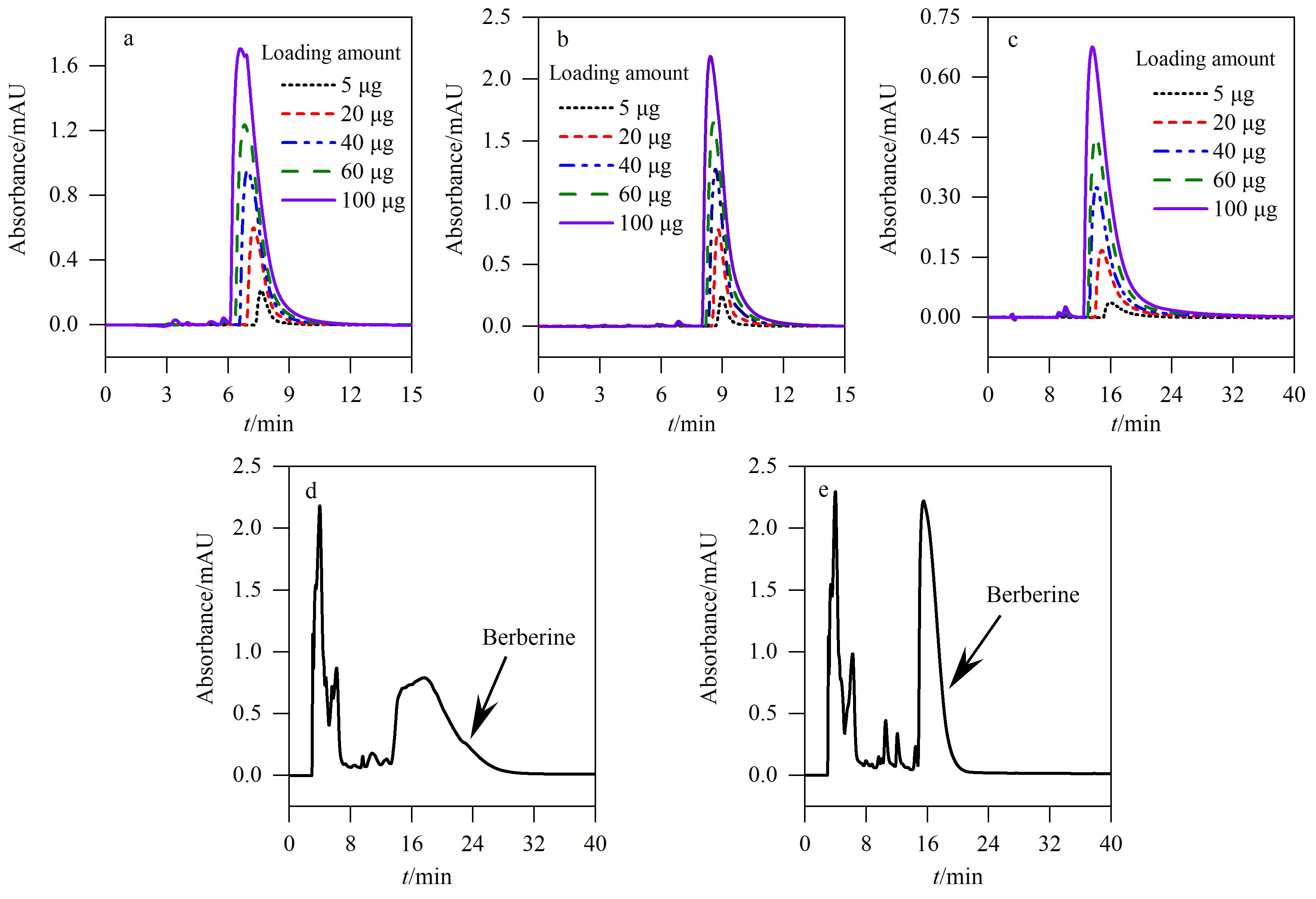
图3 (a~c)流动相中添加ChCl时盐酸小檗碱在分析柱上的色谱图;黄连提取物在流动相中ChCl添加(d)前和(e)后在半制备柱上的色谱图
Fig. 3 (a-c) Chromatograms of berberine HCl on the analytical column without and with the addition of ChCl in the mobile phase; Coptis chinensis extracts on the semi-preparative column (d) before and (e) after ChCl was added to the mobile phaseMobile phases: a. ACN-13.8 mmol/L PB (pH 2.5) (35∶65); b. ACN-13.8 mmol/L PB (pH 2.5, cChCl=80 mmol/L) (35∶65); c. ACN-9.2 mmol/L PB (pH 6.5) (35∶65); d. ACN-9.2 mmol/L PB (pH 6.5) (35∶65); e. ACN-9.2 mmol/L PB (pH 6.5, cChCl=80 mmol/L) (35∶65).
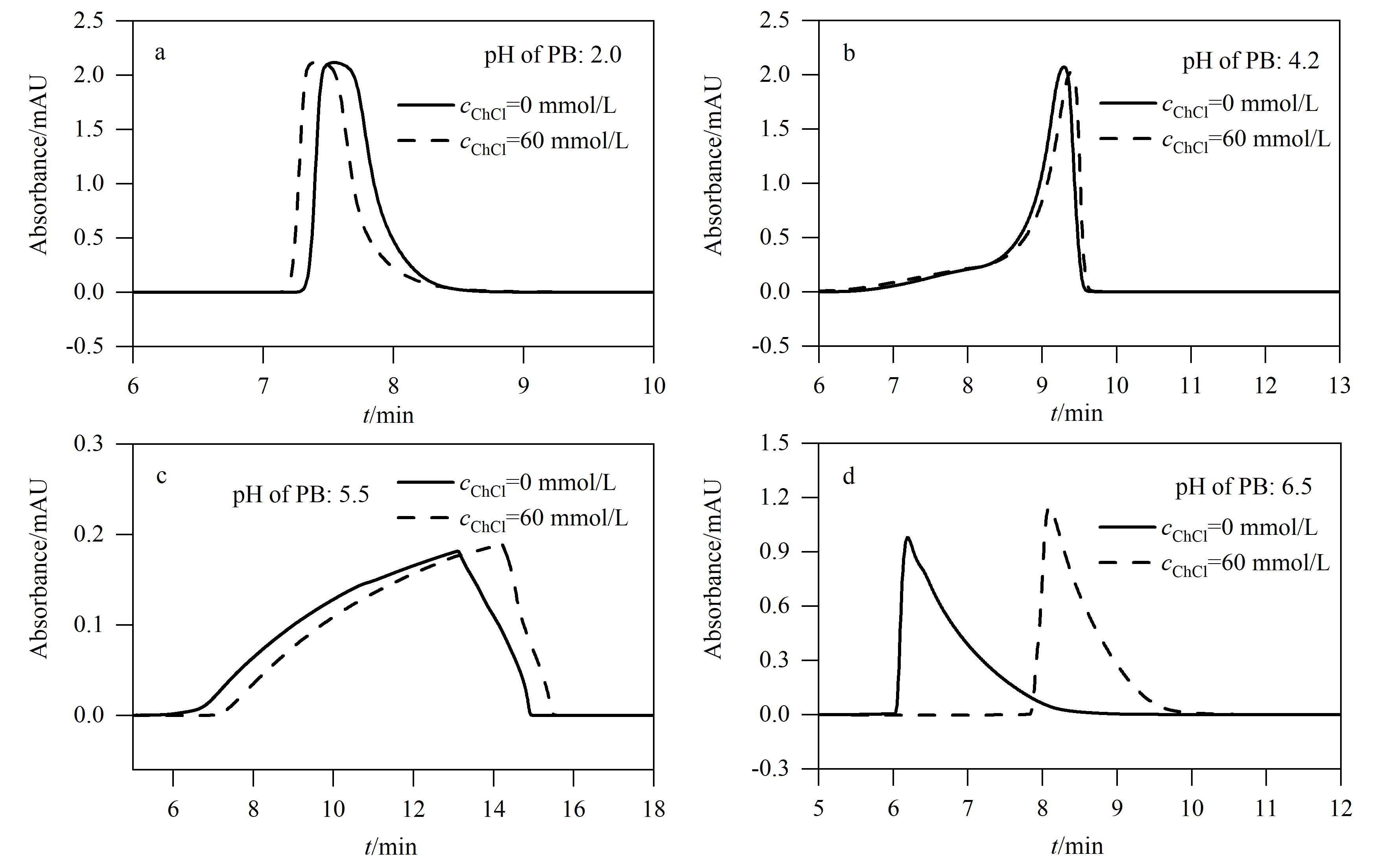
图4 不同pH条件下在流动相中添加ChCl对苯甲酸在分析柱上过载行为的影响
Fig. 4 Effect of ChCl addition in the mobile phase on the overloading behavior of benzoic acid on the analytical column under different pHMobile phases: a. ACN-40.0 mmol/L H3PO4 (34∶66); b. ACN-20.3 mmol/L PB (29∶71); c. ACN-20.0 mmol/L PB (11.5∶88.5); d. ACN-18.2 mmol/L PB (5∶95).
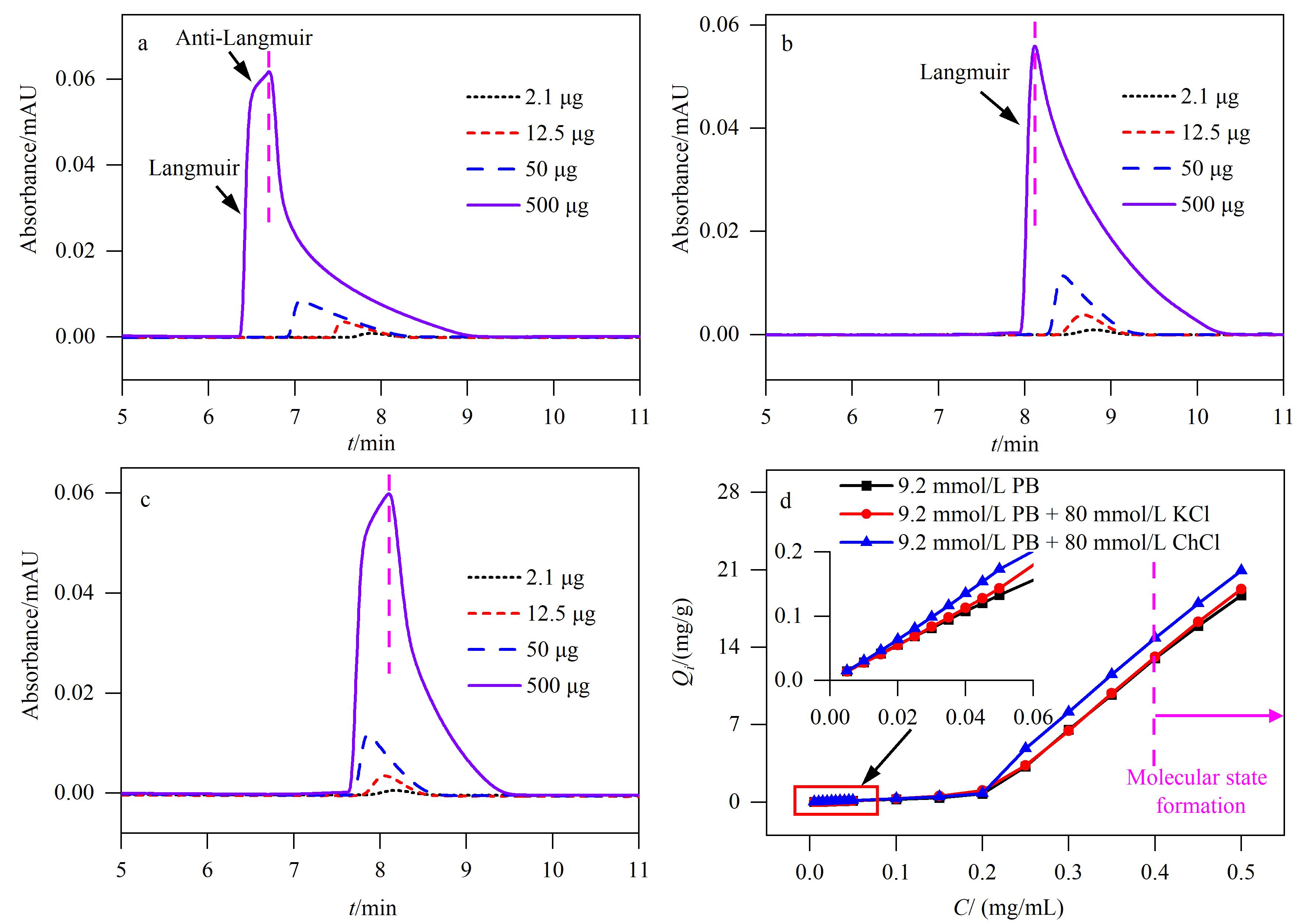
图5 流动相添加剂对苯甲酸在分析柱上的过载行为影响
Fig. 5 Effect of additives in the mobile phase on the overloading behavior of benzoic acid on the analytical columnMobile phases: a. ACN-9.2 mmol/L PB (pH 6.5) (5∶95); b. ACN-9.2 mmol/L PB (pH 6.5, cChCl=80 mmol/L) (5∶95); c. ACN-9.2 mmol/L PB (pH 6.5, cKCl=80 mmol/L) (5∶95); d. adsorption isotherms of benzoic acid under the corresponding conditions of Figs. 5a, 5b and 5c.
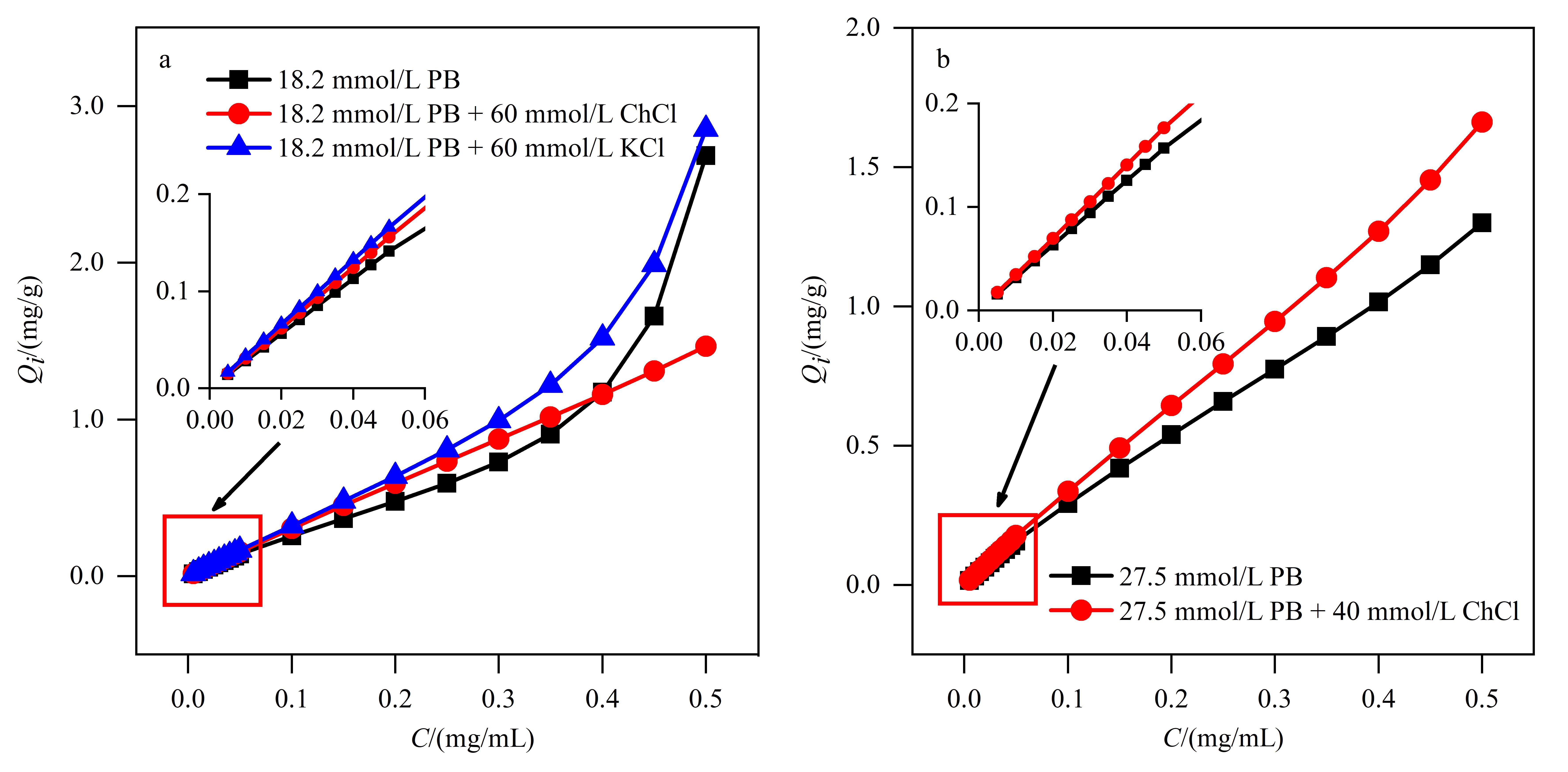
图6 不同色谱条件下氯化胆碱对苯甲酸在分析柱上吸附行为的影响
Fig. 6 Adsorption isotherms of benzoic acid on the analytical column under different chromatographic conditions with choline chlorideMobile phases: a. ACN-18.2 mmol/L PB (pH 6.5, cChCl or cKCl were marked in the Fig. 6a) (5∶95); b. ACN-27.5 mmol/L PB (pH 6.5, cChCl was marked in the Fig. 6b).
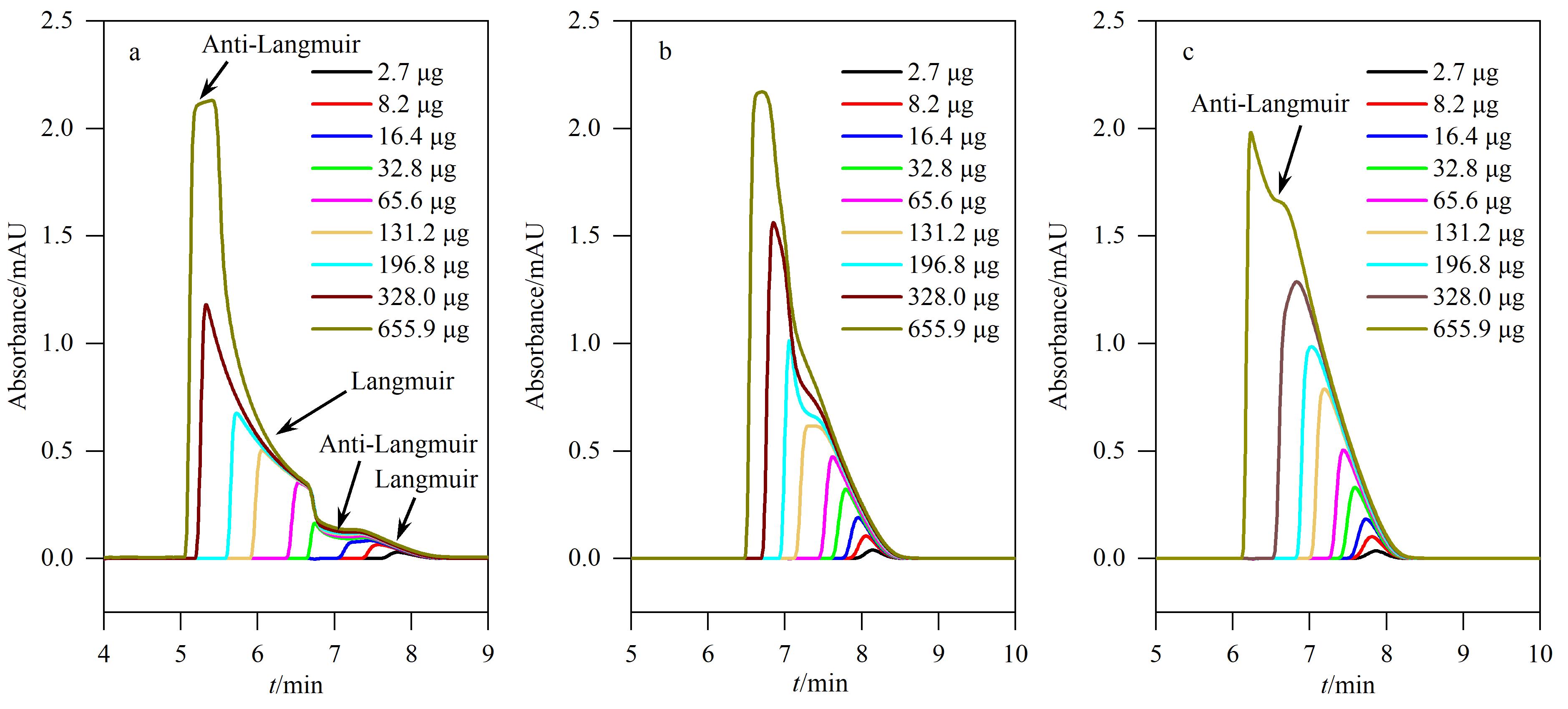
图7 不同流动相条件下苯甲酸钾在分析柱上的过载效果图
Fig. 7 Overload profiles of potassium benzoate on the analytical column under different mobile phase conditionsMobile phases: a. ACN-8.1 mmol/L PB (pH 7.0) (5∶95); b. ACN-8.1 mmol/L PB (pH 7.0, cKCl=80 mmol/L) (5∶95); c. ACN-8.1 mmol/L PB (pH 7.0, cChCl=80 mmol/L) (5∶95).
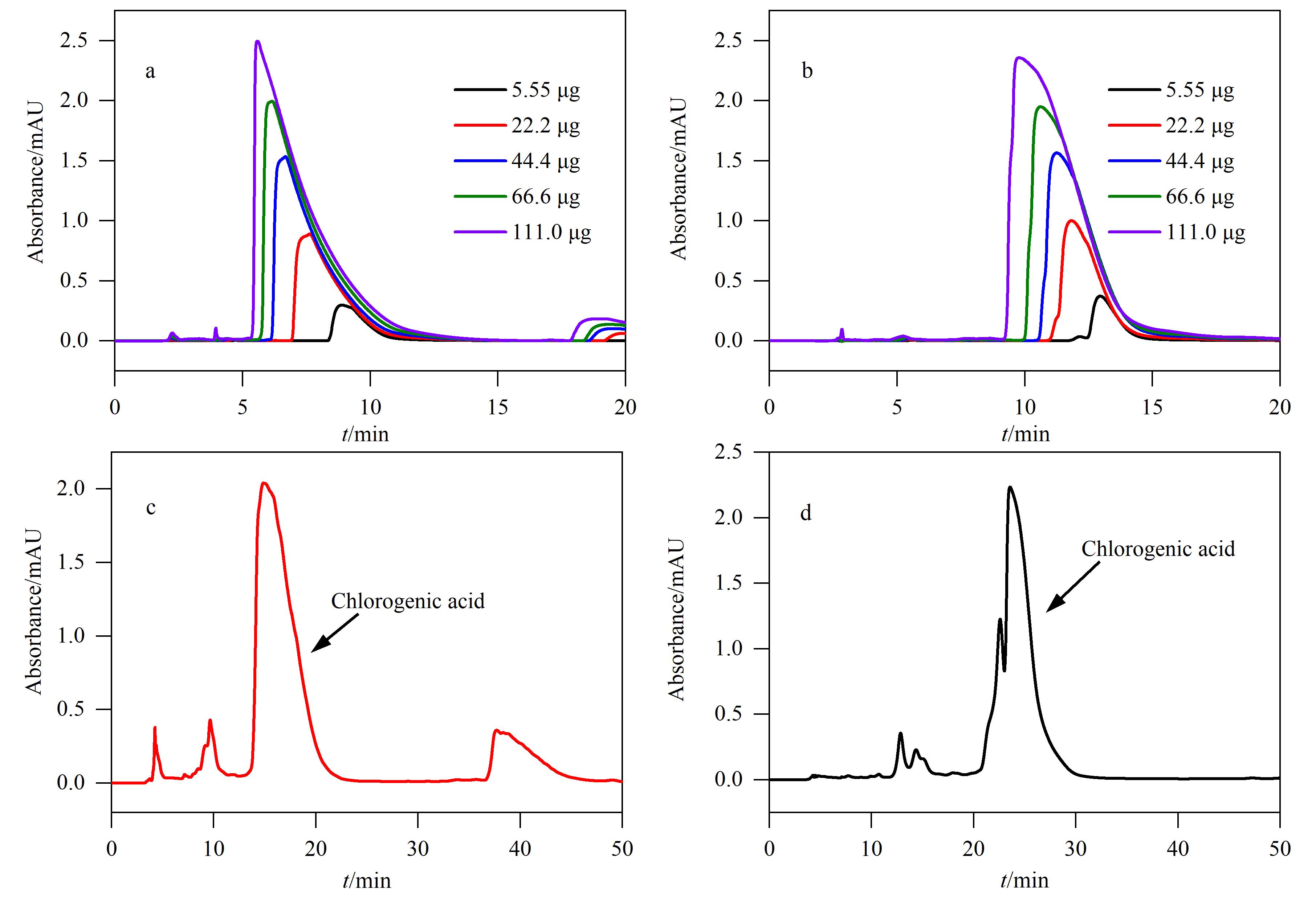
图8 绿原酸钾在(a)未经改性和(b)经ChCl改性分析柱上的过载行为;(c)未经ChCl改性(d)经改性的半制备柱纯化金银花提取物
Fig. 8 Overloading behavior of potassium chlorogenate on the (a) unmodified and (b) ChCl-modified analytical columns; the purification of Lonicera japonica extracts on the (c) unmodified and (d) ChCl-modified semi-preparative columnsMobile phases: a, c. ACN-9.2 mmol/L PB (pH 6.5) (5∶95); b, d. ACN-9.2 mmol/L PB (pH 6.5, cChCl=80 mmol/L)(5∶95).
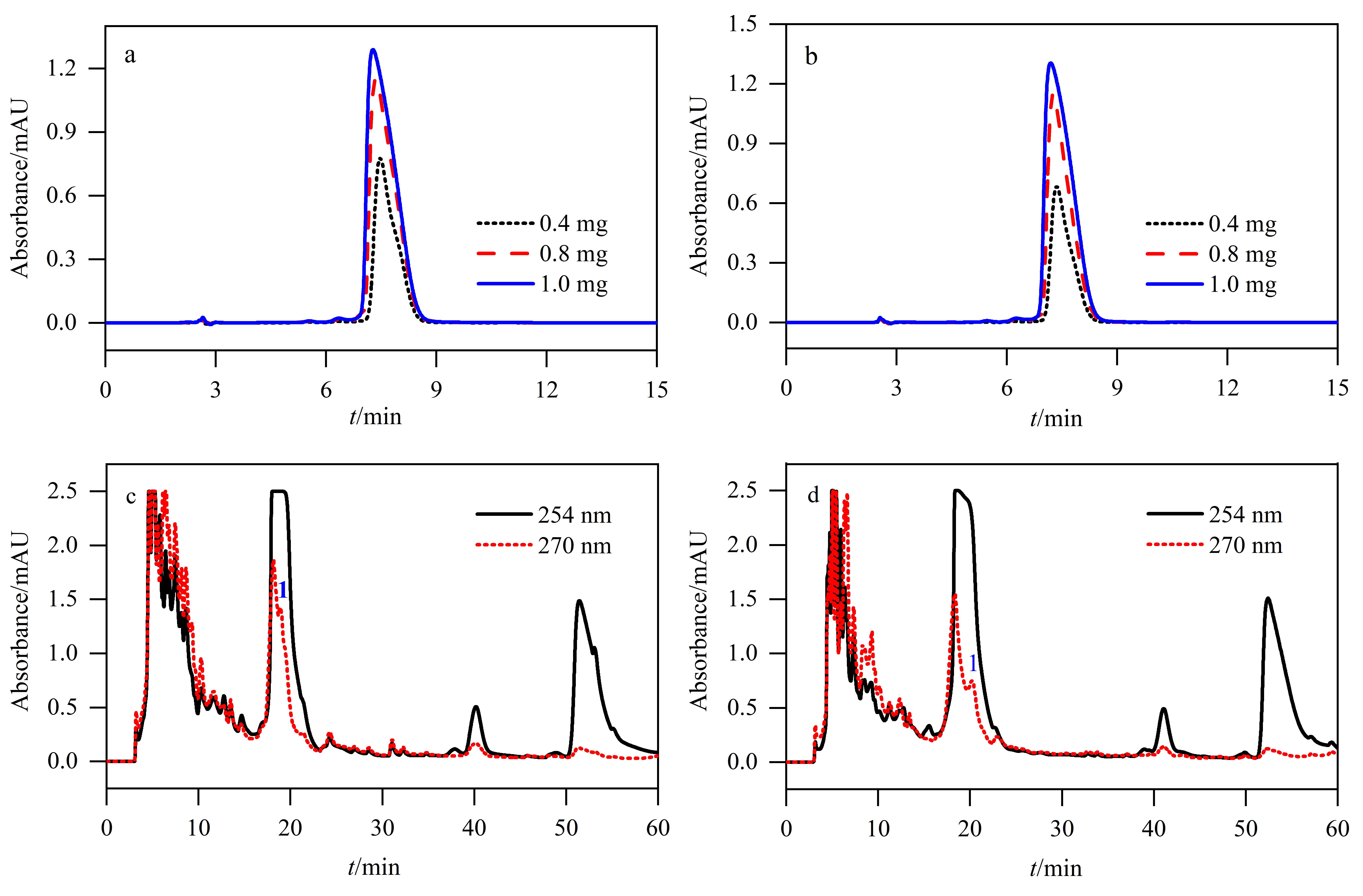
图9 莫诺苷在(a)未经、(b)经ChCl改性的分析柱上的过载行为;山茱萸提取物在(c)未经、(d)经ChCl改性的半制备柱上的纯化
Fig. 9 Overloading behavior of morroniside on the (a) unmodified and (b) ChCl-modified analytical columns; the purification of Cornus officinalis extracts on the (c) unmodified and (d) ChCl-modified semi-preparative columnsMobile phases: a, c: methanol-9.2 mmol/L PB (pH 6.5) (25∶75); b, d: methanol-9.2 mmol/L PB (pH 6.5, cChCl=80 mmol/L) (25∶75).Peak: 1. morroniside.
|
| [1] | 曲清莉, 王小芳, 邸多隆, 裴栋. 生物亲和垂钓技术在天然产物活性成分发现中的研究进展[J]. 色谱, 2026, 44(8): 900-910. |
| [2] | 徐锐洺, 吴友谊, 顾智灏, 魏唯, 陆星宇, 夏紫菡. 基于低共熔溶剂和改进针式滤头的液膜微萃取结合高效液相色谱法测定牛奶中磺胺与氟喹诺酮残留[J]. 色谱, 2026, 44(4): 422-431. |
| [3] | 宋春颖, 金高娃, 俞东萍, 夏东海, 丰静, 郭志谋, 梁鑫淼. 超临界流体色谱固定相的发展及在天然产物中的应用[J]. 色谱, 2023, 41(10): 866-878. |
| [4] | 蒋文倩, 陈宇媚, 毕文韬. 基于低共熔溶剂的多孔有机框架材料合成及其在固相萃取中的应用[J]. 色谱, 2023, 41(10): 901-910. |
| [5] | 赵泽馨, 纪颖鹤, 刘晓妹, 赵龙山. 基于低共熔溶剂的萃取分离技术及其应用研究进展[J]. 色谱, 2021, 39(2): 152-161. |
| [6] | 张琪. 毛细管电泳新型手性分离体系研究进展[J]. 色谱, 2020, 38(9): 1028-1037. |
| [7] | 王双双, 杨云鹤, 凡珊珊, 李卉卉, DavidD. Y. CHEN. 毛细管电泳结合电喷雾质谱分析人类癌基因c-myb四链体核酸与活性天然产物的相互作用[J]. 色谱, 2020, 38(9): 1069-1077. |
| [8] | 李凤, 张艳梅, 康经武. 基于毛细管电泳的天然产物中酶抑制剂筛选研究进展[J]. 色谱, 2020, 38(5): 502-515. |
| [9] | 薛雅茹, 郭睿, 张博. 马鲛鱼抗氧化肽的纳流液相色谱法分离与筛选[J]. 色谱, 2020, 38(12): 1431-1439. |
| [10] | 吴智超, 吴恩国, 杨仲毅, 陶宇翔, 陈潭, 钟永军. 高效液相色谱法测定生物转化反应液中N,N'-乙二胺二琥珀酸[J]. 色谱, 2019, 37(10): 1118-1123. |
| [11] | 陈娜, 张毅军, 赵万里, 陈军, 张裕平. 基于低共熔溶剂的整体式萃取头的制备及其对湖水中3种多环芳烃的固相微萃取(英文)[J]. 色谱, 2018, 36(1): 5-11. |
| [12] | 谭婷, 乔鑫, 万益群, 邱洪灯. 低共熔溶剂——新型亲水作用色谱流动相改性剂[J]. 色谱, 2015, 33(9): 934-937. |
| [13] | 李桂珍, 唐为扬, 曹伟敏, 王倩, 朱涛. 印迹分子聚合物结合低共熔溶剂用于山楂中咖啡酸的固相萃取[J]. 色谱, 2015, 33(8): 792-798. |
| [14] | 邹春苗, 张小东, 于泓, 关超, 王淼煜. 整体柱和填充柱离子对色谱-间接紫外检测法分析四乙基铵根离子[J]. 色谱, 2015, 33(7): 759-764. |
| [15] | 王淼煜, 于泓, 李萍, 李杰, 高玉凤. 离子对色谱-间接紫外检测法分析哌啶离子液体阳离子[J]. 色谱, 2014, 32(7): 773-778. |
| 阅读次数 | ||||||
|
全文 |
|
|||||
|
摘要 |
|
|||||
