
Chinese Journal of Chromatography ›› 2026, Vol. 44 ›› Issue (8): 946-959.DOI: 10.3724/SP.J.1123.2026.04013
• Articles • Previous Articles Next Articles
ZHANG Hui, WU Huimin, HE Qun, QIN Tianxue, GUO Suying, LI Wenjing, JIANG Rong, SUN Guangying( )
)
Received:2026-04-12
Online:2026-08-08
Published:2026-07-30
Supported by:CLC Number:
ZHANG Hui, WU Huimin, HE Qun, QIN Tianxue, GUO Suying, LI Wenjing, JIANG Rong, SUN Guangying. Deep eutectic solvents modified reversed-phase liquid chromatography for the separation of natural products[J]. Chinese Journal of Chromatography, 2026, 44(8): 946-959.
Add to citation manager EndNote|Ris|BibTeX
URL: https://www.chrom-china.com/EN/10.3724/SP.J.1123.2026.04013
| DES | Hydrogen bond acceptor (HBA) | Hydrogen bond donor (HBD) | Molar ratio of HBA to HBD | Preparation amounts/g |
|---|---|---|---|---|
| DES-A | choline chloride (ChCl) | urea | 1∶2 | 11.17+9.60 |
| DES-B | tetramethylammonium chloride | ethylene glycol | 1∶3 | 8.77+14.90 |
| DES-C | ChCl | citric acid | 1∶1 | 11.17+15.37 |
| DES-D | ChCl | glycerol | 1∶2 | 11.17+14.73 |
| DES-E | tetraethylammonium chloride | ethylene glycol | 1∶3 | 13.26+14.90 |
Table 1 Compositions of five deep eutectic solvents (DESs)
| DES | Hydrogen bond acceptor (HBA) | Hydrogen bond donor (HBD) | Molar ratio of HBA to HBD | Preparation amounts/g |
|---|---|---|---|---|
| DES-A | choline chloride (ChCl) | urea | 1∶2 | 11.17+9.60 |
| DES-B | tetramethylammonium chloride | ethylene glycol | 1∶3 | 8.77+14.90 |
| DES-C | ChCl | citric acid | 1∶1 | 11.17+15.37 |
| DES-D | ChCl | glycerol | 1∶2 | 11.17+14.73 |
| DES-E | tetraethylammonium chloride | ethylene glycol | 1∶3 | 13.26+14.90 |
| No. | Compound | Contents/(mg/mL) | Injection volumes/μL | Solvent for working solution | Mobile phase composition | Detection wavelength/nm |
|---|---|---|---|---|---|---|
| Determination of the effect of DESs on the retention factors of nortriptyline HCl and benzoic acid on the analytical column | ||||||
| 1 | nortriptyline HCl | 0.1 | 5 | H2O | ACN-13.8 mmol/L phosphate buffer (PB, pH 2.5, CDES-A=20.78 mg/mL) (40∶60. All such ratios are volume ratios, and the same applies hereafter.) | 230 |
| 2 | nortriptyline HCl | 0.1 | 5 | H2O | ACN-13.8 mmol/L PB (pH 2.5, CDES-B=23.66 mg/mL) (40∶60) | 230 |
| 3 | nortriptyline HCl | 0.1 | 5 | H2O | ACN-13.8 mmol/L PB (pH 2.5, CDES-C=26.54 mg/mL) (40∶60) | 230 |
| 4 | nortriptyline HCl | 0.1 | 5 | H2O | ACN-13.8 mmol/L PB (pH 2.5, CDES-D=25.90 mg/mL) (40∶60) | 230 |
| 5 | nortriptyline HCl | 0.1 | 5 | H2O | ACN-13.8 mmol/L PB (pH 2.5, CDES-E=28.15 mg/mL) (40∶60) | 230 |
| 6 | nortriptyline HCl | 0.1 | 5 | H2O | ACN-13.8 mmol/L PB (pH 2.5, CChCl=11.17 mg/mL) (40∶60) | 230 |
| 7 | benzoic acid | 0.042 | 50 | methanol-H2O (50∶50) | ACN-9.2 mmol/L PB (pH 6.5, CDES-A=20.78 mg/mL) (5∶95) | 230 |
| 8 | benzoic acid | 0.042 | 50 | methanol-H2O (50∶50) | ACN-9.2 mmol/L PB (pH 6.5, CDES-B=23.66 mg/mL) (5∶95) | 230 |
| 9 | benzoic acid | 0.042 | 50 | methanol-H2O (50∶50) | ACN-9.2 mmol/L PB (pH 6.5, CDES-C=26.54 mg/mL) (5∶95) | 230 |
| 10 | benzoic acid | 0.042 | 50 | methanol-H2O (50∶50) | ACN-9.2 mmol/L PB (pH 6.5, CDES-D=25.90 mg/mL) (5∶95) | 230 |
| 11 | benzoic acid | 0.042 | 50 | methanol-H2O (50∶50) | ACN-9.2 mmol/L PB (pH 6.5, CDES-E=28.15 mg/mL) (5∶95) | 230 |
| 12 | benzoic acid | 0.042 | 50 | methanol-H2O (50∶50) | ACN-9.2 mmol/L PB (pH 6.5, CChCl=11.17 mg/mL) (5∶95) | 230 |
| Investigation of the effect of ChCl on the retention factor of nortriptyline HCl at different pH | ||||||
| 13 | nortriptyline HCl | 0.1 | 5 | H2O | ACN-25.4 mmol/L PB (pH 2.5) (40∶60) | 230 |
| 14 | nortriptyline HCl | 0.1 | 5 | H2O | ACN-25.4 mmol/L PB (pH 2.5, cChCl=60 mmol/L) (40∶60) | 230 |
| 15 | nortriptyline HCl | 0.1 | 5 | H2O | ACN-20.3 mmol/L PB (pH 4.2) (40∶60) | 230 |
| 16 | nortriptyline HCl | 0.1 | 5 | H2O | ACN-20.3 mmol/L PB (pH 4.2, cChCl=60 mmol/L) (40∶60) | 230 |
| 17 | nortriptyline HCl | 0.1 | 5 | H2O | ACN-20.0 mmol/L PB (pH 5.5) (40∶60) | 230 |
| 18 | nortriptyline HCl | 0.1 | 5 | H2O | ACN-20.0 mmol/L PB (pH 5.5, cChCl=60 mmol/L) (40∶60) | 230 |
| 19 | nortriptyline HCl | 0.1 | 5 | H2O | ACN-18.2 mmol/L PB (pH 6.5) (40∶60) | 230 |
| 20 | nortriptyline HCl | 0.1 | 5 | H2O | ACN-18.2 mmol/L PB (pH 6.5, cChCl=60 mmol/L) (40∶60) | 230 |
| Investigation of the effect of ChCl or KCl concentration on the overloading behavior of nortriptyline HCl on analytical column | ||||||
| 21 | nortriptyline HCl | 1 | 100 | H2O | ACN-13.8 mmol/L PB (pH 2.5, cChCl=0-80 mmol/L) (40∶60) | 290 |
| 22 | nortriptyline HCl | 1 | 100 | H2O | ACN-13.8 mmol/L PB (pH 2.5, cKCl=0-80 mmol/L) (40∶60) | 290 |
| Investigation of the effect of DES-A, DES-C, and DES-D on the overloading behavior of nortriptyline HCl on analytical column | ||||||
| 23 | nortriptyline HCl | 1 | 100 | H2O | ACN-13.8 mmol/L PB (pH 2.5, CDES-A=20.78 mg/mL) (40∶60) | 290 |
| 24 | nortriptyline HCl | 1 | 100 | H2O | ACN-13.8 mmol/L PB (pH 2.5, CDES-C=26.54 mg/mL) (40∶60) | 290 |
| 25 | nortriptyline HCl | 1 | 100 | H2O | ACN-13.8 mmol/L PB (pH 2.5, CDES-D=25.90 mg/mL) (40∶60) | 290 |
| Investigation of the effect of ChCl on the chromatographic behavior of berberine HCl on analytical column | ||||||
| 26 | berberine HCl | 1 | 5, 20, 40, 60, 100 | H2O | ACN-13.8 mmol/L PB (pH 2.5) (35∶65) | 290 |
| 27 | berberine HCl | 1 | 5, 20, 40, 60, 100 | H2O | ACN-13.8 mmol/L PB (pH 2.5, cChCl=80 mmol/L) (35∶65) | 290 |
| 28 | berberine HCl | 1 | 5, 20, 40, 60, 100 | H2O | ACN-9.2 mmol/L PB (pH 6.5) (35∶65) | 290 |
| Investigation of the effect of ChCl addition on the overloading behavior of benzoic acid on analytical column under different pH | ||||||
| 29 | benzoic acid | 5 | 50 | methanol-H2O (50∶50) | ACN-40.0 mmol/L H3PO4 (pH 2.0) (34∶66) | 275 |
| 30 | benzoic acid | 5 | 50 | methanol-H2O (50∶50) | ACN-40.0 mmol/L H3PO4 (pH 2.0, cChCl=60 mmol/L ) (34∶66) | 275 |
| 31 | benzoic acid | 5 | 50 | methanol-H2O (50∶50) | ACN-20.3 mmol/L PB (pH 4.2) (29∶71) | 275 |
| 32 | benzoic acid | 5 | 50 | methanol-H2O (50∶50) | ACN-20.3 mmol/L PB (pH 4.2, cChCl=60 mmol/L) (29∶71) | 275 |
| 33 | benzoic acid | 5 | 50 | methanol-H2O (50∶50) | ACN-20.0 mmol/L PB (pH 5.5) (11.5∶88.5) | 275 |
| 34 | benzoic acid | 5 | 50 | methanol-H2O (50∶50) | ACN-20.0 mmol/L PB (pH 5.5, cChCl=60 mmol/L) (11.5∶88.5) | 275 |
| 35 | benzoic acid | 5 | 50 | methanol-H2O (50∶50) | ACN-18.2 mmol/L PB (pH 6.5) (5∶95) | 275 |
| 36 | benzoic acid | 5 | 50 | methanol-H2O (50∶50) | ACN-18.2 mmol/L PB (pH 6.5, cChCl=60 mmol/L) (5∶95) | 275 |
| Investigation of the effect of ChCl or KCl on the overloading behavior of benzoic acid on analytical column | ||||||
| 37 | benzoic acid | 0.042, 0.25, 1, 10 | 50 | methanol-H2O (50∶50) | ACN- 9.2 mmol/L PB (pH 6.5) (5∶95) | 290 |
| 38 | benzoic acid | 0.042, 0.25, 1, 10 | 50 | methanol-H2O (50∶50) | ACN- 9.2 mmol/L PB (pH 6.5, cChCl=80 mmol/L) (5∶95) | 290 |
| 39 | benzoic acid | 0.042, 0.25, 1, 10 | 50 | methanol-H2O (50∶50) | ACN- 9.2 mmol/L PB (pH 6.5, cKCl=80 mmol/L) (5∶95) | 290 |
| Investigation of the effect of ChCl or KCl on the overloading behavior of potassium benzoate on analytical column | ||||||
| 40 | potassium benzoate | 13.118,6.559,3.936,2.624,1.312,0.656,0.328,0.164,0.054 | 50 | H2O | ACN-8.1 mmol/L PB (pH 7.0) (5∶95) | 270 |
| 41 | potassium benzoate | 13.118,6.559,3.936,2.624,1.312,0.656,0.328,0.164,0.054 | 50 | H2O | ACN-8.1 mmol/L PB (pH 7.0, cKCl=80 mmol/L) (5∶95) | 270 |
| 42 | potassium benzoate | 13.118,6.559,3.936,2.624,1.312,0.656,0.328,0.164,0.054 | 50 | H2O | ACN-8.1 mmol/L PB (pH 7.0, cChCl=80 mmol/L) (5∶95) | 270 |
| Investigation of the effect of ChCl on the overloading behavior of potassium chlorogenate on analytical column | ||||||
| 43 | potassium chlorogenate | 1.11 | 5, 20, 40, 60, 100 | H2O | ACN-9.2 mmol/L PB (pH 6.5) (5∶95) | 370 |
| 44 | potassium chlorogenate | 1.11 | 5, 20, 40, 60, 100 | H2O | ACN-9.2 mmol/L PB (pH 6.5, cChCl=80 mmol/L) (5∶95) | 370 |
| Investigation of the effect of ChCl on the overloading behavior of morroniside on analytical column | ||||||
| 45 | morroniside | 10 | 40, 80, 100 | methanol-9.2 mmol/L PB (pH 6.5) (25∶75) | methanol-9.2 mmol/L PB (pH 6.5) (25∶75) | 270 |
| 46 | morroniside | 10 | 40, 80, 100 | methanol-9.2 mmol/L PB (pH 6.5) (25∶75) | methanol-9.2 mmol/L PB (pH 6.5, cChCl=80 mmol/L) (25∶75) | 270 |
Table 2 Separation conditions for each compound on the analytical C18 column
| No. | Compound | Contents/(mg/mL) | Injection volumes/μL | Solvent for working solution | Mobile phase composition | Detection wavelength/nm |
|---|---|---|---|---|---|---|
| Determination of the effect of DESs on the retention factors of nortriptyline HCl and benzoic acid on the analytical column | ||||||
| 1 | nortriptyline HCl | 0.1 | 5 | H2O | ACN-13.8 mmol/L phosphate buffer (PB, pH 2.5, CDES-A=20.78 mg/mL) (40∶60. All such ratios are volume ratios, and the same applies hereafter.) | 230 |
| 2 | nortriptyline HCl | 0.1 | 5 | H2O | ACN-13.8 mmol/L PB (pH 2.5, CDES-B=23.66 mg/mL) (40∶60) | 230 |
| 3 | nortriptyline HCl | 0.1 | 5 | H2O | ACN-13.8 mmol/L PB (pH 2.5, CDES-C=26.54 mg/mL) (40∶60) | 230 |
| 4 | nortriptyline HCl | 0.1 | 5 | H2O | ACN-13.8 mmol/L PB (pH 2.5, CDES-D=25.90 mg/mL) (40∶60) | 230 |
| 5 | nortriptyline HCl | 0.1 | 5 | H2O | ACN-13.8 mmol/L PB (pH 2.5, CDES-E=28.15 mg/mL) (40∶60) | 230 |
| 6 | nortriptyline HCl | 0.1 | 5 | H2O | ACN-13.8 mmol/L PB (pH 2.5, CChCl=11.17 mg/mL) (40∶60) | 230 |
| 7 | benzoic acid | 0.042 | 50 | methanol-H2O (50∶50) | ACN-9.2 mmol/L PB (pH 6.5, CDES-A=20.78 mg/mL) (5∶95) | 230 |
| 8 | benzoic acid | 0.042 | 50 | methanol-H2O (50∶50) | ACN-9.2 mmol/L PB (pH 6.5, CDES-B=23.66 mg/mL) (5∶95) | 230 |
| 9 | benzoic acid | 0.042 | 50 | methanol-H2O (50∶50) | ACN-9.2 mmol/L PB (pH 6.5, CDES-C=26.54 mg/mL) (5∶95) | 230 |
| 10 | benzoic acid | 0.042 | 50 | methanol-H2O (50∶50) | ACN-9.2 mmol/L PB (pH 6.5, CDES-D=25.90 mg/mL) (5∶95) | 230 |
| 11 | benzoic acid | 0.042 | 50 | methanol-H2O (50∶50) | ACN-9.2 mmol/L PB (pH 6.5, CDES-E=28.15 mg/mL) (5∶95) | 230 |
| 12 | benzoic acid | 0.042 | 50 | methanol-H2O (50∶50) | ACN-9.2 mmol/L PB (pH 6.5, CChCl=11.17 mg/mL) (5∶95) | 230 |
| Investigation of the effect of ChCl on the retention factor of nortriptyline HCl at different pH | ||||||
| 13 | nortriptyline HCl | 0.1 | 5 | H2O | ACN-25.4 mmol/L PB (pH 2.5) (40∶60) | 230 |
| 14 | nortriptyline HCl | 0.1 | 5 | H2O | ACN-25.4 mmol/L PB (pH 2.5, cChCl=60 mmol/L) (40∶60) | 230 |
| 15 | nortriptyline HCl | 0.1 | 5 | H2O | ACN-20.3 mmol/L PB (pH 4.2) (40∶60) | 230 |
| 16 | nortriptyline HCl | 0.1 | 5 | H2O | ACN-20.3 mmol/L PB (pH 4.2, cChCl=60 mmol/L) (40∶60) | 230 |
| 17 | nortriptyline HCl | 0.1 | 5 | H2O | ACN-20.0 mmol/L PB (pH 5.5) (40∶60) | 230 |
| 18 | nortriptyline HCl | 0.1 | 5 | H2O | ACN-20.0 mmol/L PB (pH 5.5, cChCl=60 mmol/L) (40∶60) | 230 |
| 19 | nortriptyline HCl | 0.1 | 5 | H2O | ACN-18.2 mmol/L PB (pH 6.5) (40∶60) | 230 |
| 20 | nortriptyline HCl | 0.1 | 5 | H2O | ACN-18.2 mmol/L PB (pH 6.5, cChCl=60 mmol/L) (40∶60) | 230 |
| Investigation of the effect of ChCl or KCl concentration on the overloading behavior of nortriptyline HCl on analytical column | ||||||
| 21 | nortriptyline HCl | 1 | 100 | H2O | ACN-13.8 mmol/L PB (pH 2.5, cChCl=0-80 mmol/L) (40∶60) | 290 |
| 22 | nortriptyline HCl | 1 | 100 | H2O | ACN-13.8 mmol/L PB (pH 2.5, cKCl=0-80 mmol/L) (40∶60) | 290 |
| Investigation of the effect of DES-A, DES-C, and DES-D on the overloading behavior of nortriptyline HCl on analytical column | ||||||
| 23 | nortriptyline HCl | 1 | 100 | H2O | ACN-13.8 mmol/L PB (pH 2.5, CDES-A=20.78 mg/mL) (40∶60) | 290 |
| 24 | nortriptyline HCl | 1 | 100 | H2O | ACN-13.8 mmol/L PB (pH 2.5, CDES-C=26.54 mg/mL) (40∶60) | 290 |
| 25 | nortriptyline HCl | 1 | 100 | H2O | ACN-13.8 mmol/L PB (pH 2.5, CDES-D=25.90 mg/mL) (40∶60) | 290 |
| Investigation of the effect of ChCl on the chromatographic behavior of berberine HCl on analytical column | ||||||
| 26 | berberine HCl | 1 | 5, 20, 40, 60, 100 | H2O | ACN-13.8 mmol/L PB (pH 2.5) (35∶65) | 290 |
| 27 | berberine HCl | 1 | 5, 20, 40, 60, 100 | H2O | ACN-13.8 mmol/L PB (pH 2.5, cChCl=80 mmol/L) (35∶65) | 290 |
| 28 | berberine HCl | 1 | 5, 20, 40, 60, 100 | H2O | ACN-9.2 mmol/L PB (pH 6.5) (35∶65) | 290 |
| Investigation of the effect of ChCl addition on the overloading behavior of benzoic acid on analytical column under different pH | ||||||
| 29 | benzoic acid | 5 | 50 | methanol-H2O (50∶50) | ACN-40.0 mmol/L H3PO4 (pH 2.0) (34∶66) | 275 |
| 30 | benzoic acid | 5 | 50 | methanol-H2O (50∶50) | ACN-40.0 mmol/L H3PO4 (pH 2.0, cChCl=60 mmol/L ) (34∶66) | 275 |
| 31 | benzoic acid | 5 | 50 | methanol-H2O (50∶50) | ACN-20.3 mmol/L PB (pH 4.2) (29∶71) | 275 |
| 32 | benzoic acid | 5 | 50 | methanol-H2O (50∶50) | ACN-20.3 mmol/L PB (pH 4.2, cChCl=60 mmol/L) (29∶71) | 275 |
| 33 | benzoic acid | 5 | 50 | methanol-H2O (50∶50) | ACN-20.0 mmol/L PB (pH 5.5) (11.5∶88.5) | 275 |
| 34 | benzoic acid | 5 | 50 | methanol-H2O (50∶50) | ACN-20.0 mmol/L PB (pH 5.5, cChCl=60 mmol/L) (11.5∶88.5) | 275 |
| 35 | benzoic acid | 5 | 50 | methanol-H2O (50∶50) | ACN-18.2 mmol/L PB (pH 6.5) (5∶95) | 275 |
| 36 | benzoic acid | 5 | 50 | methanol-H2O (50∶50) | ACN-18.2 mmol/L PB (pH 6.5, cChCl=60 mmol/L) (5∶95) | 275 |
| Investigation of the effect of ChCl or KCl on the overloading behavior of benzoic acid on analytical column | ||||||
| 37 | benzoic acid | 0.042, 0.25, 1, 10 | 50 | methanol-H2O (50∶50) | ACN- 9.2 mmol/L PB (pH 6.5) (5∶95) | 290 |
| 38 | benzoic acid | 0.042, 0.25, 1, 10 | 50 | methanol-H2O (50∶50) | ACN- 9.2 mmol/L PB (pH 6.5, cChCl=80 mmol/L) (5∶95) | 290 |
| 39 | benzoic acid | 0.042, 0.25, 1, 10 | 50 | methanol-H2O (50∶50) | ACN- 9.2 mmol/L PB (pH 6.5, cKCl=80 mmol/L) (5∶95) | 290 |
| Investigation of the effect of ChCl or KCl on the overloading behavior of potassium benzoate on analytical column | ||||||
| 40 | potassium benzoate | 13.118,6.559,3.936,2.624,1.312,0.656,0.328,0.164,0.054 | 50 | H2O | ACN-8.1 mmol/L PB (pH 7.0) (5∶95) | 270 |
| 41 | potassium benzoate | 13.118,6.559,3.936,2.624,1.312,0.656,0.328,0.164,0.054 | 50 | H2O | ACN-8.1 mmol/L PB (pH 7.0, cKCl=80 mmol/L) (5∶95) | 270 |
| 42 | potassium benzoate | 13.118,6.559,3.936,2.624,1.312,0.656,0.328,0.164,0.054 | 50 | H2O | ACN-8.1 mmol/L PB (pH 7.0, cChCl=80 mmol/L) (5∶95) | 270 |
| Investigation of the effect of ChCl on the overloading behavior of potassium chlorogenate on analytical column | ||||||
| 43 | potassium chlorogenate | 1.11 | 5, 20, 40, 60, 100 | H2O | ACN-9.2 mmol/L PB (pH 6.5) (5∶95) | 370 |
| 44 | potassium chlorogenate | 1.11 | 5, 20, 40, 60, 100 | H2O | ACN-9.2 mmol/L PB (pH 6.5, cChCl=80 mmol/L) (5∶95) | 370 |
| Investigation of the effect of ChCl on the overloading behavior of morroniside on analytical column | ||||||
| 45 | morroniside | 10 | 40, 80, 100 | methanol-9.2 mmol/L PB (pH 6.5) (25∶75) | methanol-9.2 mmol/L PB (pH 6.5) (25∶75) | 270 |
| 46 | morroniside | 10 | 40, 80, 100 | methanol-9.2 mmol/L PB (pH 6.5) (25∶75) | methanol-9.2 mmol/L PB (pH 6.5, cChCl=80 mmol/L) (25∶75) | 270 |
| No. | Sample | Content/(mg/mL) | Injection volume/μL | Solvent for working solution | Mobile phase composition | Detection wavelengths/nm |
|---|---|---|---|---|---|---|
| 1 | Coptis chinensisextracts | 100 | 100 | methanol-H2O (50∶50) | ACN-9.2 mmol/L PB (pH 6.5) (35∶65) | 290 |
| 2 | Coptis chinensisextracts | 100 | 100 | methanol-H2O (50∶50) | ACN-9.2 mmol/L PB (pH 6.5, cChCl=80 mmol/L) (35∶65) | 290 |
| 3 | Lonicera Japonica extracts | 100 | 50 | aqueous KOH solution | ACN-9.2 mmol/L PB (pH 6.5) (5∶95) | 350 |
| 4 | Lonicera Japonica extracts | 100 | 50 | aqueous KOH solution | ACN-9.2 mmol/L PB (pH 6.5, cChCl=80 mmol/L) (5∶95) | 350 |
| 5 | Cornus officinalis extracts | 100 | 100 | mobile phase | methanol-9.2 mmol/L PB (pH 6.5) (25∶75) | 254/270 |
| 6 | Cornus officinalis extracts | 100 | 100 | mobile phase | methanol-9.2 mmol/L PB (pH 6.5, cChCl=80 mmol/L) (25∶75) | 254/270 |
Table 3 Separation conditions for various plant extracts on a semi-preparative C18 column
| No. | Sample | Content/(mg/mL) | Injection volume/μL | Solvent for working solution | Mobile phase composition | Detection wavelengths/nm |
|---|---|---|---|---|---|---|
| 1 | Coptis chinensisextracts | 100 | 100 | methanol-H2O (50∶50) | ACN-9.2 mmol/L PB (pH 6.5) (35∶65) | 290 |
| 2 | Coptis chinensisextracts | 100 | 100 | methanol-H2O (50∶50) | ACN-9.2 mmol/L PB (pH 6.5, cChCl=80 mmol/L) (35∶65) | 290 |
| 3 | Lonicera Japonica extracts | 100 | 50 | aqueous KOH solution | ACN-9.2 mmol/L PB (pH 6.5) (5∶95) | 350 |
| 4 | Lonicera Japonica extracts | 100 | 50 | aqueous KOH solution | ACN-9.2 mmol/L PB (pH 6.5, cChCl=80 mmol/L) (5∶95) | 350 |
| 5 | Cornus officinalis extracts | 100 | 100 | mobile phase | methanol-9.2 mmol/L PB (pH 6.5) (25∶75) | 254/270 |
| 6 | Cornus officinalis extracts | 100 | 100 | mobile phase | methanol-9.2 mmol/L PB (pH 6.5, cChCl=80 mmol/L) (25∶75) | 254/270 |
| DES | k | |
|---|---|---|
| Nortriptyline HCl* | Benzoic acid** | |
| DES-A | 3.18 | 3.14 |
| DES-B | 2.96 | 3.03 |
| DES-C | 3.17 | >6.00 |
| DES-D | 3.01 | 3.17 |
| DES-E | 2.33 | 6.05 |
| ChCl | 3.12 | 3.23 |
Table 4 Effects of DESs as additives on retention factors (C18 column) of nortriptyline HCl and benzoic acid
| DES | k | |
|---|---|---|
| Nortriptyline HCl* | Benzoic acid** | |
| DES-A | 3.18 | 3.14 |
| DES-B | 2.96 | 3.03 |
| DES-C | 3.17 | >6.00 |
| DES-D | 3.01 | 3.17 |
| DES-E | 2.33 | 6.05 |
| ChCl | 3.12 | 3.23 |
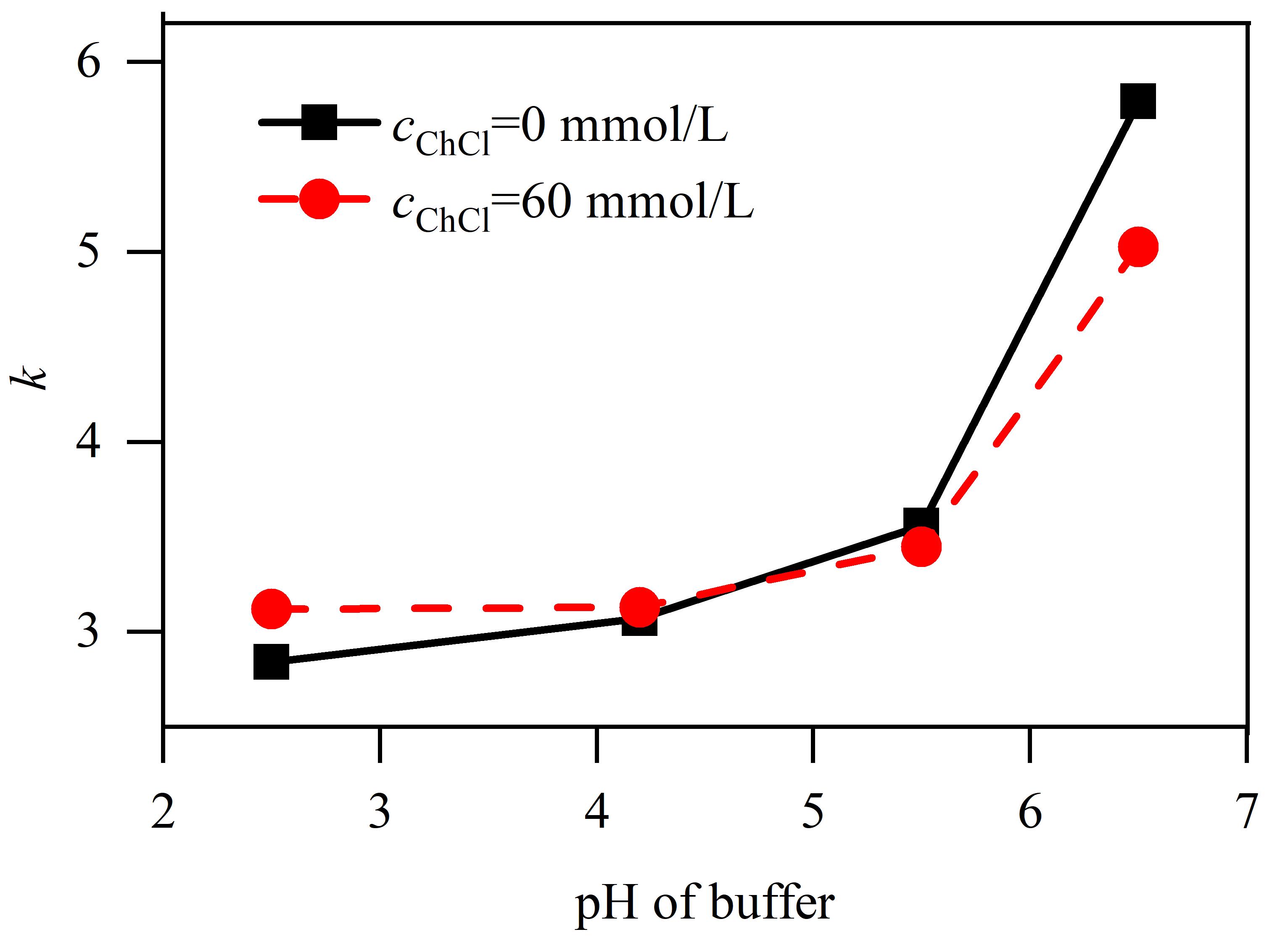
Fig. 1 Effect of the addition of ChCl in the mobile phase on the retention factor of nortriptyline hydrochloride on a C18 column at different pHLoading amount: 0.5 μg; mobile phase: for dark solid line, ACN-PB (40∶60); for red dashed line, ACN-PB with ChCl (cChCl=60 mmol/L) (40∶60).
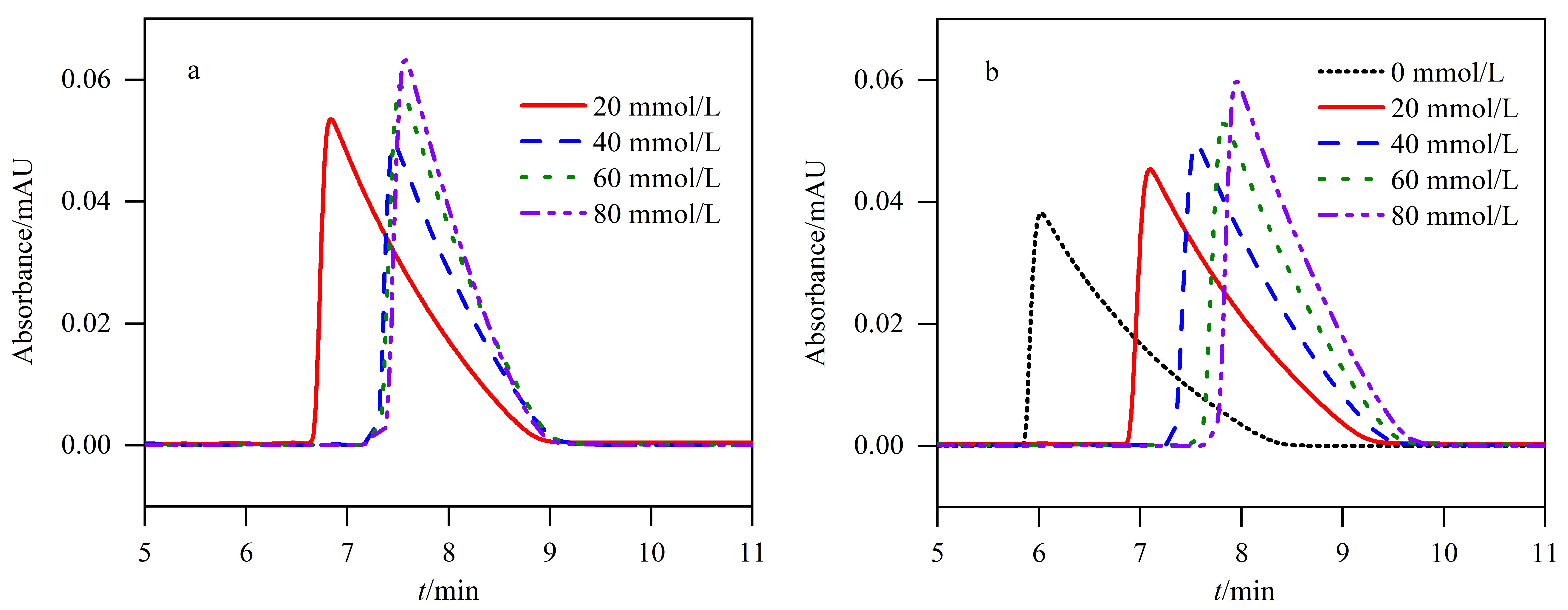
Fig. 2 Effects of concentrations of (a) ChCl and (b) KCl on the overloading behavior of nortriptyline HCl on the analytical columnLoading amount: 0.1 mg; mobile phase: ACN-13.8 mmol/L PB (pH 2.5) (40∶60).
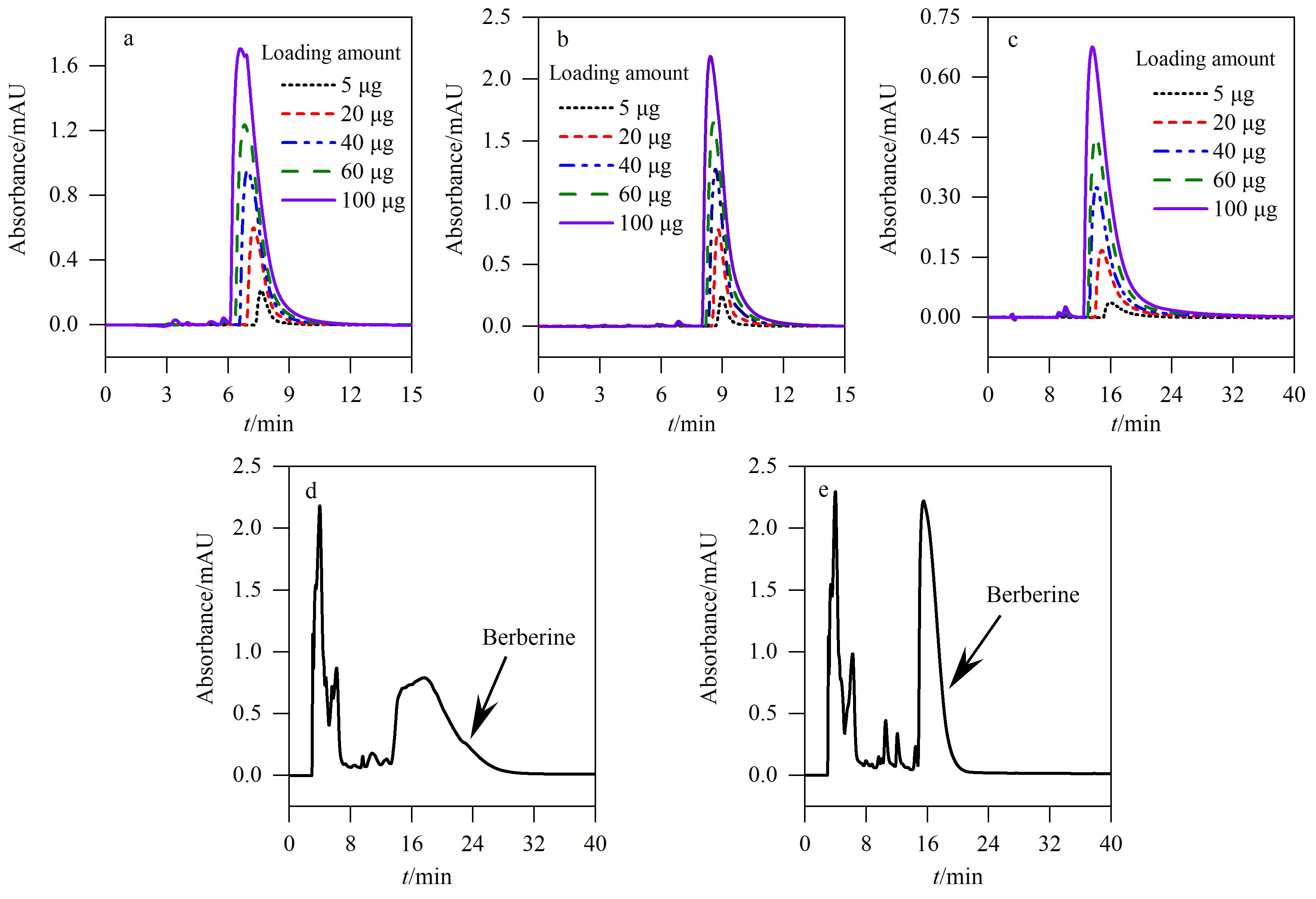
Fig. 3 (a-c) Chromatograms of berberine HCl on the analytical column without and with the addition of ChCl in the mobile phase; Coptis chinensis extracts on the semi-preparative column (d) before and (e) after ChCl was added to the mobile phaseMobile phases: a. ACN-13.8 mmol/L PB (pH 2.5) (35∶65); b. ACN-13.8 mmol/L PB (pH 2.5, cChCl=80 mmol/L) (35∶65); c. ACN-9.2 mmol/L PB (pH 6.5) (35∶65); d. ACN-9.2 mmol/L PB (pH 6.5) (35∶65); e. ACN-9.2 mmol/L PB (pH 6.5, cChCl=80 mmol/L) (35∶65).
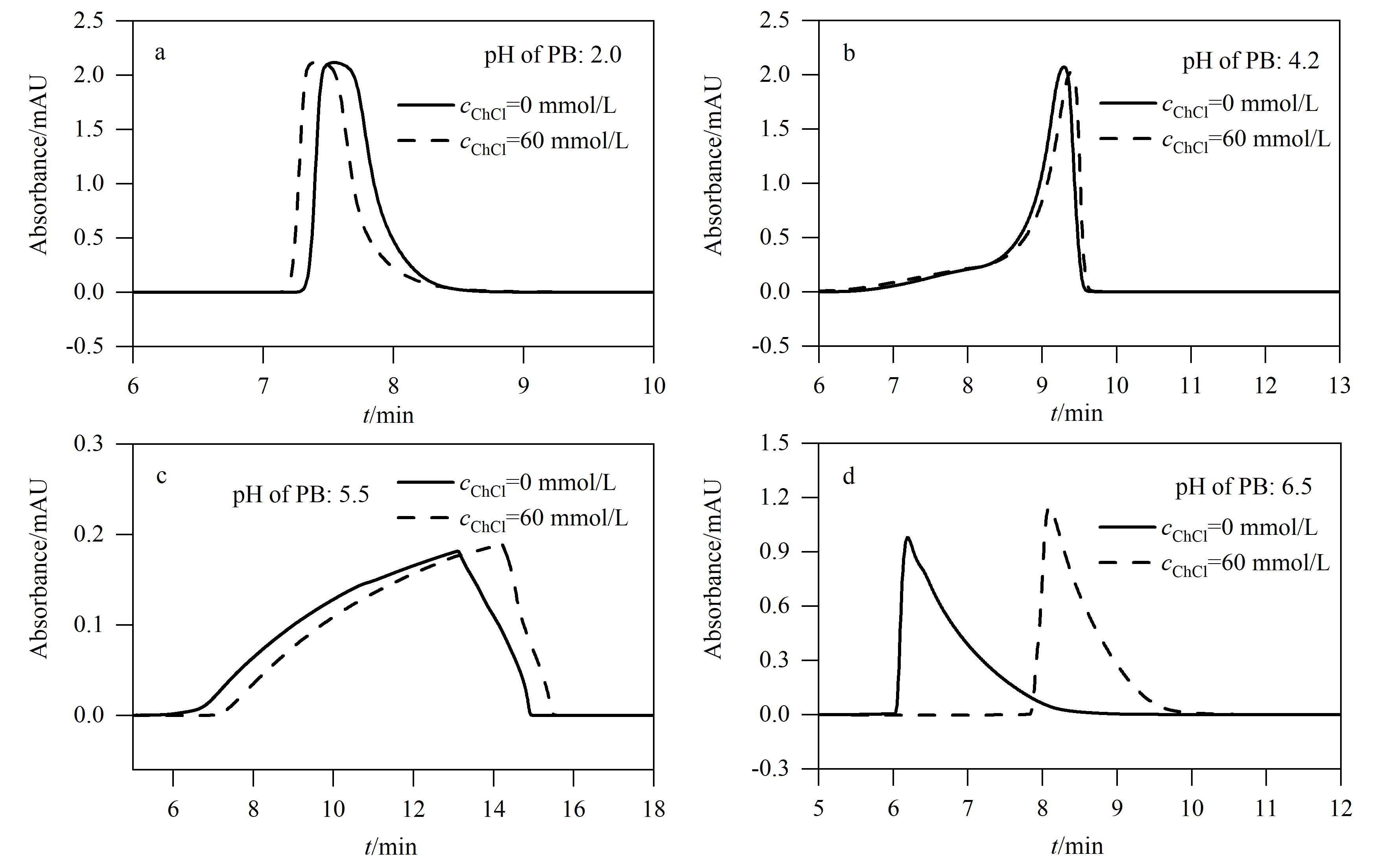
Fig. 4 Effect of ChCl addition in the mobile phase on the overloading behavior of benzoic acid on the analytical column under different pHMobile phases: a. ACN-40.0 mmol/L H3PO4 (34∶66); b. ACN-20.3 mmol/L PB (29∶71); c. ACN-20.0 mmol/L PB (11.5∶88.5); d. ACN-18.2 mmol/L PB (5∶95).
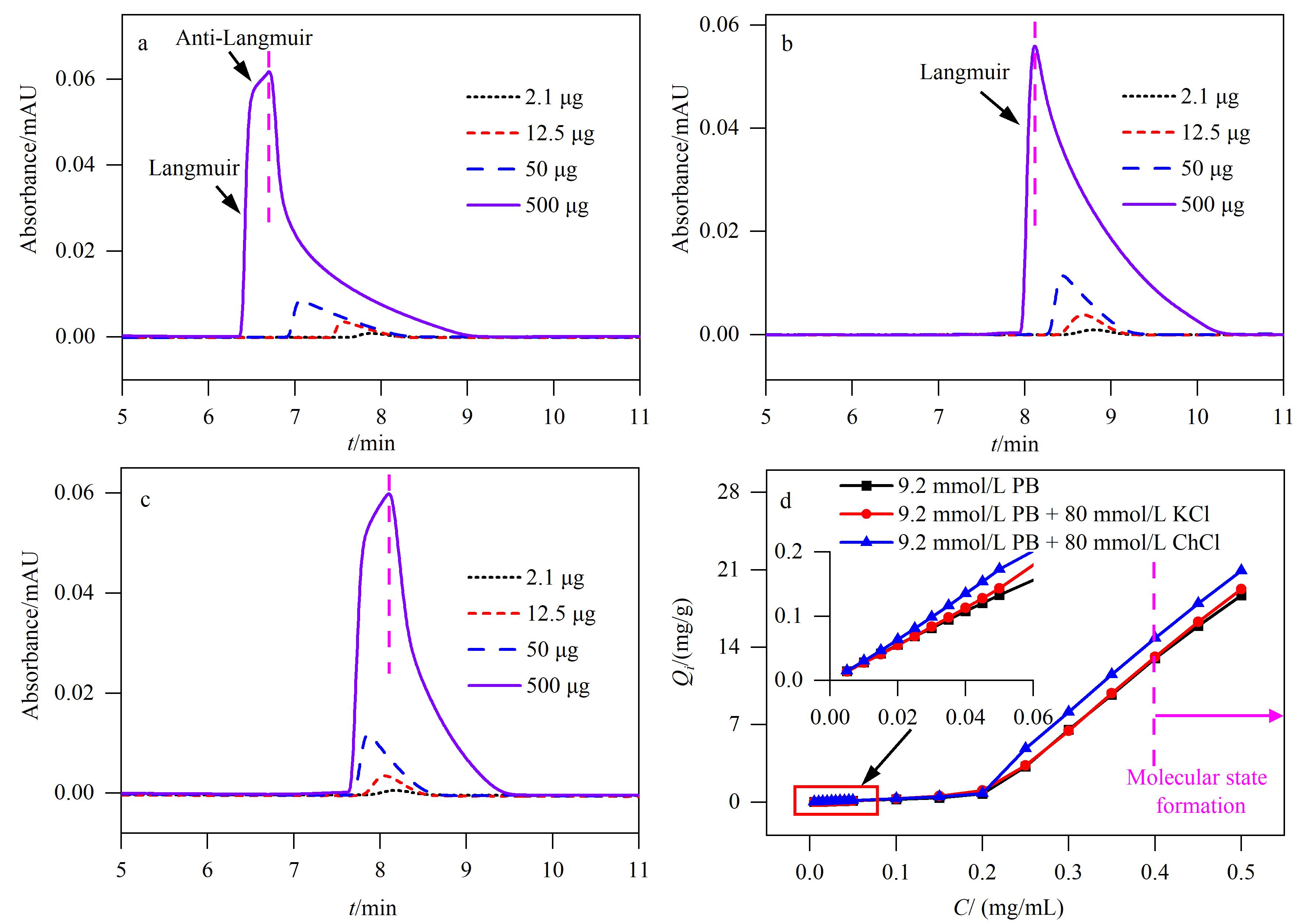
Fig. 5 Effect of additives in the mobile phase on the overloading behavior of benzoic acid on the analytical columnMobile phases: a. ACN-9.2 mmol/L PB (pH 6.5) (5∶95); b. ACN-9.2 mmol/L PB (pH 6.5, cChCl=80 mmol/L) (5∶95); c. ACN-9.2 mmol/L PB (pH 6.5, cKCl=80 mmol/L) (5∶95); d. adsorption isotherms of benzoic acid under the corresponding conditions of Figs. 5a, 5b and 5c.
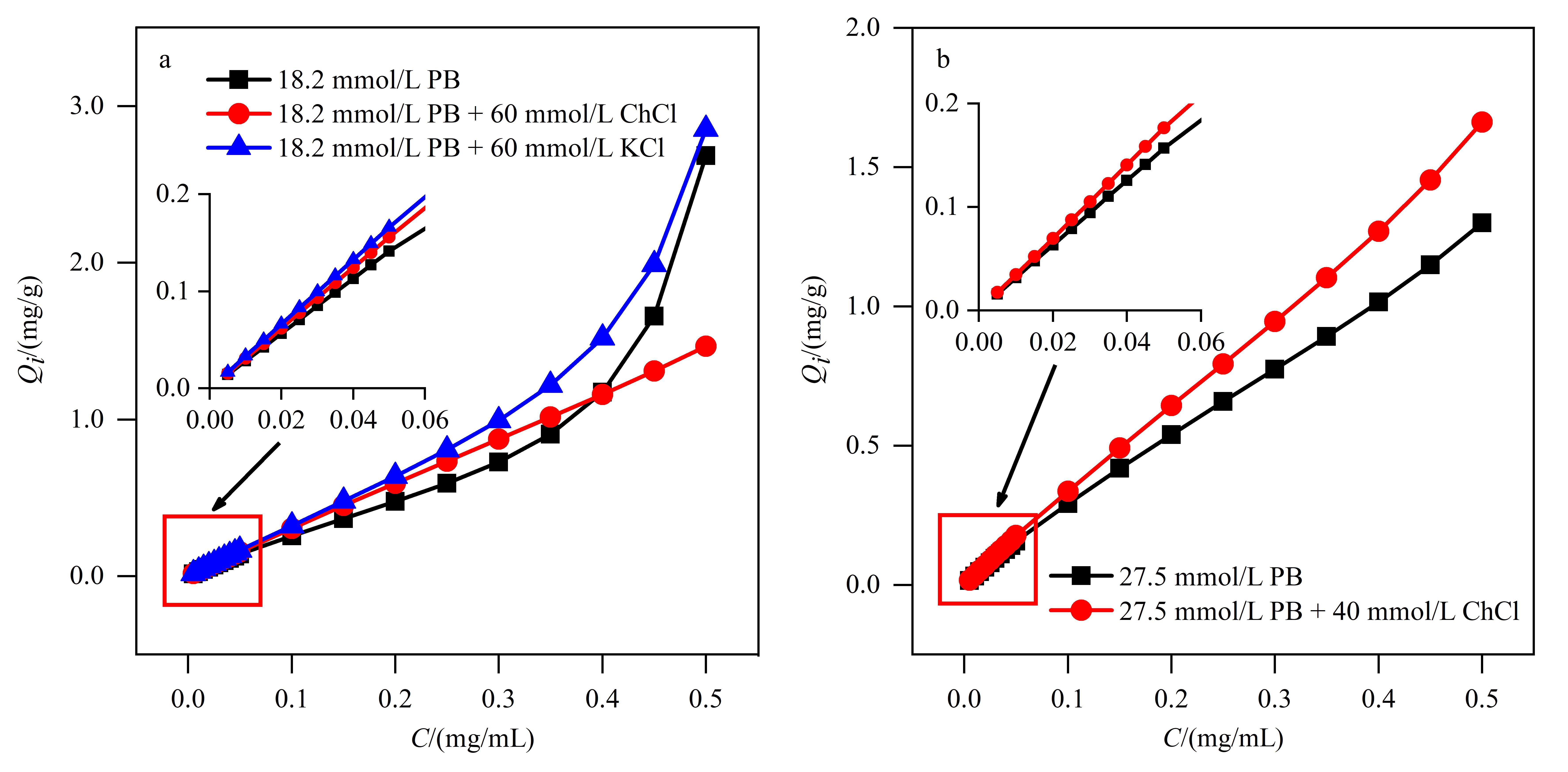
Fig. 6 Adsorption isotherms of benzoic acid on the analytical column under different chromatographic conditions with choline chlorideMobile phases: a. ACN-18.2 mmol/L PB (pH 6.5, cChCl or cKCl were marked in the Fig. 6a) (5∶95); b. ACN-27.5 mmol/L PB (pH 6.5, cChCl was marked in the Fig. 6b).
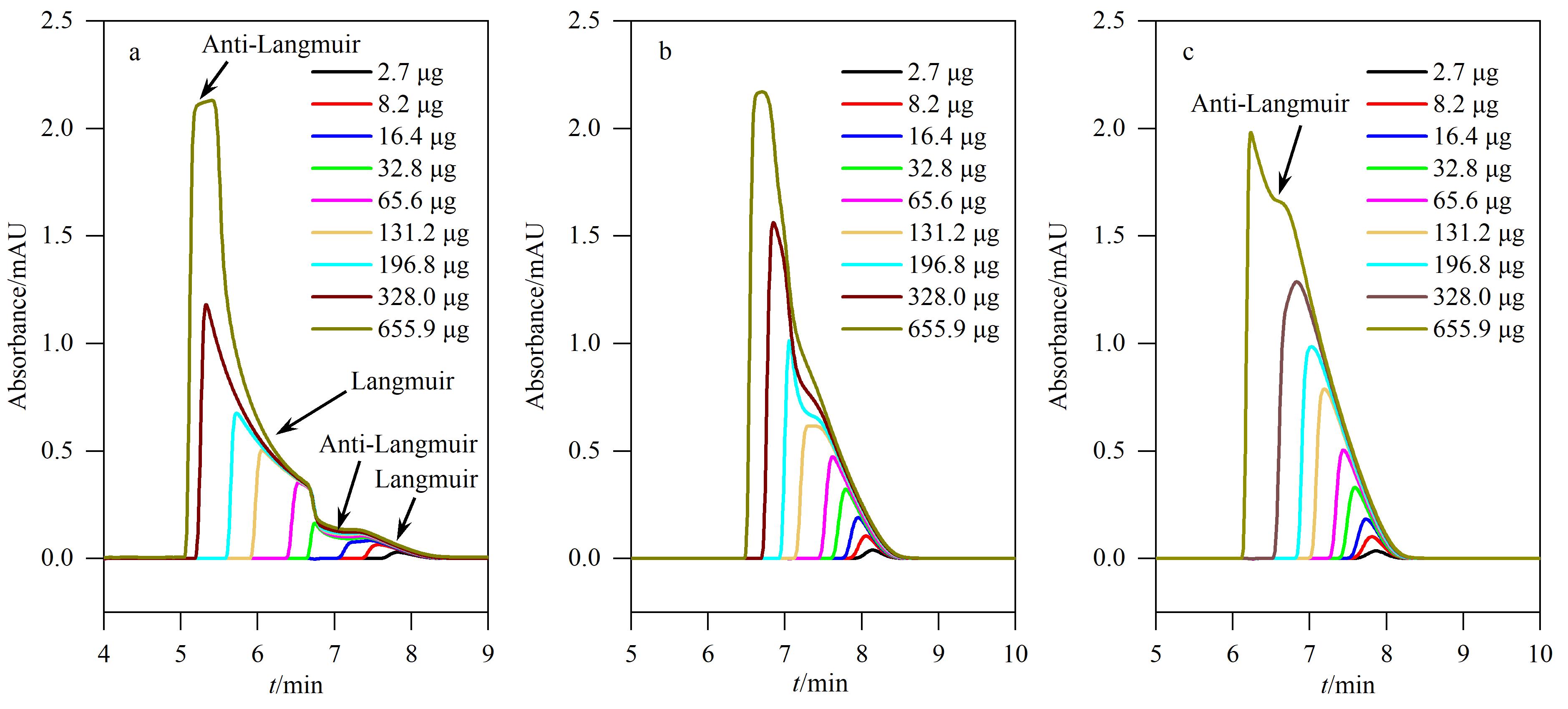
Fig. 7 Overload profiles of potassium benzoate on the analytical column under different mobile phase conditionsMobile phases: a. ACN-8.1 mmol/L PB (pH 7.0) (5∶95); b. ACN-8.1 mmol/L PB (pH 7.0, cKCl=80 mmol/L) (5∶95); c. ACN-8.1 mmol/L PB (pH 7.0, cChCl=80 mmol/L) (5∶95).
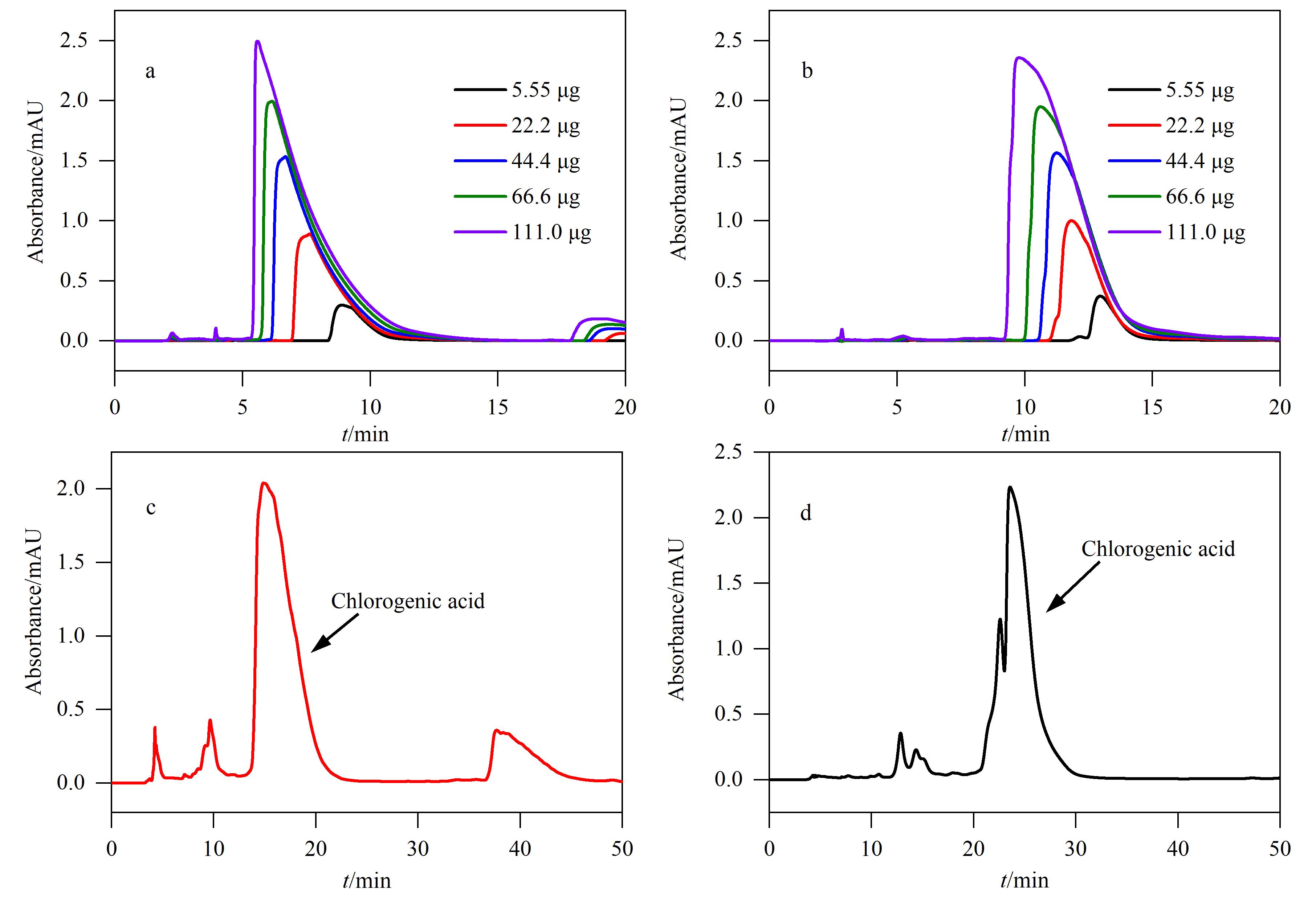
Fig. 8 Overloading behavior of potassium chlorogenate on the (a) unmodified and (b) ChCl-modified analytical columns; the purification of Lonicera japonica extracts on the (c) unmodified and (d) ChCl-modified semi-preparative columnsMobile phases: a, c. ACN-9.2 mmol/L PB (pH 6.5) (5∶95); b, d. ACN-9.2 mmol/L PB (pH 6.5, cChCl=80 mmol/L)(5∶95).
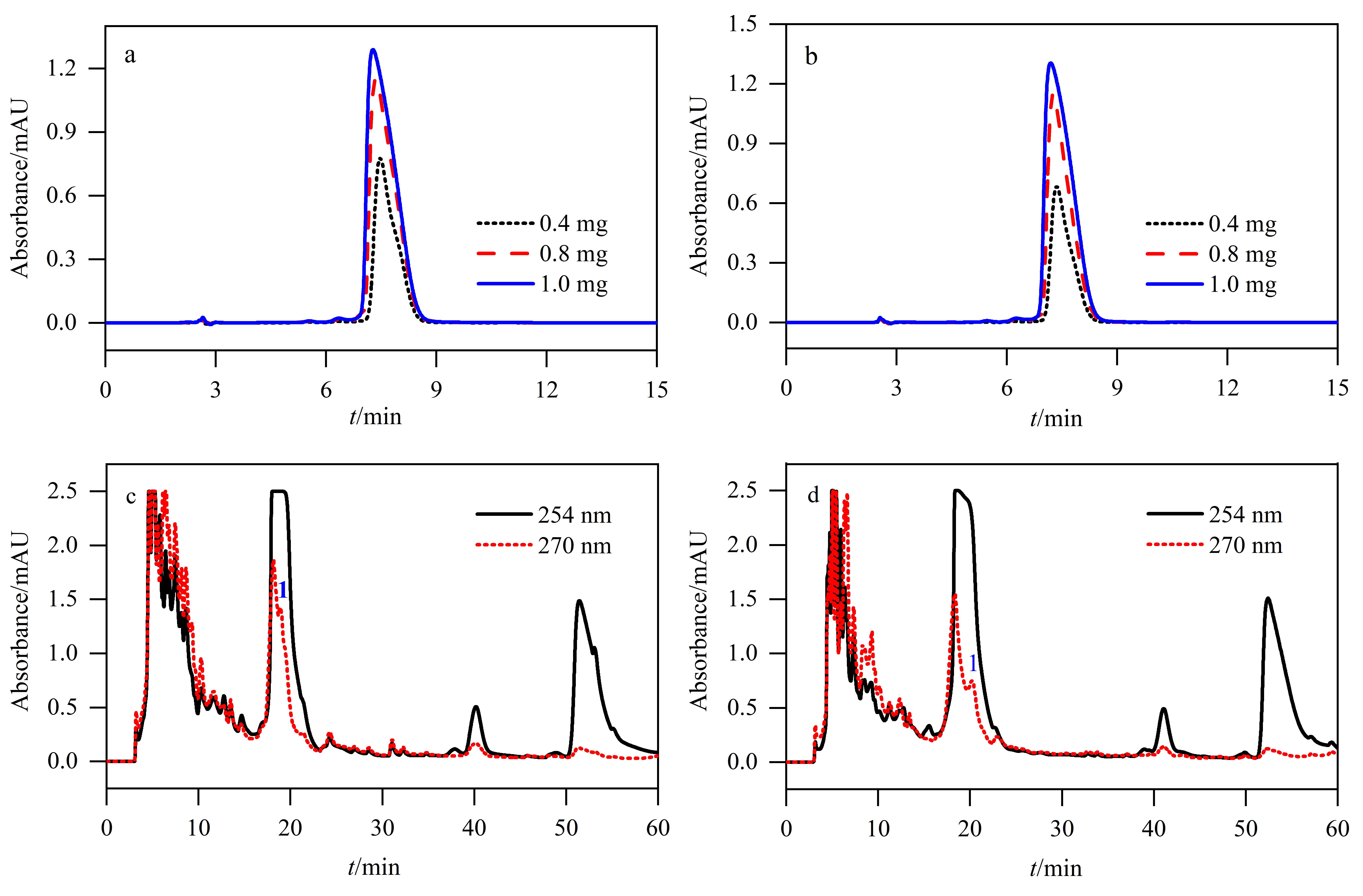
Fig. 9 Overloading behavior of morroniside on the (a) unmodified and (b) ChCl-modified analytical columns; the purification of Cornus officinalis extracts on the (c) unmodified and (d) ChCl-modified semi-preparative columnsMobile phases: a, c: methanol-9.2 mmol/L PB (pH 6.5) (25∶75); b, d: methanol-9.2 mmol/L PB (pH 6.5, cChCl=80 mmol/L) (25∶75).Peak: 1. morroniside.
|
| Viewed | ||||||
|
Full text |
|
|||||
|
Abstract |
|
|||||


