
Chinese Journal of Chromatography ›› 2026, Vol. 44 ›› Issue (8): 864-876.DOI: 10.3724/SP.J.1123.2025.08025
• Reviews • Previous Articles Next Articles
FENG Jing1,2, XIA Donghai1,2, SONG Chunying1, QI Yi1, JIN Gaowa1, LIU Yanfang1,3, LIANG Xinmiao1,3, YU Dongping1,3,*( ), GUO Zhimou1,*()
Received:2025-08-31
Online:2026-08-08
Published:2026-07-30
Supported by:CLC Number:
FENG Jing, XIA Donghai, SONG Chunying, QI Yi, JIN Gaowa, LIU Yanfang, LIANG Xinmiao, YU Dongping, GUO Zhimou. Development of high-performance chromatographic materials and their application in herbalome research since 2020[J]. Chinese Journal of Chromatography, 2026, 44(8): 864-876.
Add to citation manager EndNote|Ris|BibTeX
URL: https://www.chrom-china.com/EN/10.3724/SP.J.1123.2025.08025
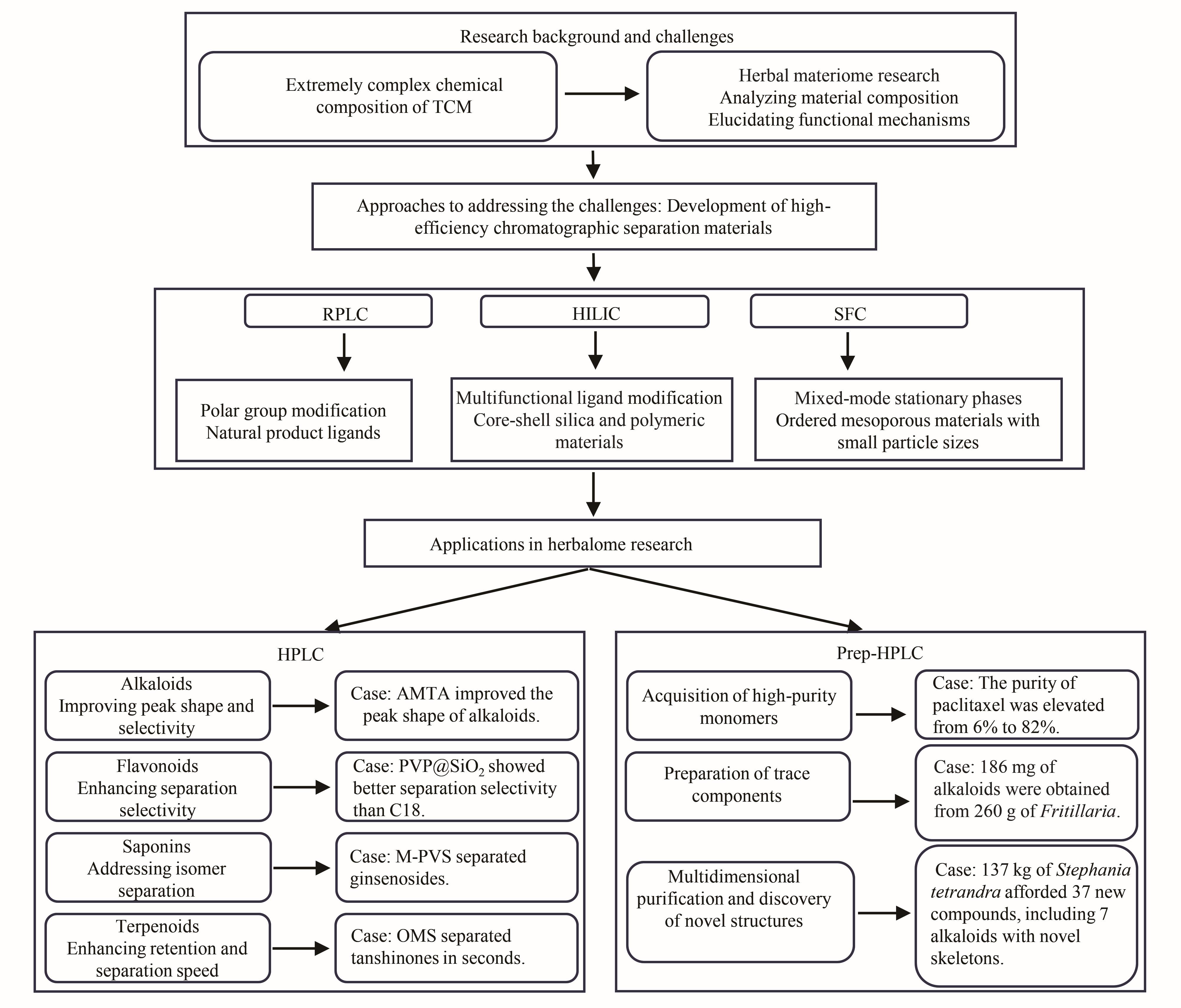
Fig. 1 Data overview figureTCM: traditional Chinese medicine; RPLC: reversed-phase liquid chromatography; HILIC: hydrophilic interaction liquid chromatography; SFC: supercritical fluid chromatography; HPLC: high-performance liquid chromatography; AMTA: 3-amino-5-mercapto-1,2,4-triazole bonded silica; PVP: polyvinylpyrrolidone; M-PVS: phenyl vinyl sulfone stationary phase; OMS: ordered mesoporous silica.
| Material | Abbr. | Mode | Analytes | Ref. |
|---|---|---|---|---|
| Fluorinated C18 bonded silica | FC8 | RPLC | alkaloids | [ |
| 9-Oxa-10-phosphaphenanthrene-10-oxide-functionalized silica gel | DOPO-SiO2 | RPLC | flavonoids | [ |
| Phenyl vinyl sulfone stationary phase bonded silica | M-PVS | RPLC | saponins, flavonoids | [ |
| Phenyl/amide/carboxyl bonded silica | PAC | RPLC | flavonoids, saponins, alkaloids, terpenoids | [ |
| Cardanol-bonded on silica | CBS | RPLC | alkaloids | [ |
| Hydrogenated rosin (β-acryloxyl ethyl) ester-bonded silica | HRE@SiO2 | RPLC | paclitaxel | [ |
| Propylene pimaric acid (16-hydroxyethyl acrylate-34-dodecyl) ester bonded silica | BRLA@SiO2 | RPLC | saponins | [ |
| 3-Amino-5-mercapto-1,2,4-triazole bonded silica | AMTA | HILIC | flavonoids, saponins, alkaloids | [ |
| Amide modified core shell silica | CSX-E-AM | HILIC | oligosaccharides | [ |
| Ayrazine-2,3-dicarboxylic anhydride bonded silica | ZAC | HILIC | oligosaccharides, flavonoids, alkaloids, organic acids | [ |
| β-Cyclodextrin stationary phase | β-CD | HILIC | steroids, saccharides | [ |
| (1-Acrylamide propyl sulfonic) n -ImprSiO2 | (AMPS) n -ImprSiO2 | HILIC | flavonoids, fructus ligustri lucidi | [ |
| Polyvinylpyrrolidone bonded silica | PVP@SiO2 | HILIC | flavonoids, alkaloids | [ |
| Sil-epoxy-polyethyleneimine | Sil-epoxy-PEI | HILIC | saccharides | [ |
| Sil-chloropropyl-polyethyleneimine | Sil-chloropropyl-PEI | HILIC | saccharides | [ |
| Methacryloxypropyl-trimethoxysilane -divinylbenzene-cysteine | MAPS-DVB-Cys | HILIC | alkaloids | [ |
| N-Propylbenzamide | PB | SFC | flavonoids | [ |
| 4-Fluoro-N-propylbenzamide | PB-F | SFC | flavonoids | [ |
| 4-Ethyl-N-propylbenzamide | PB-ET | SFC | flavonoids | [ |
| Aniline bonded silica | S-aniline | SFC | flavonoids | [ |
| 1-Aminonaphthalene bonded silica | S-1-ami-naph | SFC | flavonoids | [ |
| 1-Aminoanthracene bonded silica | S-1-ami-anth | SFC | flavonoids | [ |
| 1-Aminopyrene bonded silica | S-1-ami-py | SFC | flavonoids | [ |
| L-Cysteine bonded silica | Click TE-Cys | SFC | tanshinones | [ |
| 3-Amino-5-mercapto-1,2,4-triazole bonded silica | AMTA | SFC | alkaloids | [ |
| C8 bonded strong anion exchange silica | C8SAX | SFC | alkaloids | [ |
| C8 bonded strong cation exchange silica | C8SCX | SFC | alkaloids | [ |
| 4-(Allylamino)butane-1-sulfonic acid | ZEX1 | SFC | basic analytes | [ |
| 4-(Prop-2-yn-1-ylamino)butane-1-sulfonic acid | ZEX2 | SFC | basic analytes | [ |
| 3-(Allylamino)propane-1-sulfonic acid | ZEX3 | SFC | basic analytes | [ |
| 4-(Allyloxy)butane-1-sulfonic acid | SCX1 | SFC | basic analytes | [ |
| 4-(Pent-4-en-1-yloxy)butane-1-sulfonic acid | SCX2 | SFC | basic analytes | [ |
| 4-(Undec-10-en-1-yloxy)butane-1-sulfonic acid | SCX3 | SFC | basic analytes | [ |
| Ordered mesoporous silica | OMS | SFC | tanshinones | [ |
| Ordered mesoporous core-shell silica | OMCS | SFC | Glycosides | [ |
Table 1 Summary of high-performance chromatographic separation materials
| Material | Abbr. | Mode | Analytes | Ref. |
|---|---|---|---|---|
| Fluorinated C18 bonded silica | FC8 | RPLC | alkaloids | [ |
| 9-Oxa-10-phosphaphenanthrene-10-oxide-functionalized silica gel | DOPO-SiO2 | RPLC | flavonoids | [ |
| Phenyl vinyl sulfone stationary phase bonded silica | M-PVS | RPLC | saponins, flavonoids | [ |
| Phenyl/amide/carboxyl bonded silica | PAC | RPLC | flavonoids, saponins, alkaloids, terpenoids | [ |
| Cardanol-bonded on silica | CBS | RPLC | alkaloids | [ |
| Hydrogenated rosin (β-acryloxyl ethyl) ester-bonded silica | HRE@SiO2 | RPLC | paclitaxel | [ |
| Propylene pimaric acid (16-hydroxyethyl acrylate-34-dodecyl) ester bonded silica | BRLA@SiO2 | RPLC | saponins | [ |
| 3-Amino-5-mercapto-1,2,4-triazole bonded silica | AMTA | HILIC | flavonoids, saponins, alkaloids | [ |
| Amide modified core shell silica | CSX-E-AM | HILIC | oligosaccharides | [ |
| Ayrazine-2,3-dicarboxylic anhydride bonded silica | ZAC | HILIC | oligosaccharides, flavonoids, alkaloids, organic acids | [ |
| β-Cyclodextrin stationary phase | β-CD | HILIC | steroids, saccharides | [ |
| (1-Acrylamide propyl sulfonic) n -ImprSiO2 | (AMPS) n -ImprSiO2 | HILIC | flavonoids, fructus ligustri lucidi | [ |
| Polyvinylpyrrolidone bonded silica | PVP@SiO2 | HILIC | flavonoids, alkaloids | [ |
| Sil-epoxy-polyethyleneimine | Sil-epoxy-PEI | HILIC | saccharides | [ |
| Sil-chloropropyl-polyethyleneimine | Sil-chloropropyl-PEI | HILIC | saccharides | [ |
| Methacryloxypropyl-trimethoxysilane -divinylbenzene-cysteine | MAPS-DVB-Cys | HILIC | alkaloids | [ |
| N-Propylbenzamide | PB | SFC | flavonoids | [ |
| 4-Fluoro-N-propylbenzamide | PB-F | SFC | flavonoids | [ |
| 4-Ethyl-N-propylbenzamide | PB-ET | SFC | flavonoids | [ |
| Aniline bonded silica | S-aniline | SFC | flavonoids | [ |
| 1-Aminonaphthalene bonded silica | S-1-ami-naph | SFC | flavonoids | [ |
| 1-Aminoanthracene bonded silica | S-1-ami-anth | SFC | flavonoids | [ |
| 1-Aminopyrene bonded silica | S-1-ami-py | SFC | flavonoids | [ |
| L-Cysteine bonded silica | Click TE-Cys | SFC | tanshinones | [ |
| 3-Amino-5-mercapto-1,2,4-triazole bonded silica | AMTA | SFC | alkaloids | [ |
| C8 bonded strong anion exchange silica | C8SAX | SFC | alkaloids | [ |
| C8 bonded strong cation exchange silica | C8SCX | SFC | alkaloids | [ |
| 4-(Allylamino)butane-1-sulfonic acid | ZEX1 | SFC | basic analytes | [ |
| 4-(Prop-2-yn-1-ylamino)butane-1-sulfonic acid | ZEX2 | SFC | basic analytes | [ |
| 3-(Allylamino)propane-1-sulfonic acid | ZEX3 | SFC | basic analytes | [ |
| 4-(Allyloxy)butane-1-sulfonic acid | SCX1 | SFC | basic analytes | [ |
| 4-(Pent-4-en-1-yloxy)butane-1-sulfonic acid | SCX2 | SFC | basic analytes | [ |
| 4-(Undec-10-en-1-yloxy)butane-1-sulfonic acid | SCX3 | SFC | basic analytes | [ |
| Ordered mesoporous silica | OMS | SFC | tanshinones | [ |
| Ordered mesoporous core-shell silica | OMCS | SFC | Glycosides | [ |
|
| [1] | LIU Yanfang, ZHOU Han, WANG Jixia, SHEN Aijin, LIU Dian, HAN Yang, YU Wenyi, YUAN Bin, WANG Zhen, ZENG Jie, XUE Xingya, FENG Jiatao, GUO Zhimou, LIANG Xinmiao. Research methods and technological advancements in herbal material science [J]. Chinese Journal of Chromatography, 2026, 44(8): 847-863. |
| [2] | LIU Xuanyu, SUI Lei, MA Mingyu, BI Yi, SONG Zhihua. Preparation of saccharide-derived carbon dots and their applications in biomedical and environmental pollutant analysis [J]. Chinese Journal of Chromatography, 2025, 43(8): 857-867. |
| [3] | ZHOU Xinying, KONG Weiheng, YU Dexiu, LI Tangyi, MA Zhou, YI Xin, WANG Fenglin, LI Tong. Development of integrated equipment for automatic sampling and distillate collection [J]. Chinese Journal of Chromatography, 2025, 43(7): 830-835. |
| [4] | WANG Zhaoxu, WANG Duanda, WANG Shutao, SONG Yongyang. Applications of ordered porous materials in chromatography separation and analysis [J]. Chinese Journal of Chromatography, 2025, 43(6): 594-605. |
| [5] | BU Aixiang, WU Guangyao, HU Lianghai. Progress and prospect of separation and analysis of single-cell and single-particle exosomes [J]. Chinese Journal of Chromatography, 2025, 43(5): 399-412. |
| [6] | HUANG Jianying, XIA Ling, XIAO Xiaohua, LI Gongke. Advances in microchip electrophoresis for the separation and analysis of biological samples [J]. Chinese Journal of Chromatography, 2023, 41(8): 641-650. |
| [7] | XU Jiabi, CHENG Yue, LU Xinling, JIN Xiaoning, WANG Yong. Recent advances in the research of chromatographic separation materials based on click chemistry [J]. Chinese Journal of Chromatography, 2023, 41(1): 1-13. |
| [8] | JIA Pu, BIAN Yangyang, BAI Yajun, MENG Xue, GAO Shuomo, ZHAO Ye, CAI Yujie, ZHENG Xiaohui. Applications of chromatography in giant complex drug-organism system [J]. Chinese Journal of Chromatography, 2021, 39(9): 950-957. |
| [9] | CHEN Wenwen, GAN Zhongqiao, QIN Jianhua. Microfluidic strategies for separation and analysis of circulating exosomes [J]. Chinese Journal of Chromatography, 2021, 39(9): 968-980. |
| [10] | XIA Hongjun, LIU Jiawei, BAI Quan. Research progress on core-shell silica stationary phases for high performance liquid chromatography [J]. Chinese Journal of Chromatography, 2020, 38(4): 372-382. |
| [11] | FANG Hongxia, QIAN Chen, CUI Peng, LIU Jingfeng, HU Xiaopo, HE Hualong, SUN Jiying. A rapid method based on advanced polymer chromatography for analyzing the products of the acid-catalyzed depolymerization of lignosulfonate [J]. Chinese Journal of Chromatography, 2019, 37(9): 983-989. |
| [12] | LIU Xingbao, LUAN Hongwei, GE Guangbo, HOU Kun, DU Xunfu, YANG Ling*. Industrial preparative chromatography purification of 10-deacetylpaclitaxel, the enzymatic product of 7-xylosyl-10-deacetylpaclitaxel [J]. Chinese Journal of Chromatography, 2012, 30(02): 165-169. |
| [13] | YANG Xiaoming1,2, GENG Xindu2,3*. Recent development for purification of active proteins from bovine pancreas with liquid chromatography [J]. Chinese Journal of Chromatography, 2011, 29(03): 199-204. |
| [14] | CAI Huanxin, YIN Baoru, YAO Ping. Preparation and high performance liquid chromatographic separation of casein peptides [J]. Chinese Journal of Chromatography, 2010, 28(7): 637-643. |
| [15] | CHEN Yi, LI Jincheng. Photonic crystals for analytical chemistry [J]. Chinese Journal of Chromatography, 2009, 27(5): 573-583. |
| Viewed | ||||||
|
Full text |
|
|||||
|
Abstract |
|
|||||


