色谱 ›› 2026, Vol. 44 ›› Issue (9): 1048-1058.DOI: 10.3724/SP.J.1123.2025.12005

• 研究论文 • 上一篇    下一篇

液相色谱-串联质谱法与气相色谱-质谱法测定毛发中15种芬太尼类似物和苯丙胺类兴奋剂

韦棋, 苏福海*(), 朱欣   

  1. 中国计量科学研究院,北京 100029
  • 收稿日期:2025-12-02 出版日期:2026-09-08 发布日期:2026-09-17
  • 通讯作者: *Tel:010-64524787,E-mail:sufh@nim.ac.cn.
  • 基金资助:
    国家质量基础设施体系专项(2022YFF0609101);中国计量科学研究院基本科研业务费(AKYZZ2531);国家标准物质资源库(APT2502-1)

Determination of 15 fentanyl analogs and amphetamine-type stimulants in hair by liquid chromatography-tandem mass spectrometry and gas chromatography-mass spectrometry

WEI Qi, SU Fuhai*(), ZHU Xin   

  1. National Institute of Metrology,Beijing 100029,China
  • Received:2025-12-02 Online:2026-09-08 Published:2026-09-17
  • Supported by:
    National Quality Infrastructure System Special Project(2022YFF0609101);Basic Scientific Research Business Expenses of the National Institute of Metrology, China(AKYZZ2531);National Reference Material Resource Library(APT2502-1)

摘要:

药物滥用,尤其是芬太尼类似物及苯丙胺类兴奋剂(ATS)等合成毒品的泛滥,已成为全球重大公共卫生问题。毛发分析能回溯数年的用药史,在司法鉴定领域独具优势,但其应用受限于基质有证标准物质的缺乏。本研究基于水-二甲基亚砜-盐酸混合溶液浸泡法,以15种目标药物(9种芬太尼类似物和6种苯丙胺类兴奋剂)为研究对象,建立了毛发样本的制备及液相色谱-串联质谱法(LC-MS/MS)与气相色谱-质谱法(GC-MS)双平台定量分析方法。实际制备结果表明,除苯丙胺(AP)外的14种药物均成功掺入毛发基质。将该双平台技术应用于该类基质标准物质的定值分析,通过双平台交叉验证提升了定值结果的可靠性,为该类标准物质的研制提供了准确可靠的定值手段。采用Box-Behnken响应面法优化前处理条件,优化后的提取条件如下:提取温度40 ℃,提取时间50 min,液固比100∶1(mL/g),盐酸浓度0.01 mol/L。结果表明,制备的毛发样本中14种目标物的含量为1.050~7.771 ng/mg,日内与日间精密度(相对标准偏差<10%)、回收率(84.46%~116.4%)及基质效应(80%~120%)均满足分析要求。两种方法的灵敏度均较高,LC-MS/MS的检出限和定量限分别为0.05 pg/mg与0.25 pg/mg,GC-MS的检出限与定量限分别为0.02 ng/mg和0.08 ng/mg。通过F检验验证,在显著性水平0.05(自由度为10,22)下,毛发样本均匀性良好。本研究建立了基于LC-MS/MS与GC-MS的双平台平行检测与交叉验证策略,通过对同一样本独立测定与结果比对,实现了结果的内部交叉验证,提升了定值结果的可靠性。同时,通过考察药物在毛发中的渗透动力学并确定最佳浸泡时间,解决了现有标准物质制备中药物-角蛋白结合态模拟不足的难题。本工作建立的方法及制备的标准物质为法医毒理学中多类毒品滥用监测和实验室质量控制提供了可靠的工具。

关键词: 芬太尼类似物, 苯丙胺类兴奋剂, 毛发, 标准物质, 液相色谱-串联质谱, 气相色谱-质谱

Abstract:

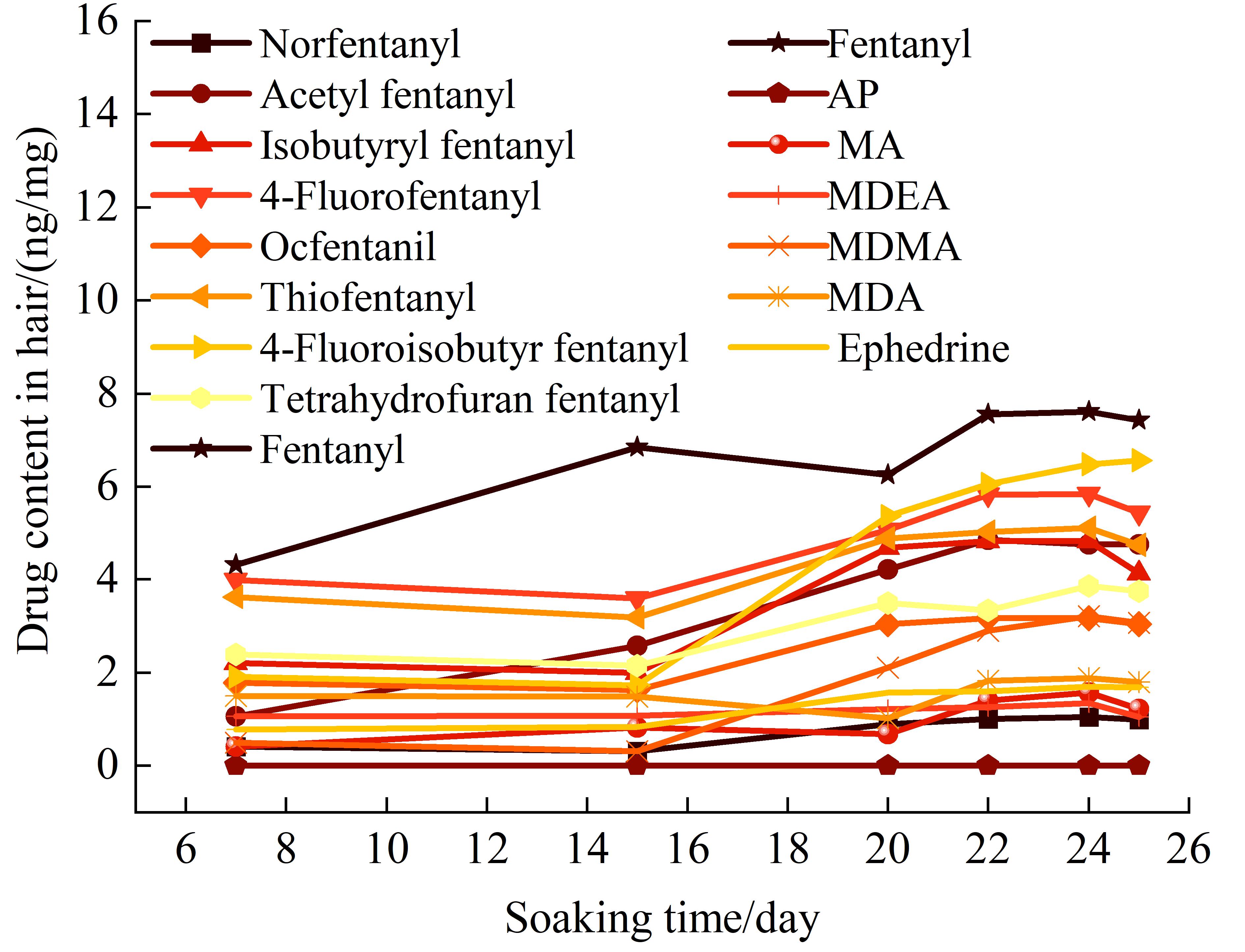
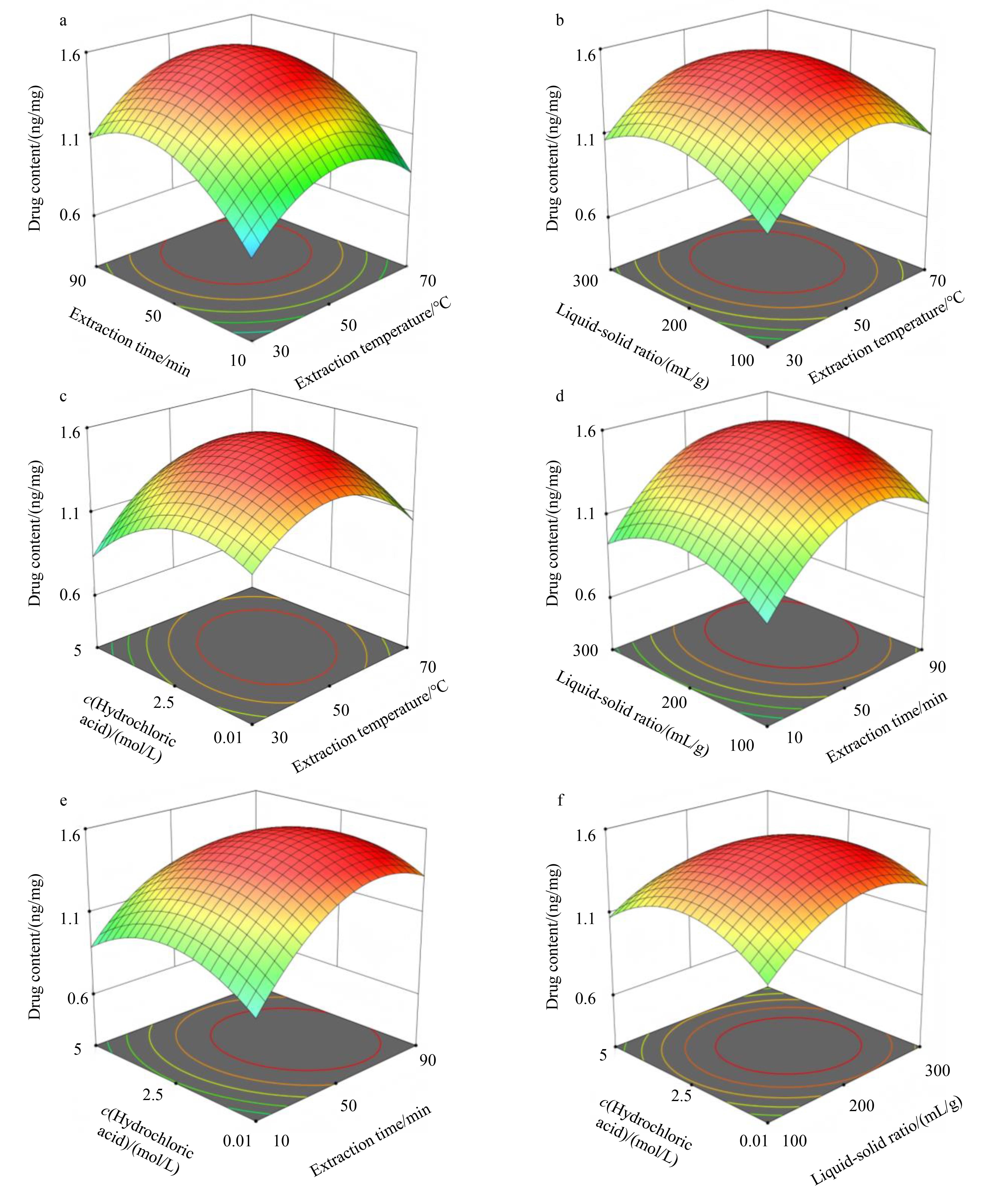
Drug abuse is a major global public health problem. Fentanyl analogs and amphetamine-type stimulants (ATS) are widely abused worldwide. Hair analysis can trace drug use history over months. This technique has unique advantages in forensic toxicology. However, its application is limited by a lack of matrix-certified reference materials (CRMs). At present, the existing CRMs are unable to simultaneously cover both fentanyl analogs and amphetamine-type stimulants. This study established a hair sample preparation method based on a water‑dimethyl sulfoxide‑hydrochloric acid soaking approach, targeting 15 analytes (nine fentanyl analogs and six ATS). The soaking time was systematically investigated. Drug incorporation into hair reached a maximum at 24 days. A slight decrease was observed at 25 days. This decrease may result from desorption and solvent-induced structural changes in keratin. Therefore, 24 days was selected as the optimal soaking time. Preparation experiments demonstrated that 14 of the 15 drugs were successfully embedded into the hair matrix. This study also applied a dual-platform quantitative strategy for certification. The two platforms were liquid chromatography-tandem mass spectrometry (LC-MS/MS) and gas chromatography-mass spectrometry (GC-MS). Cross-validation between the two platforms improved the reliability of certified values. Sample pretreatment conditions were optimized using Box-Behnken response surface methodology. Four factors were investigated: extraction temperature, extraction time, liquid-to-solid ratio, and hydrochloric acid concentration. The effects of the four factors on extraction efficiency followed a decreasing order: extraction temperature>extraction time>liquid-to-solid ratio>hydrochloric acid concentration. The optimal extraction conditions were as follows: extraction temperature 40 ℃, extraction time 50 min, liquid-solid ratio 100∶1 (mL/g), and hydrochloric acid concentration 0.01 mol/L. Method validation was performed according to international guidelines. For LC-MS/MS, the limits of detection (LODs) and quantification (LOQs) were 0.05 pg/mg and 0.25 pg/mg, respectively. For GC-MS, the LODs and LOQs were 0.02 ng/mg and 0.08 ng/mg, respectively. Good linearities were obtained for all 15 drugs. Correlation coefficients (r) were greater than 0.999 for both platforms. Good linearities were obtained for all 15 analytes on both platforms with correlation coefficients >0.999 over the respective concentration ranges Intra-day precisions (n=6) were evaluated as relative standard deviations (RSDs). Inter-day precision (n=30 over 5 days) was also calculated. For 14 drugs (except amphetamine), RSD values ranged from 0.2% to 9.4%. All RSDs were below 10%, indicating good repeatability and intermediate precision. Stability of hair extracts was assessed at 1, 24, 48, 72, and 96 h at room temperature. The extracts were stable for at least 96 h when stored at room temperature, with RSDs below 6.0% for LC-MS/MS and below 10% for GC-MS. Recovery tests were performed at three quality control levels (low, medium, high). For LC-MS/MS, average recoveries ranged from 84.46% to 116.4% (n=3). For GC-MS, average recoveries ranged from 85.50% to 116.4% (n=3). All RSDs were below 15%. Matrix effects (MEs) were evaluated by comparing matrix-matched standards with solvent standards. ME values between 80% and 120% (n=3) were observed for both platforms. These results indicate negligible ion suppression or enhancement. Homogeneity of the prepared hair reference material was assessed. The results show that the uniformity of the hair samples is good. The contents of the 14 drugs in the prepared hair samples were determined. For LC-MS/MS, the values ranged from 1.012 ng/mg to 7.830 ng/mg. For GC-MS, the values ranged from 1.087 ng/mg to 7.712 ng/mg. Amphetamine was not detected by either platform, likely due to its high polarity and weak binding to keratin. Most drugs showed good agreement between the two platforms. Relative deviations were below 10% for most analytes. However, methamphetamine showed a deviation of -12%. This may be due to matrix effects in LC-MS/MS. The GC-MS results for methamphetamine were more robust. The dual-platform approach allowed cross-validation and enhanced the reliability of the certified values. In conclusion, a dual-platform method based on LC-MS/MS and GC-MS was successfully applied to certify a new hair matrix reference material. The cross-validation strategy enhances the accuracy and traceability of the certified values. This work provides a valuable tool for quality control in forensic toxicology laboratories. The prepared reference material and validated method will facilitate inter-laboratory comparisons. They will also support the monitoring of drug abuse in forensic and clinical settings.

Key words: fentanyl analogs, amphetamine-type stimulants, hair, reference material, liquid chromatography-tandem mass spectrometry (LC-MS/MS), gas chromatography-mass spectrometry (GC-MS)

中图分类号: