
Chinese Journal of Chromatography ›› 2026, Vol. 44 ›› Issue (8): 877-888.DOI: 10.3724/SP.J.1123.2025.08020
• Reviews • Previous Articles Next Articles
XU Yongbing1,2, NIU Yujia1,2,3, GUO Mingquan1,2,*( )
)
Received:2025-08-28
Online:2026-08-08
Published:2026-07-30
Supported by:CLC Number:
XU Yongbing, NIU Yujia, GUO Mingquan. Recent advances of affinity ultrafiltration-liquid chromatography-mass spectrometry in screening natural active substances[J]. Chinese Journal of Chromatography, 2026, 44(8): 877-888.
Add to citation manager EndNote|Ris|BibTeX
URL: https://www.chrom-china.com/EN/10.3724/SP.J.1123.2025.08020
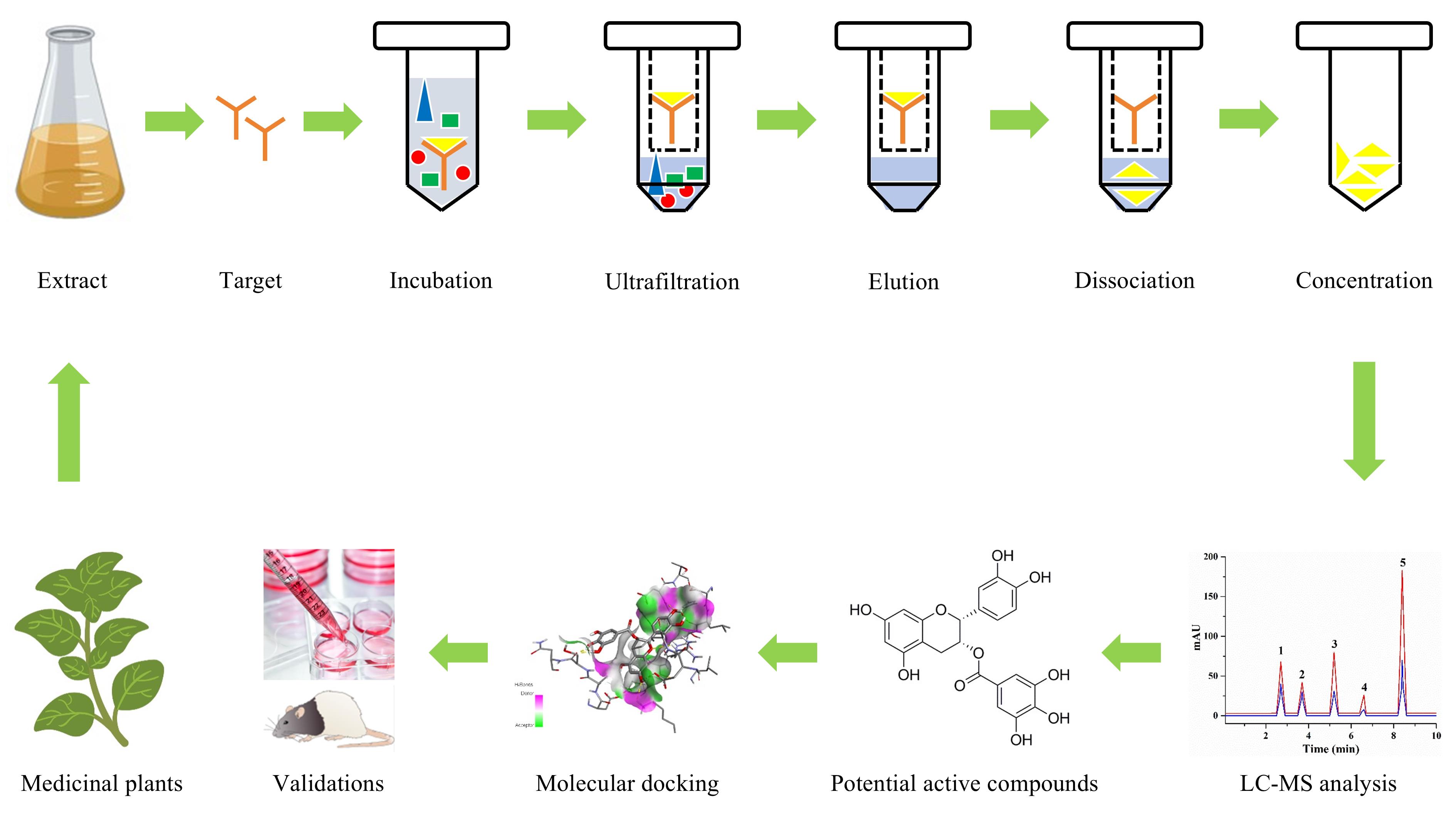
Fig. 1 Schematic diagram of the working principle of affinity ultrafiltration-liquid chromatography-mass spectrometry (AUF-LC-MS)
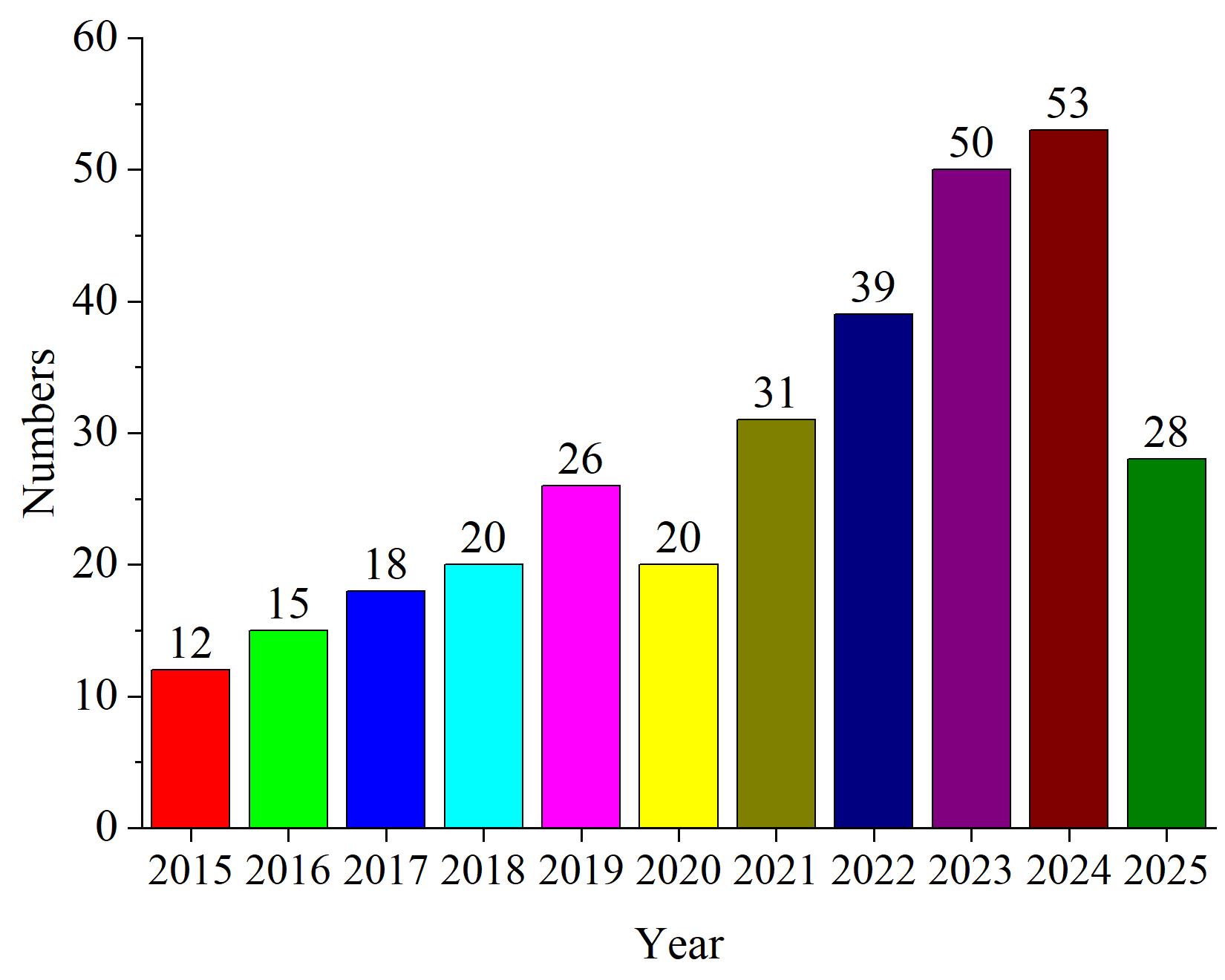
Fig. 2 Statistical chart of the number of related literature on AUF-LC-MS over the last decade
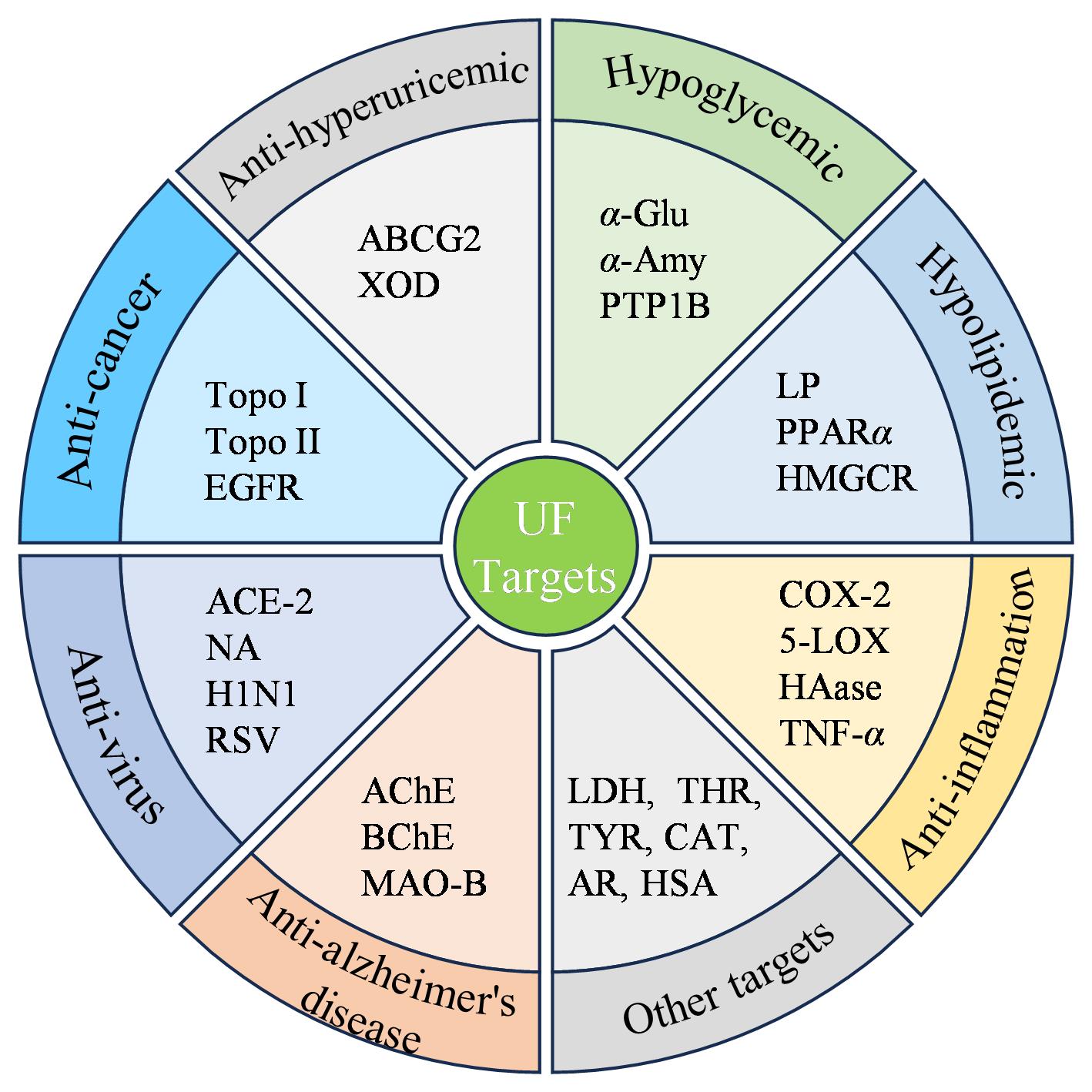
Fig. 3 Target classification in published articles on AUF-LC-MS over the last decade Topo I: DNA topoisomerase I; Topo Ⅱ: DNA topoisomerase Ⅱ; ABCG2: ATP binding cassette transporter G2; XOD: xanthine oxidase; α-Glu: α-glucosidase; α-Amy: α-amylase; PTP1B: protein tyrosine phosphatase 1B; LP: lipase; PPARα: peroxisome proliferator-activated receptor alpha; HMGCR: 3-hydroxy-3-methylglutaryl coenzyme A reductase; COX-2: cyclooxygenase-2; 5-LOX: 5-lipoxygenase; HAase: hyaluronidase; TNF-α: tumor necrosis factor-alpha; LDH: lactate dehydrogenase; THR: thrombin; TYR: tyrosinase; CAT: catalase; AR: aldose reductase; HSA: human serum albumin; AChE: acetylcholinesterase; BChE: butylcholinesterase; MAO-B: monoamine oxidase B; ACE2: angiotensin-converting enzyme 2; NA: neuraminidase; H1N1: influenza A virus subtype H1N1; RSV: respiratory syncytial virus.
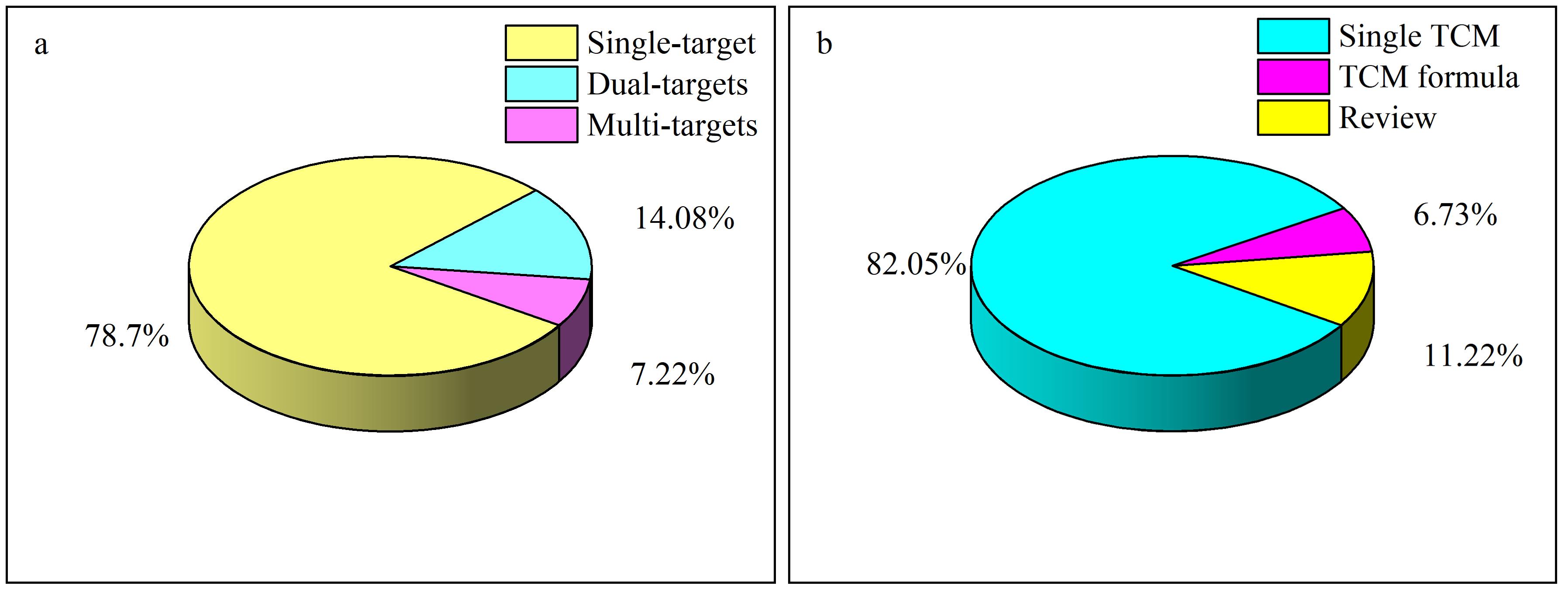
Fig. 4 (a) Target proportion and (b) traditional Chinese medicine (TCM) formula proportion in published articles on AUF-LC-MS over the last decade
| Number of compounds | Activity/disease | Target | Active compound | Main verification methods | Ref. |
|---|---|---|---|---|---|
| 10 | depression | PTGS2 | neomangiferin | zebrafish, cell, MD | [ |
| 6 | immunity | Siglec-1 | glycyrrhetinic acid | / | [ |
| 22 | anti-tumor | PD-L1 | β-NAD | cell, MD | [ |
| 6 | antimalarial | HSA | piperaquine | MD | [ |
| 5 | anti-cancer | Tim-3 | atractylenolide I | / | [ |
Table 1 AUF-LC-MS screening at the compound level
| Number of compounds | Activity/disease | Target | Active compound | Main verification methods | Ref. |
|---|---|---|---|---|---|
| 10 | depression | PTGS2 | neomangiferin | zebrafish, cell, MD | [ |
| 6 | immunity | Siglec-1 | glycyrrhetinic acid | / | [ |
| 22 | anti-tumor | PD-L1 | β-NAD | cell, MD | [ |
| 6 | antimalarial | HSA | piperaquine | MD | [ |
| 5 | anti-cancer | Tim-3 | atractylenolide I | / | [ |
| Name of herb | Activity/disease | Targets | Main active compounds | Verification methods | Ref. |
|---|---|---|---|---|---|
| Morus alba L. | anti-inflammatory | COX-2, 5-LOX | neochlorogenic acid, rutin | cell, EAT, MD | [ |
| Nauclea officinalis | anti-inflammatory | COX-2, 5-LOX | angustine, angustidine | EAT, MD | [ |
| Dendropanax dentiger | anti-inflammatory | COX-2 | cryptochlorogenic acid | EAT, MD, MDS | [ |
| Curcuma longa | anti-inflammatory | COX-2 | BHPHO | zebrafish, MD | [ |
| Moringa oleifera | anti-inflammatory | COX-2 | quercetin 3-acetyl-glycoside | MD | [ |
| Aquilaria sinensis | hypoglycemic | α-Glu | epicatechin, epigallocatechin gallate | cell, EAT, MD | [ |
| Phyllanthi Fructus | hypoglycemic | α-Glu | hyperoside, gallic acid, corilagin | EAT, MD | [ |
| Diospyros kaki | hypoglycemic | α-Amy, α-Glu | hederagenin, ursolic acid | EAT, MD | [ |
| Rubus corchorifolius | hypoglycemic | α-Amy, α-Glu | cyanidin-3-rutinoside | EAT, MD | [ |
| Clematis tangutica | hypolipidemic | LP | tanguticoside B, rutin | EAT, MD | [ |
| Rheum palmatum | hypolipidemic | LP | procyanidin B5 3,3′-di-O-gallate-di-O-gallate | EAT, MD | [ |
| Polygonum cuspidatum | anti-hyperuricemic | XOD | polydatin, resveratrol | EAT, MD | [ |
| Polyporus umbellatus | anti-hyperuricemic | XOD | polyporusterone A | EAT, MD, MDS | [ |
| Cortex Fraxini | anti-hyperuricemic | ABCG2 | fraxin | MD | [ |
| Bletilla striata | skin-whitening | TYR | coelonin | zebrafish, MD | [ |
| Ampelopsis grossedentata | skin-whitening | TYR | dihydromyricetin | cell, MD | [ |
| Semen Oroxyli | skin-whitening | TYR | oroxin A, baicalein | EAT, MD | [ |
| Gastrodia elata | skin-whitening | TYR | 4,4′-dihydroxybenzylsulfid | EAT | [ |
| Peach Kernel | anticoagulant | THR | L-arginine, cytidine | zebrafish, MD | [ |
| Salvia miltiorrhiza | anticoagulant | THR | salvianolic acid C | EAT, MD | [ |
| Ligusticum chuanxiong | anticoagulant | THR | ferulic acid, chlorogenic acid | EAT, MD | [ |
| Oenothera biennis | diabetes complications | AR | gallic acid, catechin | EAT | [ |
| Caesalpinia spinose | diabetes complications | AR | methyl gallate, pistafolin B | EAT, MD | [ |
| Polygala tenuifolia | anti-stroke | LDH | sibiricose A5, glomeratose A | cell | [ |
| Glycine max L. | anti-stroke | LDH | daidzin, glycitin, genistin | cell | [ |
| Bupleuri Radix | anti-influenza virus | NA | 6″-O-acetylsaikosaponin A | EAT, MD | [ |
| Polygonum cuspidatum | anti-influenza virus | NA | cis-polydatin | EAT, MD | [ |
| Dalbergia odorifera | alzheimer’s disease | AChE | tectorigenin, fisetin, dalbergin | EAT, MD | [ |
| Astragalus membranaceus | alzheimer’s disease | AChE, 5-LOX | calycosin-7-glucoside | MD | [ |
| Radix Paeoniae alba | anti-allergy | HDC | catechin | EAT, MD | [ |
| Glycyrrhiza uralensis | antiviral | H1N1, RSV | glycyrrhizic acid, licochalcone A | cell | [ |
| Scutellaria baicalensis | antiviral | ACE2, DPP-4 | wogonoside, chrysin, oroxylin A | / | [ |
| Moringa oleifera | anti-aging | HAase, Ela, Col | 4-caffeoylquinic acid, vicenin-2 | MD | [ |
| Rodgersia podophylla | antioxidant, anti-hyperuricemic | SOD, XOD | norbergenin, bergenin, catechin | EAT, MD | [ |
| Polygonatum sibiricum | antioxidant, anti-hyperuricemic | SOD, XOD | N-cis-p-coumaroyltyramine | MD | [ |
| Moringa oleifera | hypoglycemic, hypolipidemic | α-Glu, LP | kaempferol 3-acetyl-glycoside | MD | [ |
| Cyclocarya paliurus | hypoglycemic, hypolipidemic | α-Glu, LP | chlorogenic acid, quercetin | MD | [ |
| Xylopia aethiopica | hypoglycemic, hypolipidemic | α-Glu, LP | liriodenine, oxonantenine | cell, EAT | [ |
| Morus alba L. | hypoglycemic, hypolipidemic | α-Glu, LP | chlorogenic acid | EAT, MD | [ |
| Azadirachta indica | antiparasitic | AChE, LDH | carnosol | EAT, MD | [ |
| Hagenia abyssinica | antiparasitic | AChE, LDH, GR | corilagin, brevifolin, quercetin | EAT, MD | [ |
| Andrographis paniculata | anti-inflammatory, antiviral | COX-2, IL-6, ACE2 | andrographolide | MD | [ |
| Rhamnus davurica | anti-inflammatory, anti-tumor | COX-2, Topo I | vitexin, apigenin, kaempferol | EAT, cell | [ |
Table 2 AUF-LC-MS screening at a single TCM level
| Name of herb | Activity/disease | Targets | Main active compounds | Verification methods | Ref. |
|---|---|---|---|---|---|
| Morus alba L. | anti-inflammatory | COX-2, 5-LOX | neochlorogenic acid, rutin | cell, EAT, MD | [ |
| Nauclea officinalis | anti-inflammatory | COX-2, 5-LOX | angustine, angustidine | EAT, MD | [ |
| Dendropanax dentiger | anti-inflammatory | COX-2 | cryptochlorogenic acid | EAT, MD, MDS | [ |
| Curcuma longa | anti-inflammatory | COX-2 | BHPHO | zebrafish, MD | [ |
| Moringa oleifera | anti-inflammatory | COX-2 | quercetin 3-acetyl-glycoside | MD | [ |
| Aquilaria sinensis | hypoglycemic | α-Glu | epicatechin, epigallocatechin gallate | cell, EAT, MD | [ |
| Phyllanthi Fructus | hypoglycemic | α-Glu | hyperoside, gallic acid, corilagin | EAT, MD | [ |
| Diospyros kaki | hypoglycemic | α-Amy, α-Glu | hederagenin, ursolic acid | EAT, MD | [ |
| Rubus corchorifolius | hypoglycemic | α-Amy, α-Glu | cyanidin-3-rutinoside | EAT, MD | [ |
| Clematis tangutica | hypolipidemic | LP | tanguticoside B, rutin | EAT, MD | [ |
| Rheum palmatum | hypolipidemic | LP | procyanidin B5 3,3′-di-O-gallate-di-O-gallate | EAT, MD | [ |
| Polygonum cuspidatum | anti-hyperuricemic | XOD | polydatin, resveratrol | EAT, MD | [ |
| Polyporus umbellatus | anti-hyperuricemic | XOD | polyporusterone A | EAT, MD, MDS | [ |
| Cortex Fraxini | anti-hyperuricemic | ABCG2 | fraxin | MD | [ |
| Bletilla striata | skin-whitening | TYR | coelonin | zebrafish, MD | [ |
| Ampelopsis grossedentata | skin-whitening | TYR | dihydromyricetin | cell, MD | [ |
| Semen Oroxyli | skin-whitening | TYR | oroxin A, baicalein | EAT, MD | [ |
| Gastrodia elata | skin-whitening | TYR | 4,4′-dihydroxybenzylsulfid | EAT | [ |
| Peach Kernel | anticoagulant | THR | L-arginine, cytidine | zebrafish, MD | [ |
| Salvia miltiorrhiza | anticoagulant | THR | salvianolic acid C | EAT, MD | [ |
| Ligusticum chuanxiong | anticoagulant | THR | ferulic acid, chlorogenic acid | EAT, MD | [ |
| Oenothera biennis | diabetes complications | AR | gallic acid, catechin | EAT | [ |
| Caesalpinia spinose | diabetes complications | AR | methyl gallate, pistafolin B | EAT, MD | [ |
| Polygala tenuifolia | anti-stroke | LDH | sibiricose A5, glomeratose A | cell | [ |
| Glycine max L. | anti-stroke | LDH | daidzin, glycitin, genistin | cell | [ |
| Bupleuri Radix | anti-influenza virus | NA | 6″-O-acetylsaikosaponin A | EAT, MD | [ |
| Polygonum cuspidatum | anti-influenza virus | NA | cis-polydatin | EAT, MD | [ |
| Dalbergia odorifera | alzheimer’s disease | AChE | tectorigenin, fisetin, dalbergin | EAT, MD | [ |
| Astragalus membranaceus | alzheimer’s disease | AChE, 5-LOX | calycosin-7-glucoside | MD | [ |
| Radix Paeoniae alba | anti-allergy | HDC | catechin | EAT, MD | [ |
| Glycyrrhiza uralensis | antiviral | H1N1, RSV | glycyrrhizic acid, licochalcone A | cell | [ |
| Scutellaria baicalensis | antiviral | ACE2, DPP-4 | wogonoside, chrysin, oroxylin A | / | [ |
| Moringa oleifera | anti-aging | HAase, Ela, Col | 4-caffeoylquinic acid, vicenin-2 | MD | [ |
| Rodgersia podophylla | antioxidant, anti-hyperuricemic | SOD, XOD | norbergenin, bergenin, catechin | EAT, MD | [ |
| Polygonatum sibiricum | antioxidant, anti-hyperuricemic | SOD, XOD | N-cis-p-coumaroyltyramine | MD | [ |
| Moringa oleifera | hypoglycemic, hypolipidemic | α-Glu, LP | kaempferol 3-acetyl-glycoside | MD | [ |
| Cyclocarya paliurus | hypoglycemic, hypolipidemic | α-Glu, LP | chlorogenic acid, quercetin | MD | [ |
| Xylopia aethiopica | hypoglycemic, hypolipidemic | α-Glu, LP | liriodenine, oxonantenine | cell, EAT | [ |
| Morus alba L. | hypoglycemic, hypolipidemic | α-Glu, LP | chlorogenic acid | EAT, MD | [ |
| Azadirachta indica | antiparasitic | AChE, LDH | carnosol | EAT, MD | [ |
| Hagenia abyssinica | antiparasitic | AChE, LDH, GR | corilagin, brevifolin, quercetin | EAT, MD | [ |
| Andrographis paniculata | anti-inflammatory, antiviral | COX-2, IL-6, ACE2 | andrographolide | MD | [ |
| Rhamnus davurica | anti-inflammatory, anti-tumor | COX-2, Topo I | vitexin, apigenin, kaempferol | EAT, cell | [ |
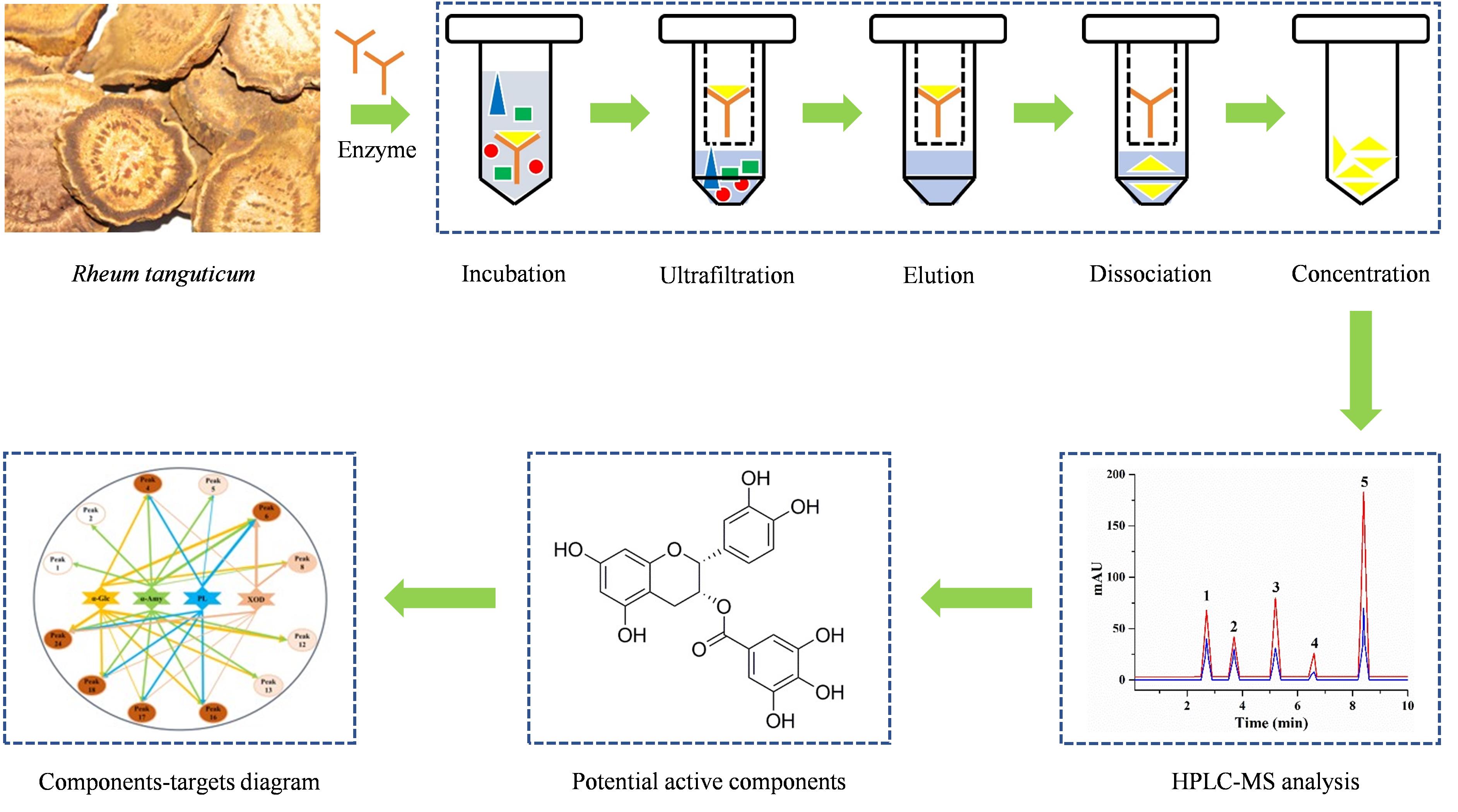
Fig. 5 Schematic workflow of the AUF-LC-MS study on the hypoglycemic, hypolipidemic, and anti-hyperuricemic compounds in Rheum tanguticum
| Name of compound recipe | Activity/disease | Targets | Main active compounds | Main verification methods | Ref. |
|---|---|---|---|---|---|
| TaoHeChengQi decoction | chronic renal failure | PHD2, RIPK3 | amygdalin, rhein | cell, SPR, CETSA | [ |
| Xuefu Zhuyu decoction | anticoagulant | THR | amygdalin, isoliquiritin | zebrafish, MD | [ |
| Shaoyao Gancao Fuzi decoction | rheumatoid arthritis | TNF-α | paeoniflorin, formononetin | cell, MD, MDS | [ |
| Sanhuang decoction | T2DM, obesity | α-Glu, α-Amy, PL | epicatechin-3-O-gallate | EAT, MD | [ |
| Zuogui pill | cancer bone metastasis | RANKL | luteolin | MD, CETSA | [ |
| TongFengTangSan | hyperuricemia | XOD | 1,3,6-trigalloylglucose | cell, EAT, MD | [ |
| Fufang Qiling granules | hyperuricemia | XOD | taxifolin, epicatechin, ferulic acid | SPR, MD | [ |
| Shenqi Jiangtang granule | diabetes complications | AR | ginsenoside Rd, gomisin J | EAT, MD | [ |
| Danggui-shaoyao-san | nephrotic syndrome | uPA, PLA | 1,2,3,4,6-O-pentagalloylglucose | EAT, MD | [ |
| Zi-shen pill | anti-inflammatory | 5-LOX | anemarrhenasaponin I | EAT, MD | [ |
Table 3 AUF-LC-MS screening at the TCM formula level
| Name of compound recipe | Activity/disease | Targets | Main active compounds | Main verification methods | Ref. |
|---|---|---|---|---|---|
| TaoHeChengQi decoction | chronic renal failure | PHD2, RIPK3 | amygdalin, rhein | cell, SPR, CETSA | [ |
| Xuefu Zhuyu decoction | anticoagulant | THR | amygdalin, isoliquiritin | zebrafish, MD | [ |
| Shaoyao Gancao Fuzi decoction | rheumatoid arthritis | TNF-α | paeoniflorin, formononetin | cell, MD, MDS | [ |
| Sanhuang decoction | T2DM, obesity | α-Glu, α-Amy, PL | epicatechin-3-O-gallate | EAT, MD | [ |
| Zuogui pill | cancer bone metastasis | RANKL | luteolin | MD, CETSA | [ |
| TongFengTangSan | hyperuricemia | XOD | 1,3,6-trigalloylglucose | cell, EAT, MD | [ |
| Fufang Qiling granules | hyperuricemia | XOD | taxifolin, epicatechin, ferulic acid | SPR, MD | [ |
| Shenqi Jiangtang granule | diabetes complications | AR | ginsenoside Rd, gomisin J | EAT, MD | [ |
| Danggui-shaoyao-san | nephrotic syndrome | uPA, PLA | 1,2,3,4,6-O-pentagalloylglucose | EAT, MD | [ |
| Zi-shen pill | anti-inflammatory | 5-LOX | anemarrhenasaponin I | EAT, MD | [ |
| Screening methods | Advantages | Disadvantages |
|---|---|---|
| Traditional phytochemical separation methods | obtaining active compounds and verifying their activities | high cost, low efficiency |
| Cell membrane chromatography | high-throughput, high sensitivity, automation | false positive cases, complex operation |
| Capillary electrophoresis | high separation efficiency, fast analysis speed, simple operation, and low sample and reagent consumption | complex operation, insufficient popularity |
| Organoids methods | no ethical issues, approximating real human conditions | no standardized organoid construction system |
| Spectrum-effect relationship | reflecting the overall efficacy of traditional Chinese medicine and the impact of component changes on efficacy | statistical methods dependency |
| Molecular docking | low cost, fast calculation speed, flexibility | false positive cases |
| Network pharmacology | low cost, integrating multi-omics data | database dependency |
Table 4 Comparison of various screening methods for natural active ingredients
| Screening methods | Advantages | Disadvantages |
|---|---|---|
| Traditional phytochemical separation methods | obtaining active compounds and verifying their activities | high cost, low efficiency |
| Cell membrane chromatography | high-throughput, high sensitivity, automation | false positive cases, complex operation |
| Capillary electrophoresis | high separation efficiency, fast analysis speed, simple operation, and low sample and reagent consumption | complex operation, insufficient popularity |
| Organoids methods | no ethical issues, approximating real human conditions | no standardized organoid construction system |
| Spectrum-effect relationship | reflecting the overall efficacy of traditional Chinese medicine and the impact of component changes on efficacy | statistical methods dependency |
| Molecular docking | low cost, fast calculation speed, flexibility | false positive cases |
| Network pharmacology | low cost, integrating multi-omics data | database dependency |
|
| Viewed | ||||||
|
Full text |
|
|||||
|
Abstract |
|
|||||


