
色谱 ›› 2026, Vol. 44 ›› Issue (10): 1129-1149.DOI: 10.3724/SP.J.1123.2026.01015
张震2, 王雪梅1,2,*( ), 张新中3, 杜新贞1,2, 卢小泉1,2
收稿日期:2026-01-26
出版日期:2026-10-08
发布日期:2026-10-13
通讯作者:
*Tel:基金资助:
ZHANG Zhen2, WANG Xuemei1,2,*(), ZHANG Xinzhong3, DU Xinzhen1,2, LU Xiaoquan1,2
Received:2026-01-26
Online:2026-10-08
Published:2026-10-13
Supported by:摘要:
样品前处理是仪器分析的核心环节,其目的是浓缩痕量组分、消除基质干扰、提高检测灵敏度并保护分析仪器,是复杂环境样品分析检测的关键步骤。以固相(微)萃取为代表的现代样品前处理技术具有快速、自动化、无溶剂或少溶剂的优点,大幅提升了分析效率。固相(微)萃取技术的核心是吸附剂,其性能直接影响分析结果的准确度。金属有机框架(MOFs)因其超高的比表面积、可修饰的孔道、纳米尺寸的孔隙环境以及优异的物理化学性质,在吸附分离领域展现出显著优势。此外,以MOFs为基础,通过功能组分的定向复合与空间结构的精准设计制备的MOFs复合材料实现了在吸附容量、传质效率、选择性、稳定性以及独特界面行为等方面的独特优势,使得MOFs及其复合材料能够应对复杂样品前处理中面临的多重挑战。本文总结了近年来MOFs及其复合材料在固相(微)萃取(固相萃取、分散固相萃取、磁性固相萃取、膜萃取、移液器尖端固相萃取、膜保护固相萃取、纤维固相微萃取和管内固相微萃取)技术中的研究进展。从吸附材料的制备和应用两方面综述了不同MOFs及其复合材料在样品前处理中的应用进展,总结了各类前处理技术的优势与局限性。其次,对多种固相(微)萃取技术的发展方向进行了展望,以期通过吸附材料和技术方法的创新推动样品前处理技术向在线、高通量、自动化方向发展,加速其在环境监测、生物医学及现场快检等领域的应用,实现从实验室到现场分析工具的转变。
中图分类号:
张震, 王雪梅, 张新中, 杜新贞, 卢小泉. 金属有机框架及其复合材料在固相(微)萃取技术中的研究进展[J]. 色谱, 2026, 44(10): 1129-1149.
ZHANG Zhen, WANG Xuemei, ZHANG Xinzhong, DU Xinzhen, LU Xiaoquan. Research progress of metal-organic frameworks and their composite materials in solid-phase (micro)extraction techniques[J]. Chinese Journal of Chromatography, 2026, 44(10): 1129-1149.
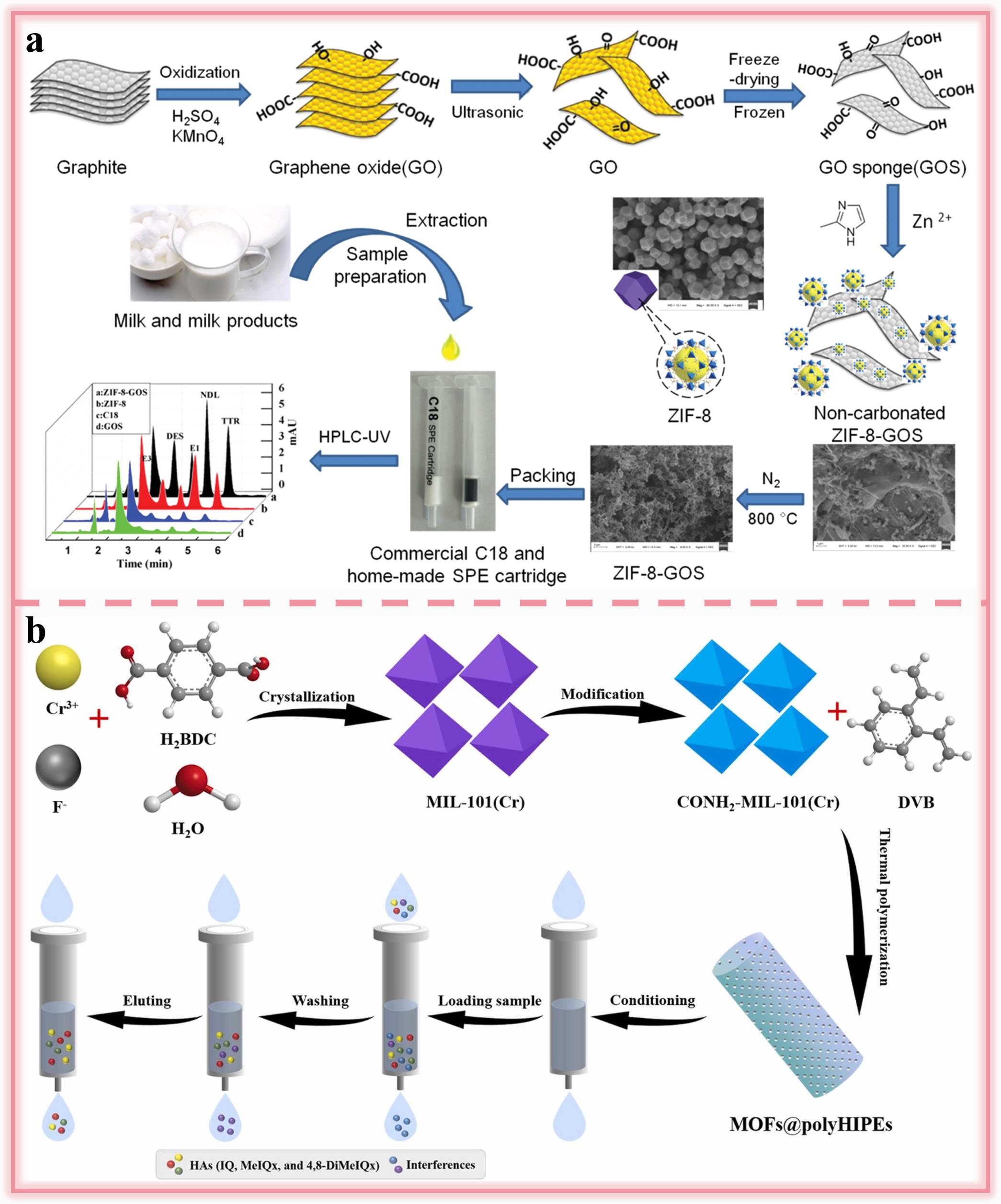
图1 (a)SPE吸附剂制备及结合HPLC测定牛奶和奶制品中性激素的流程图[35]和(b)使用MOFs@PolyHIPEs对HAs的固相萃取程序示意图[37]
Fig. 1 (a)Schematic diagram of the preparation of solid-phase extraction (SPE) adsorbent and coupled high performance liquid chromatography (HPLC) for the determination of sex hormones in milk and milk products[35] and (b) schematics of the SPE procedure for heterocyclic amines (HAs) using the MOFs@polyHIPEs[37]DVB: divinylbenzene; MOFs: metal-organic frameworks.
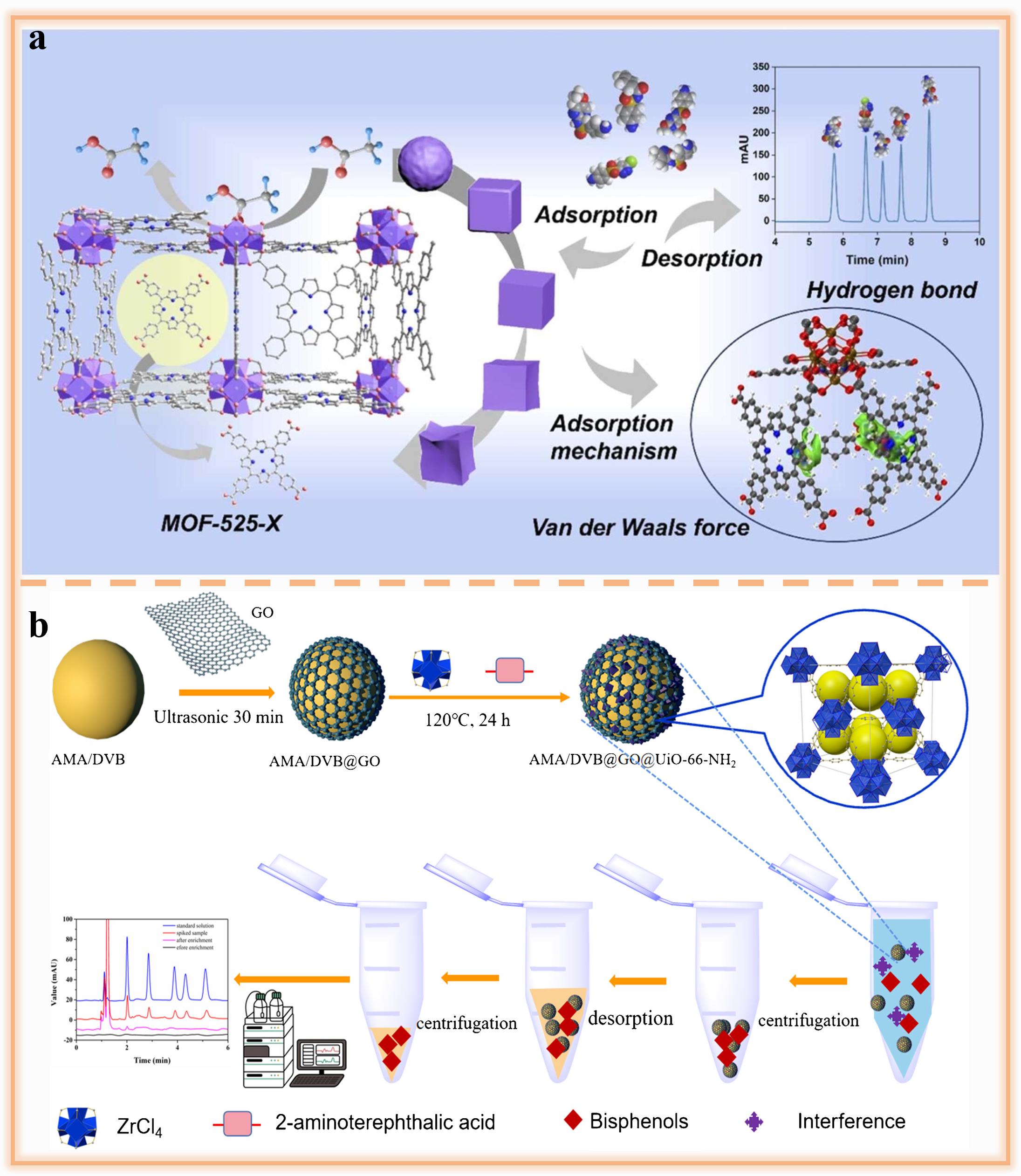
图2 (a)酸调制MOF-525-X材料的制备及其与SAs的作用机理示意图[42]和(b)AMA/DVB@GO@Uio-66-NH2的制备及应用图示[43]
Fig. 2 (a) Schematic illustration of the synthesis of acid-modulated MOF-525-X materials and their interaction mechanism with sulfonamide antibiotics (SAs)[42] and (b) illustration of the preparation and application of AMA/DVB@GO@UiO-66-NH2[43] AMA: allylmethacrylate; GO: graphene oxide.
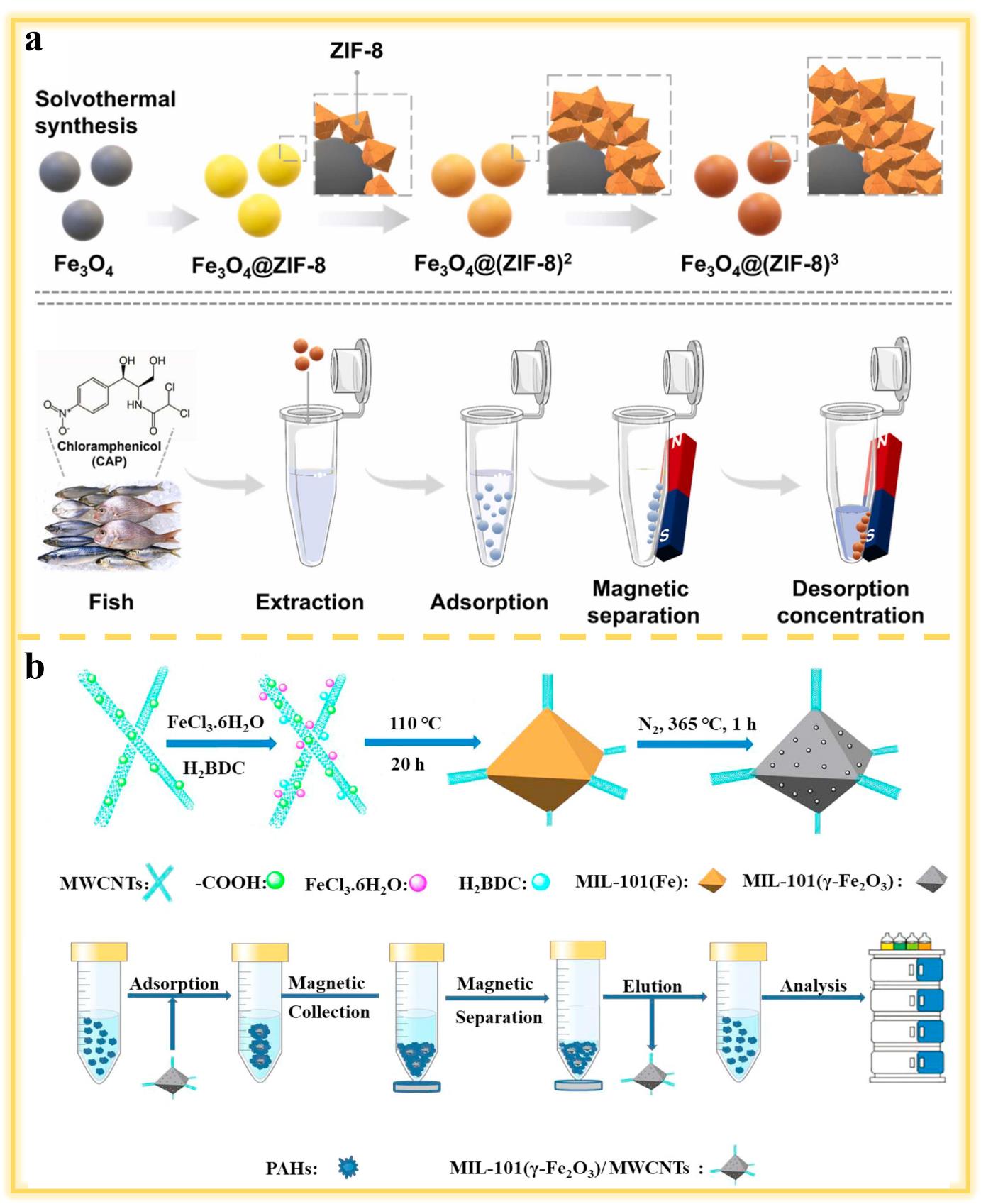
图3 (a)Fe3O4@(ZIF-8)3的合成及其MSPE的流程示意图[48]和(b)MIL-101(γ-Fe2O3)/MWCNTs的制备及其用于MSPE-HPLC的示意图[50]
Fig. 3 (a) Schematic diagram of the synthesis of Fe3O4@(ZIF-8)3 and its magnetic solid-phase extraction (MSPE) process[48] and (b) schematic illustration of the preparation of MIL-101(γ-Fe₂O₃)/MWCNTs and its application in MSPE-HPLC[50]MWCNTs: multi-walled carbon nanotubes; H2BDC: 1,4-dicarboxybenzene; PAHs: polycyclic aromatic hydrocarbons.
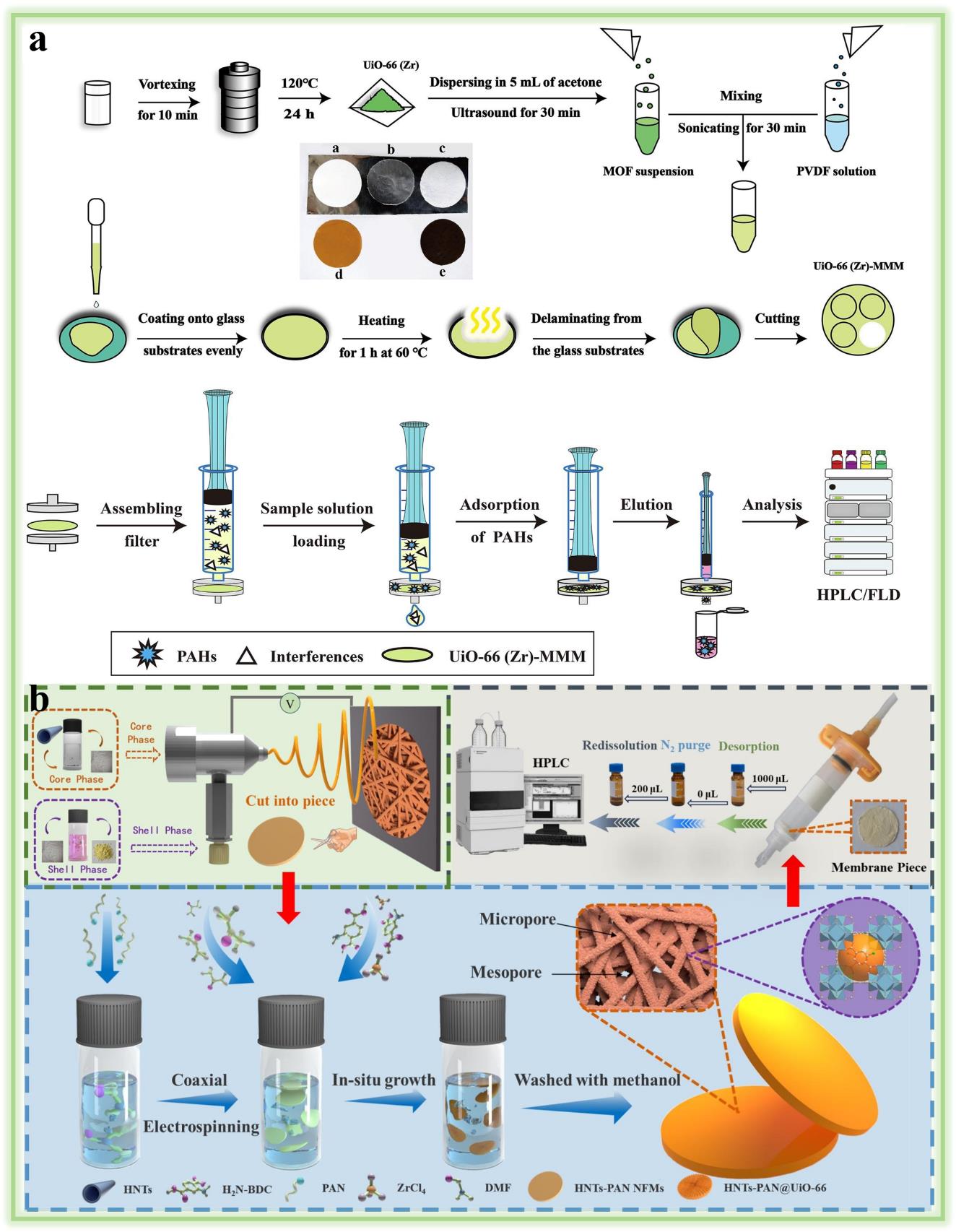
图4 (a)UiO-66(Zr)-MMM的制备过程及SMME萃取流程示意图[53]和(b)HNTs-PAN@UiO-66膜和集成萃取平台的制备原理图以及ME工艺[24]
Fig. 4 (a) Schematic diagram of the fabrication process of Uio-66(Zr)-MMM and its syringe membrane-based microextraction(SMME) extraction procedure[53] and (b) schematic of preparation of HNTs-PAN@UiO-66 membrane and the integrated extraction platform as well as the membrane extraction (ME) process[24]PVDF: polyvinylidene fluoride; MMM: mixed matrix membrane; FLD: fluorescence detector; HNTs: hallysite nanotubes; H2N-BDC: 2-aminoterephthalic acid; PAN: polyacrylonitrile; NFMs: nanofiber membranes.
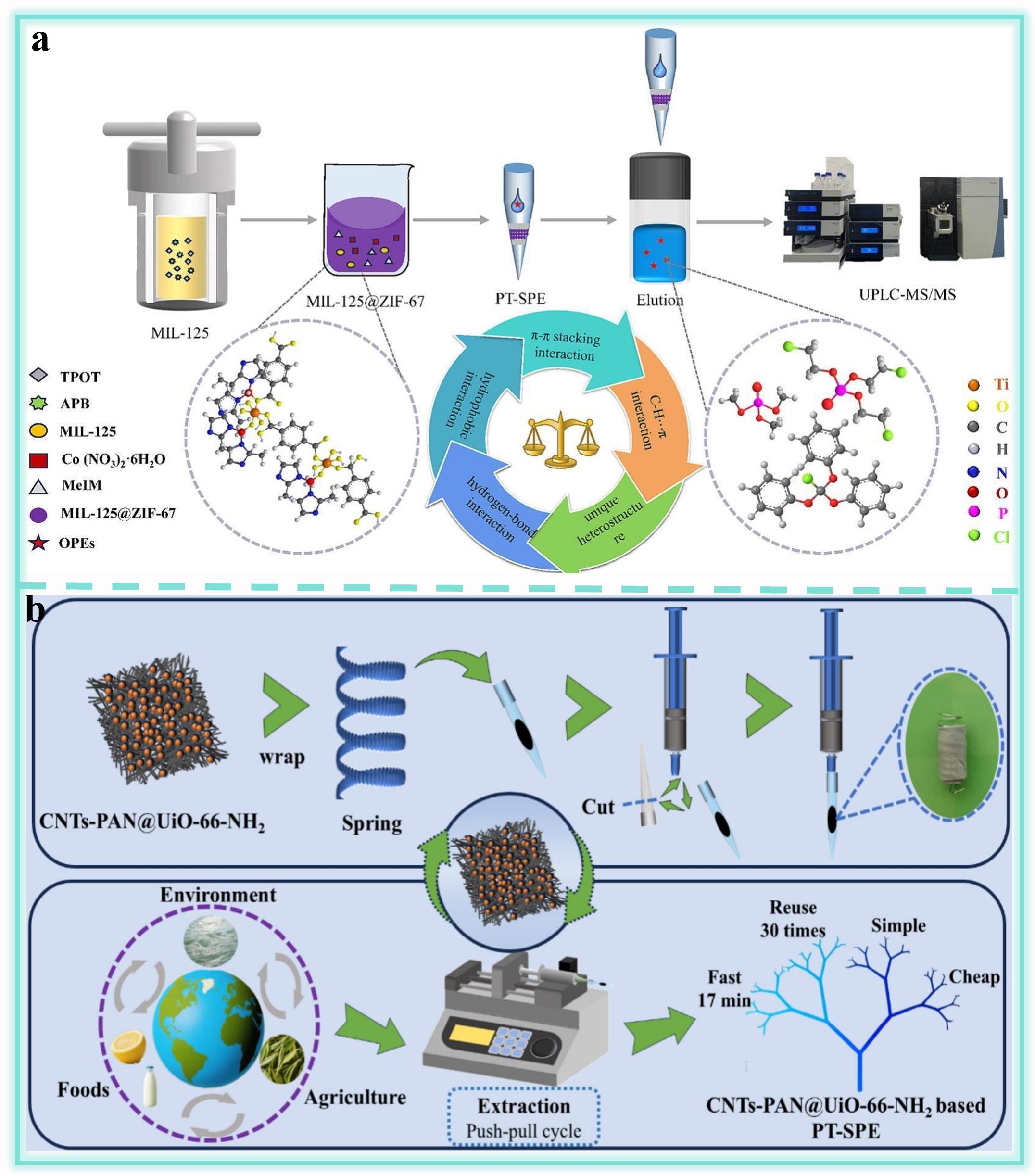
图5 (a)MIL-125@ZIF-67的制备及其PT-SPE萃取流程示意图[56]和(b)基于双增强CNTs-PAN@UiO-66-NH2 NFM的PT-SPE制备示意图和萃取步骤[22]
Fig. 5 (a) Schematic diagram of the fabrication process of MIL-125@ZIF-67 and its PT-SPE extraction procedure[56] and (b) schematic of the preparation of PT-SPE based on dually enhanced CNTs-PAN@UiO-66-NH2 NFM and extraction procedures[22]TPOT: triphenylmethane sulfonamide; APB: 2-aminoterephthalic acid; MeIM: methylimidazole; OPEs: organophosphate esters; PT-SPE: pipette tip solid-phase extraction; UPLC-MS/MS: ultra-high performance liquid chromatography-tandem mass spectrometry; CNTs: carbon nanotubes; PAN: polyacrylonitrile.
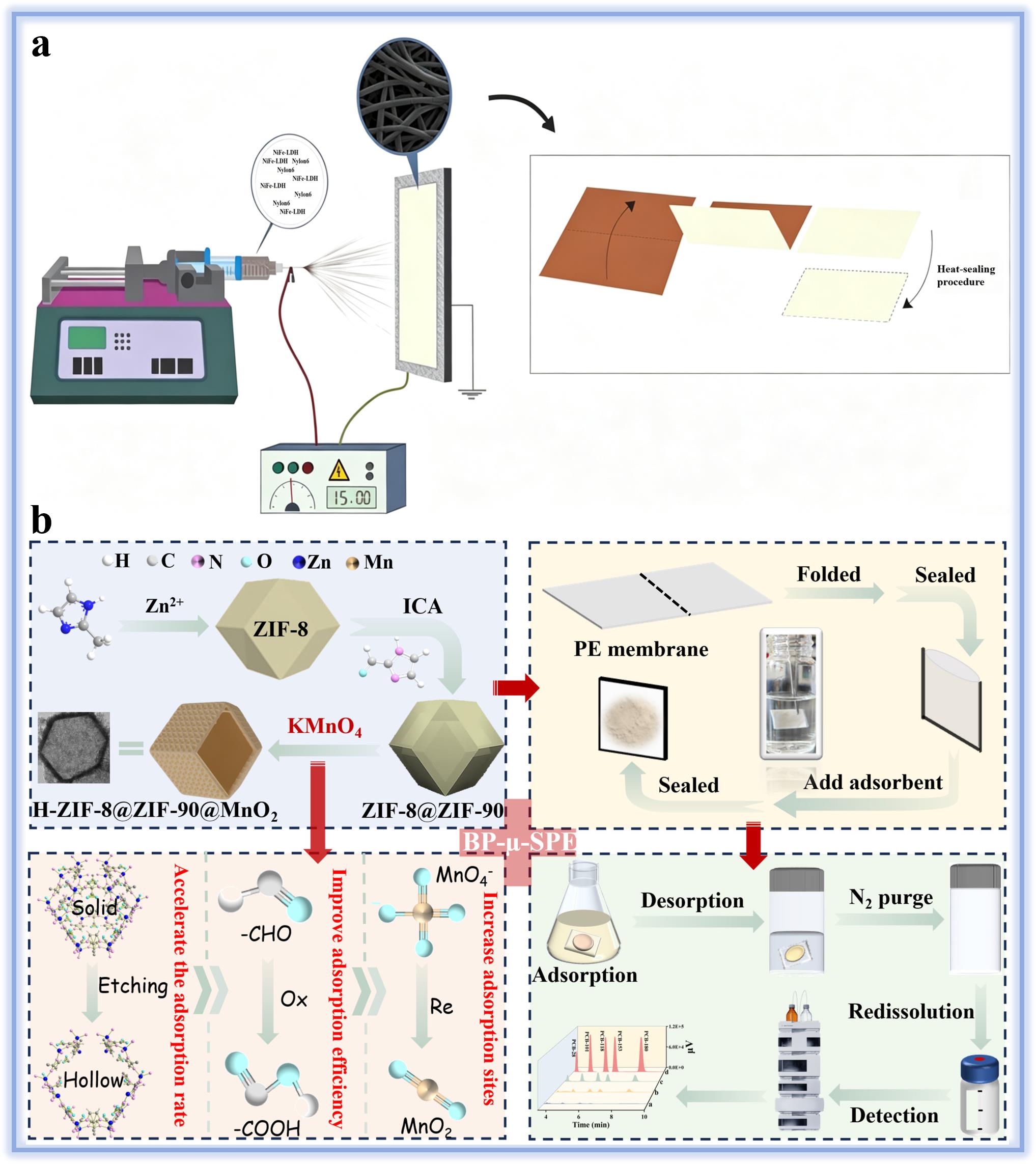
图6 (a)NiFe-LDH/尼龙6复合电纺纳米纤维制备和MP-μ-SPE器件制备程序的示意图[59]和(b)H-ZIF-8@ZIF-90@MnO2的制备原理及BP-μ-SPE工艺[23]
Fig. 6 (a) Schematic presentation of NiFe-LDH/Nylon 6 composite electrospun nanofiber fabrication and MP-μ-SPE device preparation procedure[59] and (b) schematic of preparation of H-ZIF-8@ZIF-90@MnO2 and the BP-μ-SPE process[23]ICA: imidazole-2-formaldehyde; PE: polyethylene; Ox: oxidation; Re: reduction; MP-μ-SPE: porous membrane-protected micro-solid-phase extraction; BP-μ-SPE: bag-protected micro-solid-phase extraction.
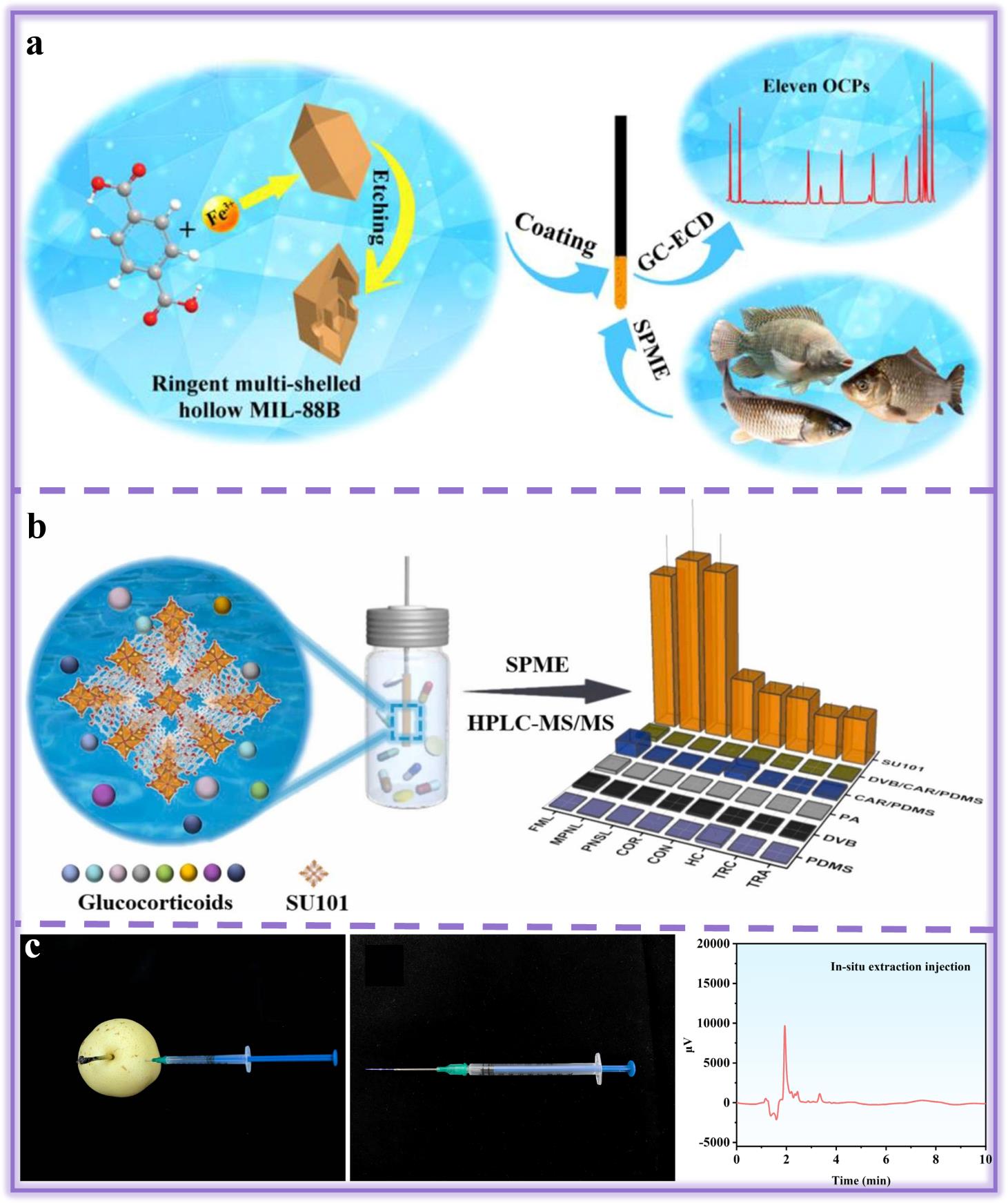
图7 (a)RMH-MIL-88B的制备及DI-SPME-GC-ECD流程示意图[69]、(b)SU101-DI-SPME-HPLC-MS/MS方法示意图以及其与商业纤维的比较[72]和(c)纤维SPME装置在原位提取过程中和之后的照片以及萃取结果的色谱图[73]
Fig. 7 (a) Schematic diagram of the fabrication of RMH-MIL-88B and its DI-SPME-GC-ECD procedure[69], (b) schematic diagram of the SU101-DI-SPME-HPLC-MS/MS method and its comparison with commercial fibers[72] and (c) Photographs of the fiber-SPME device during and after in-situ extraction, and the chromatogram of the extraction results[73]OCPs: organochlorine pesticides; GC-ECD: gas chromatography-electron capture detection; SPME: solid-phase microextraction; FML: fluorometholone; MPNL: methylprednisolone; PNSL: prednisolone; COR: cortisone; HC: cortisol; TRC: triamcinolone; TRA: triamcinolone acetonide; CAR: carboxen; PDMS: polydimethylsiloxane; PA: polyacrylate; DI: direct immersion.
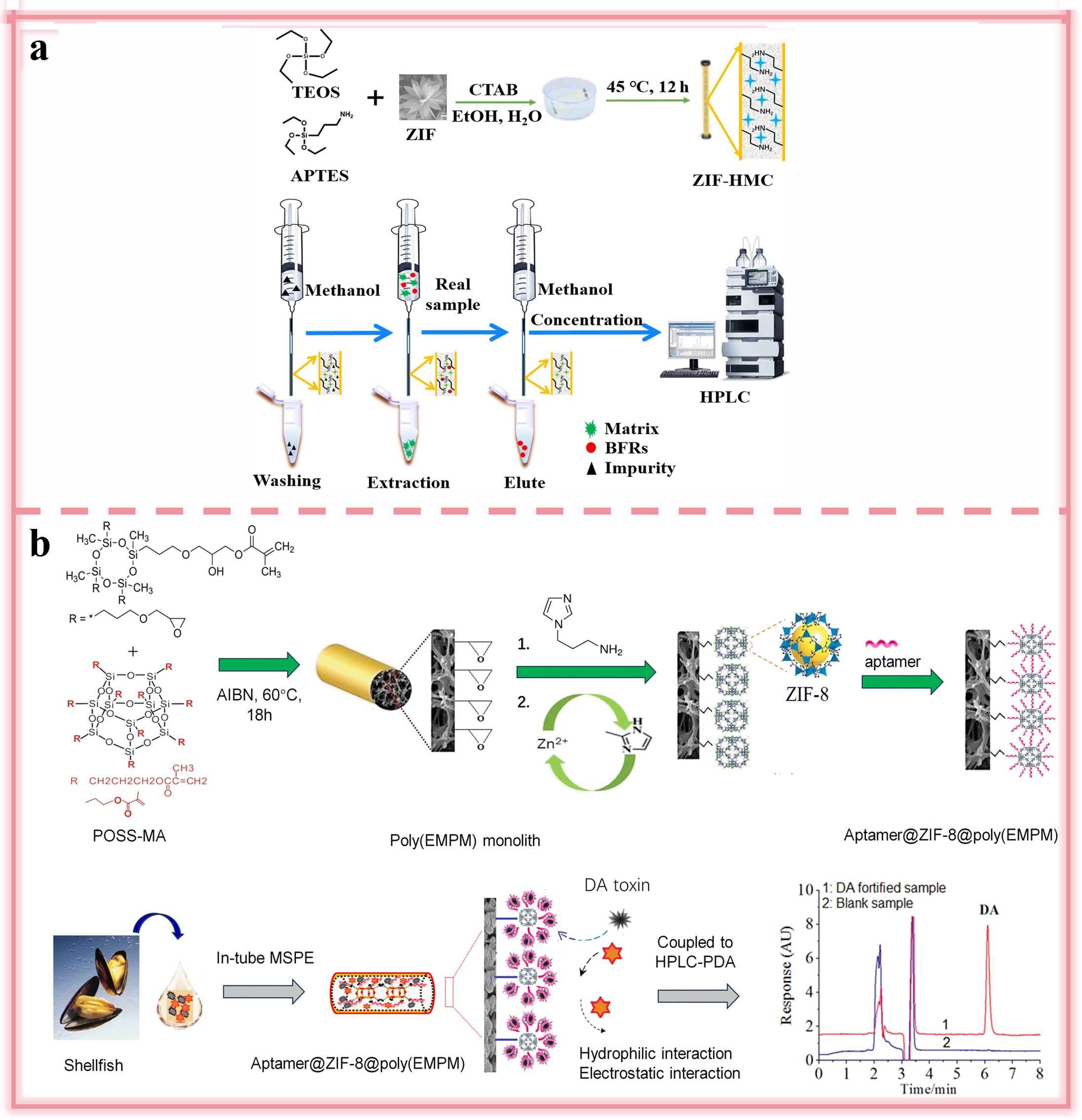
图8 (a)ZIF-HMC的制备及CME应用示意图[77]和(b)适配体@ZIF-8-MOF修饰亲和整体柱的制备方案[80]
Fig. 8 (a) Schematic diagram for the preparation of ZIF-HMC and the application of CME[77] and (b) preparation scheme for the aptamer@ZIF-8-MOF-modified affinity monolithic column[80]ZIF-HMC: zeolitic imidazolate framework doped organic-inorganic hybrid monolithic column; CME: capillary microextraction; TEOS: tetraethyl orthosilicate; APTES: 3-aminopropyltriethoxysilane; ZIF: zeolitic imidazolate framework; CTAB: cetyltrimethyl ammonium bromide; HMC: hybrid monolithic column; BFRs: brominated flame retardants; POSS-MA: polyhedral oligomeric silsesquioxane-methacryl substituted; AIBN: 2,2′-azobis(2-methylpropionitrile); poly(EMPM): poly(epoxy-methacryl trisepoxy cyclosiloxane-co-polyhedral oligomeric silsesquioxane-methacryl substituted); DA: domoic acid; MSPE: magnetic solid-phase extraction; PDA: photo-diode array.
|
| [1] | 詹昆松, 唐明珠, 林颖, 倪林君, 余丽双. 铁卟啉金属有机框架材料用于高效富集地龙多肽[J]. 色谱, 2026, 44(8): 960-967. |
| [2] | 李世杰, 李振, 汤紫霞, 吕美, 王利涛. 基于混合模式的高效液相色谱固定相研究进展[J]. 色谱, 2026, 44(6): 615-628. |
| [3] | 张羽凡, 夏静雯, 朱佳源, 曾茂盛, 白静怡, 徐琴, 高杭. 分子印迹聚合物在急性冠脉综合征生物标志物测定传感器中的应用[J]. 色谱, 2026, 44(2): 180-190. |
| [4] | 李菲, 贾保林, 胡乔, 何锡文, 陈朗星, 张玉奎. 分子印迹聚合物:新型绿色制备方法与前沿应用综述[J]. 色谱, 2026, 44(2): 119-133. |
| [5] | 刘莉萌, 解文哲, 曲艳莹, 蔡天培, 李东浩, 商海波. 光响应金属-有机骨架结构特征与吸附分离性能动态调控[J]. 色谱, 2026, 44(10): 1150-1161. |
| [6] | 王璇, 王春晓, 夏炎. 三氟乙酸调控合成缺陷型UiO-66用于高效去除全氟壬烯氧基苯磺酸钠[J]. 色谱, 2026, 44(10): 1223-1232. |
| [7] | 黄泽鑫, 汤胜. 基于硅胶基质多孔材料的液相色谱固定相研究进展[J]. 色谱, 2026, 44(10): 1118-1128. |
| [8] | 李赛楠, 殷小菊, 刘家玮, 杨旸, 白泉. 氟功能化锆基金属有机框架负载薄膜微萃取阵列用于草甘膦残留的高通量分析[J]. 色谱, 2026, 44(10): 1233-1242. |
| [9] | 吴江毅, 黄晓佳. 电场辅助分子印迹技术进展[J]. 色谱, 2026, 44(1): 43-52. |
| [10] | 袁雪婷, 王亮, 陈鲁茜, 胡良海. 靶向生物膜的分子印迹策略与进展[J]. 色谱, 2026, 44(1): 30-42. |
| [11] | 黄晶滢, 闫敬怡, 齐骥, 陈令新, 李金花. 基于金属/共价有机框架分子印迹材料的固相萃取结合色谱/质谱在海岸带新污染物筛查识别中的应用[J]. 色谱, 2025, 43(8): 841-856. |
| [12] | 徐启彤, 余濛, 谢畅, 曹衍, 梅素容. 多孔材料基吸附剂在环境和食品样品中提取农药残留物的最新应用[J]. 色谱, 2025, 43(7): 713-725. |
| [13] | 周鼎, 郭丹丹, 朱岩. 聚酰胺-胺树状大分子功能化离子型分离介质研究进展[J]. 色谱, 2025, 43(7): 726-733. |
| [14] | 骆娅娜, 陈珈, 胡宇宇, 高世杰, 王艳丽, 刘艳明, 冯娟娟, 孙敏. 磁增强管内固相微萃取的材料制备及应用进展[J]. 色谱, 2025, 43(6): 606-619. |
| [15] | 钱柬坤, 何润茗, 方珂, 李晨龙, 鲍珊, 顾雯, 唐宋. 人体内多环芳烃及其衍生物的代谢转化研究进展[J]. 色谱, 2025, 43(6): 571-584. |
| 阅读次数 | ||||||
|
全文 |
|
|||||
|
摘要 |
|
|||||
