
Chinese Journal of Chromatography ›› 2026, Vol. 44 ›› Issue (6): 705-712.DOI: 10.3724/SP.J.1123.2025.08010
• Teaching Research • Previous Articles Next Articles
LI Shuang*( ), ZHU Yiling, REN Zhen, GAO Dangdang, GU Helin, LAO Junlang
Received:2025-08-15
Online:2026-06-08
Published:2026-06-03
Supported by:CLC Number:
LI Shuang, ZHU Yiling, REN Zhen, GAO Dangdang, GU Helin, LAO Junlang. Revolution teaching practice in sample pretreatment supported by large-scale instrument: a case study of magnetic covalent organic framework enriching organic ultraviolet filters in seawater[J]. Chinese Journal of Chromatography, 2026, 44(6): 705-712.
Add to citation manager EndNote|Ris|BibTeX
URL: https://www.chrom-china.com/EN/10.3724/SP.J.1123.2025.08010
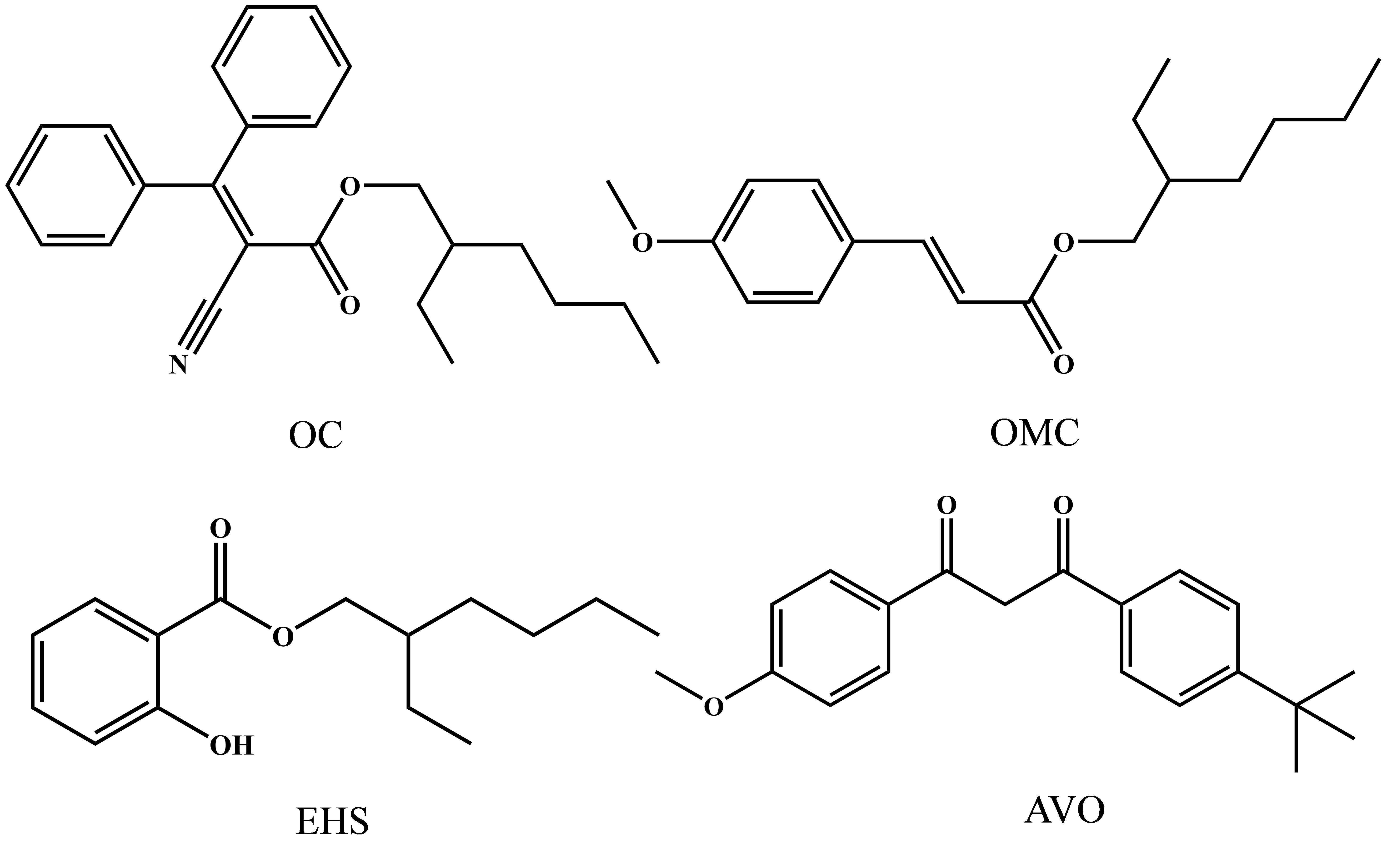
Fig. 1 Structural formulas of the four organic ultraviolet filters (OUVFs)OC: octocrylene; OMC: octyl methoxycinnamate; EHS: ethylhexyl salicylate; AVO: avobenzone.
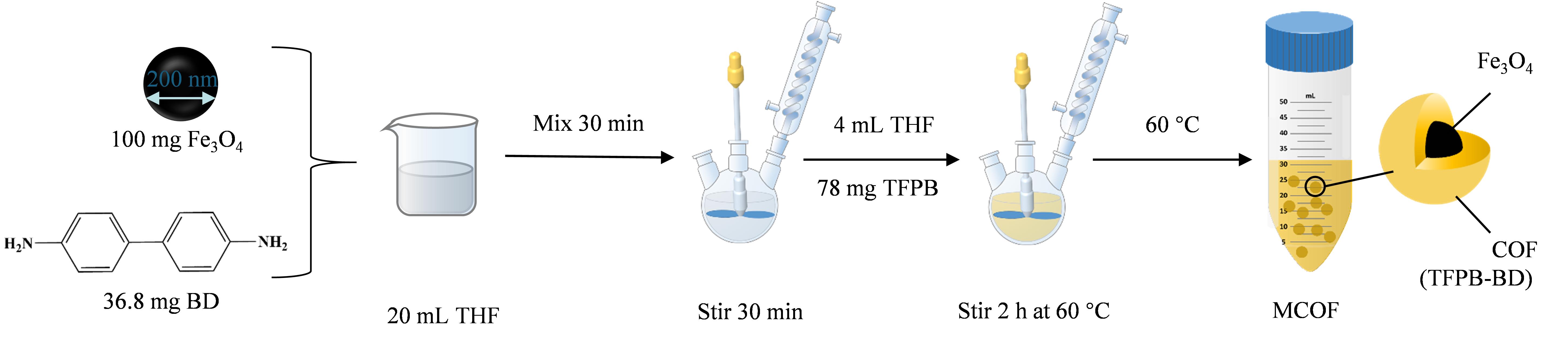
Fig. 2 Synthesis process of Fe3O4@TFPB-BDBD: benzidine; THF: tetrahydrofuran; TFPB: 4-[3,5-bis(4-formylphenyl)phenyl]ben-zaldehyde; COF: covalent organic framework; MCOF: magnetic covalent organic framework.

Fig. 3 Procedure of magnetic solid phase extraction
| Analyte | Mr | pKa | lg Kow | tR/min | Precursor ion (m/z) | Product ions (m/z) | Declustering potentials/V | Collision energies/eV |
|---|---|---|---|---|---|---|---|---|
| OC | 361.5 | 7.5 | 6.4 | 8.7 | 362.1 | 250.1*, 231.9 | 45.4, 50.0 | 12.0, 29.0 |
| OMC | 290.4 | 7.5 | 5.0 | 9.0 | 291.3 | 179.0*, 161.0 | 45.8, 36.5 | 12.9, 26.4 |
| EHS | 250.3 | 8.1 | 4.4 | 9.2 | 251.1 | 120.9*, 138.9 | 33.3, 36.5 | 33.7, 12.6 |
| AVO | 310.4 | 9.7 | 4.3 | 8.9 | 311.0 | 161.0*, 135.1 | 52.9, 55.9 | 35.0, 30.7 |
Table 1 Physicochemical properties and MS parameters of the four OUVFs
| Analyte | Mr | pKa | lg Kow | tR/min | Precursor ion (m/z) | Product ions (m/z) | Declustering potentials/V | Collision energies/eV |
|---|---|---|---|---|---|---|---|---|
| OC | 361.5 | 7.5 | 6.4 | 8.7 | 362.1 | 250.1*, 231.9 | 45.4, 50.0 | 12.0, 29.0 |
| OMC | 290.4 | 7.5 | 5.0 | 9.0 | 291.3 | 179.0*, 161.0 | 45.8, 36.5 | 12.9, 26.4 |
| EHS | 250.3 | 8.1 | 4.4 | 9.2 | 251.1 | 120.9*, 138.9 | 33.3, 36.5 | 33.7, 12.6 |
| AVO | 310.4 | 9.7 | 4.3 | 8.9 | 311.0 | 161.0*, 135.1 | 52.9, 55.9 | 35.0, 30.7 |
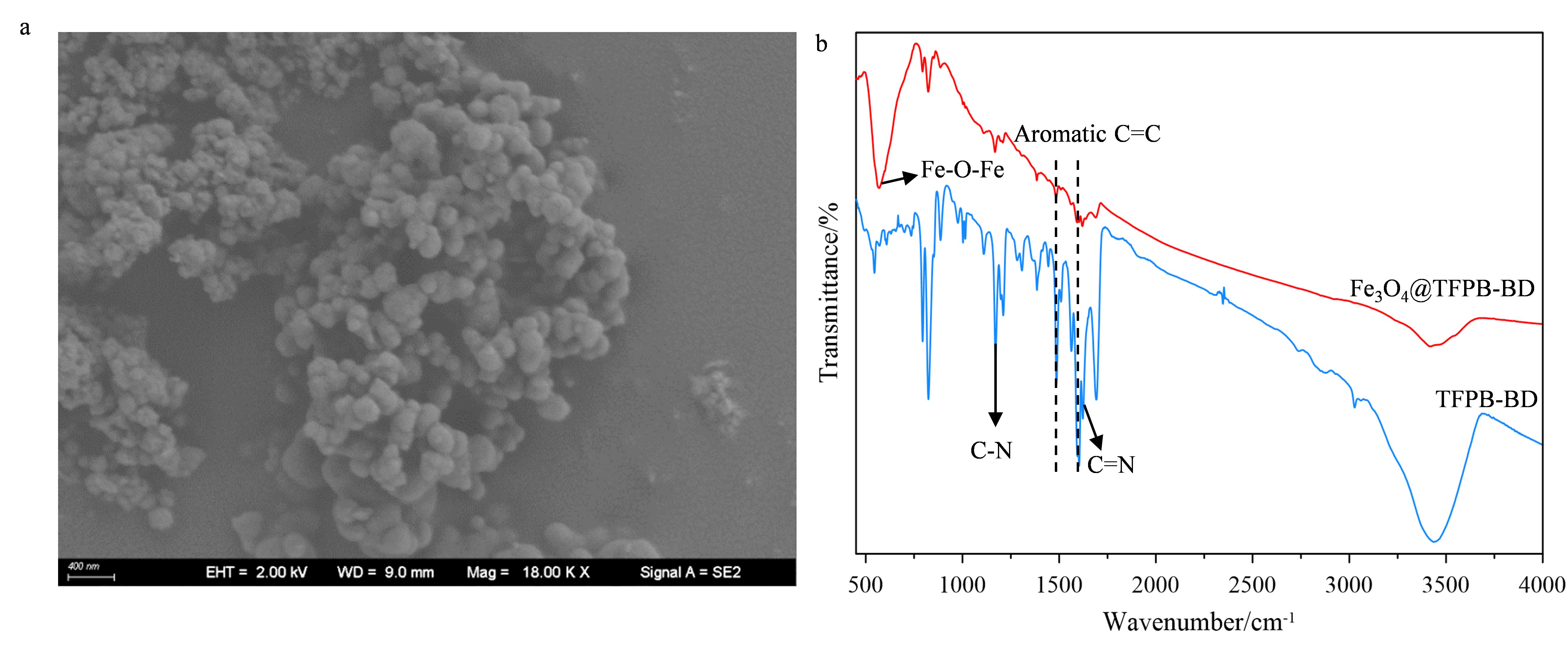
Fig. 4 (a) Microstructural image and (b) FT-IR spectra of Fe3O4@TFPB-BD
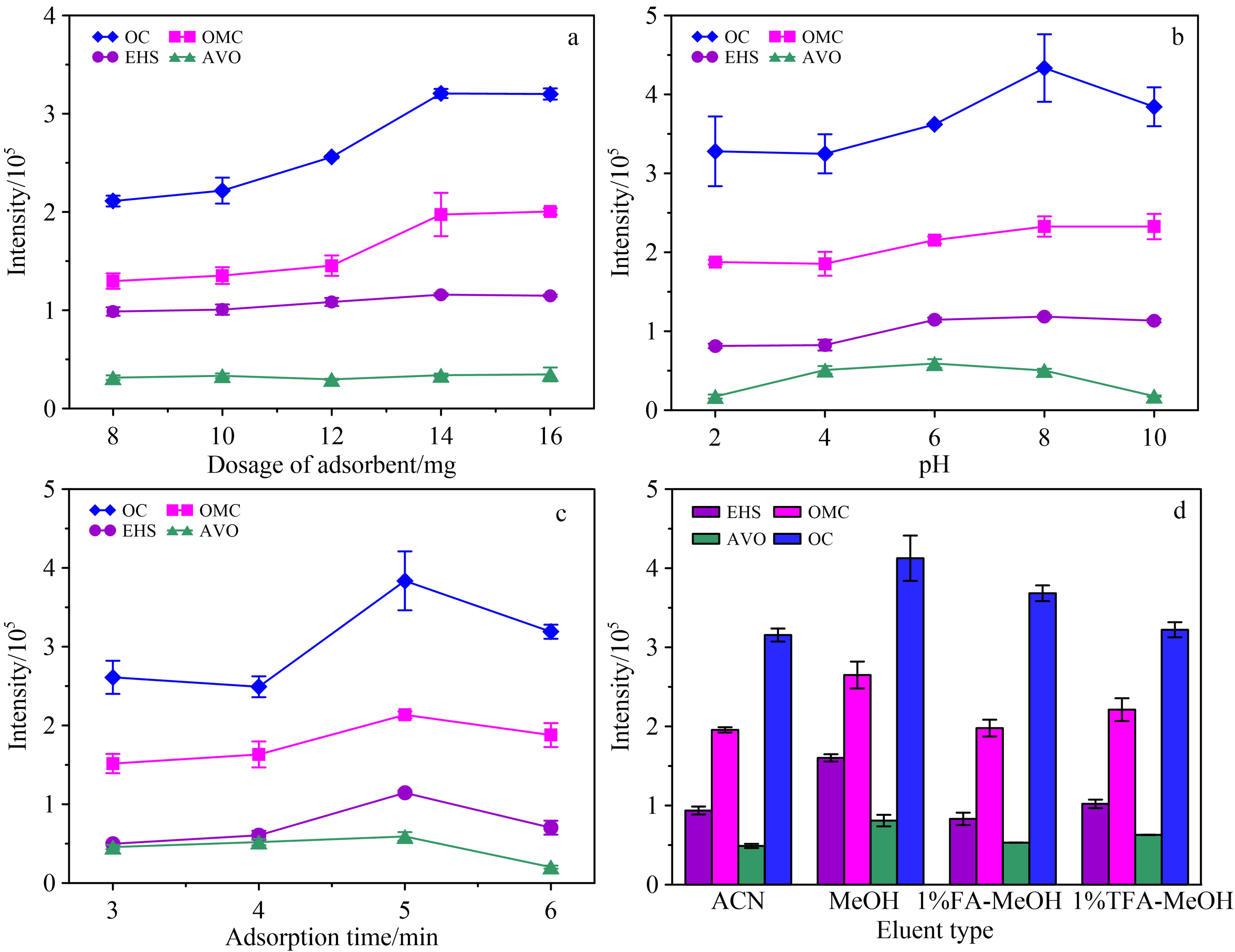
Fig. 5 Effects of (a) dosage of Fe3O4@TFPB-BD, (b) pH of water sample, (c) adsorption time and (d) type of eluent on the enrichment efficienciesACN: acetonitrile; MeOH: methanol; FA: formic acid; TFA: trifluoroacetic acid.
| OUVF | Regression equation | Correlation coefficient | Linear range/(ng/L) | LOD/(ng/L) | LOQ/(ng/L) | RSD/% |
|---|---|---|---|---|---|---|
| OC | y=109.95x+1579.61 | 0.9955 | 2‒2000 | 0.38 | 1.24 | 7.89‒14.87 |
| AVO | y=320.00x+67294.86 | 0.9998 | 2‒2000 | 0.29 | 0.94 | 9.15‒14.53 |
| OMC | y=170.44x‒1876.29 | 0.9905 | 2‒2000 | 0.23 | 0.77 | 0.97‒12.44 |
| EHS | y=11.65x+166.83 | 0.9973 | 2‒2000 | 0.34 | 1.13 | 9.48‒14.89 |
Table 2 Performance parameters of the analytical method for the four OUVFs
| OUVF | Regression equation | Correlation coefficient | Linear range/(ng/L) | LOD/(ng/L) | LOQ/(ng/L) | RSD/% |
|---|---|---|---|---|---|---|
| OC | y=109.95x+1579.61 | 0.9955 | 2‒2000 | 0.38 | 1.24 | 7.89‒14.87 |
| AVO | y=320.00x+67294.86 | 0.9998 | 2‒2000 | 0.29 | 0.94 | 9.15‒14.53 |
| OMC | y=170.44x‒1876.29 | 0.9905 | 2‒2000 | 0.23 | 0.77 | 0.97‒12.44 |
| EHS | y=11.65x+166.83 | 0.9973 | 2‒2000 | 0.34 | 1.13 | 9.48‒14.89 |
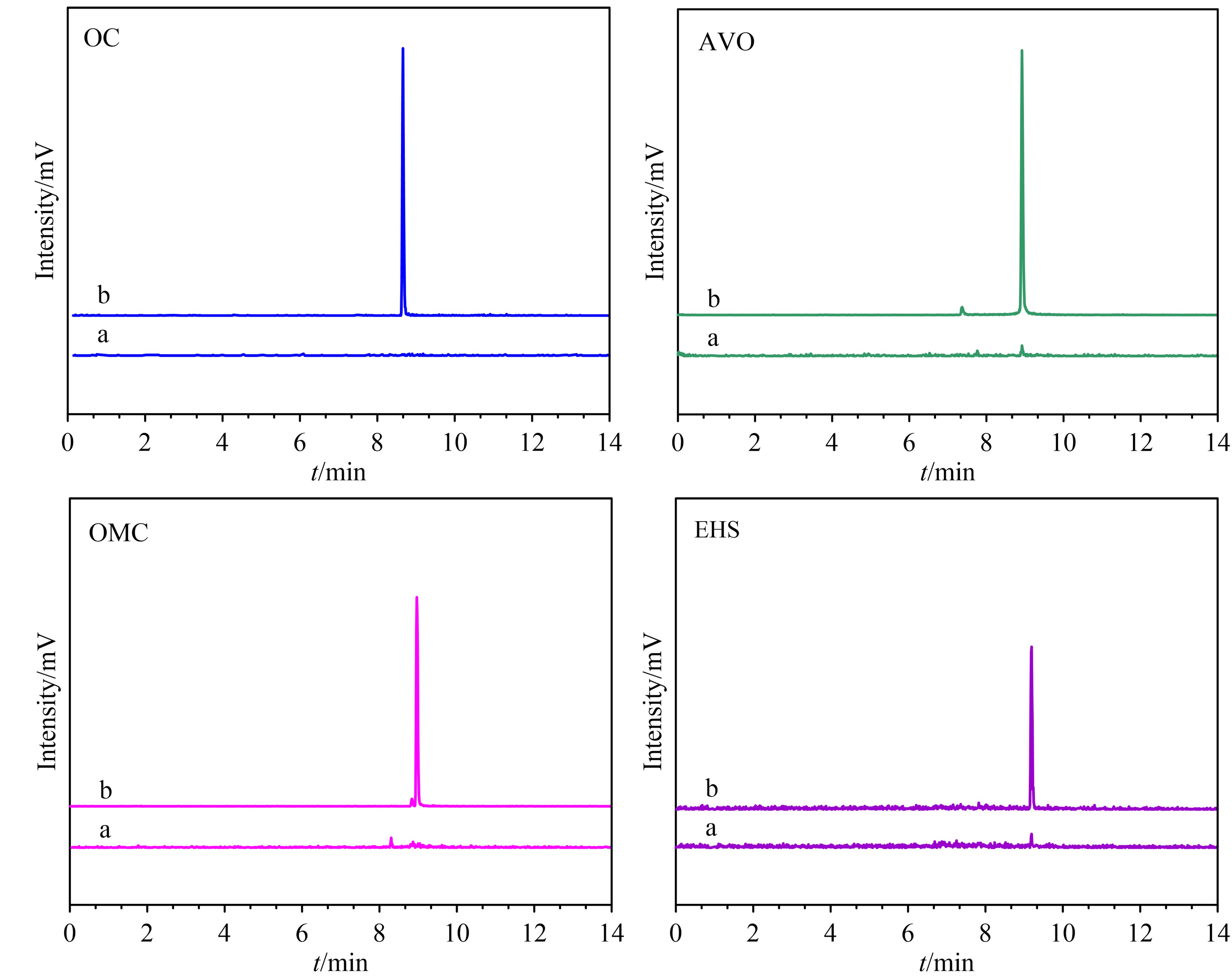
Fig. 6 Chromatograms of the four OUVFs in (a) a real seawater sample and (b) a spiked seawater sample (2?000 ng/L)
|
| Viewed | ||||||
|
Full text |
|
|||||
|
Abstract |
|
|||||


