
Chinese Journal of Chromatography ›› 2026, Vol. 44 ›› Issue (6): 639-649.DOI: 10.3724/SP.J.1123.2025.09020
• Articles • Previous Articles Next Articles
ZHAO Xingyun1,2,*( ), JIN Jiangyan1, LIU Xiaojian1, YAN Lijuan1, YANG Siyu1, ZHANG Zhenwei1, ZHANG Liyun2, WU Rongfang2,*()
Received:2025-10-14
Online:2026-06-08
Published:2026-06-03
Supported by:CLC Number:
ZHAO Xingyun, JIN Jiangyan, LIU Xiaojian, YAN Lijuan, YANG Siyu, ZHANG Zhenwei, ZHANG Liyun, WU Rongfang. Preparation of mesoporous covalent organic framework core-shell stationary phase and its application in the analysis of astragaloside Ⅳ content in Astragalus[J]. Chinese Journal of Chromatography, 2026, 44(6): 639-649.
Add to citation manager EndNote|Ris|BibTeX
URL: https://www.chrom-china.com/EN/10.3724/SP.J.1123.2025.09020
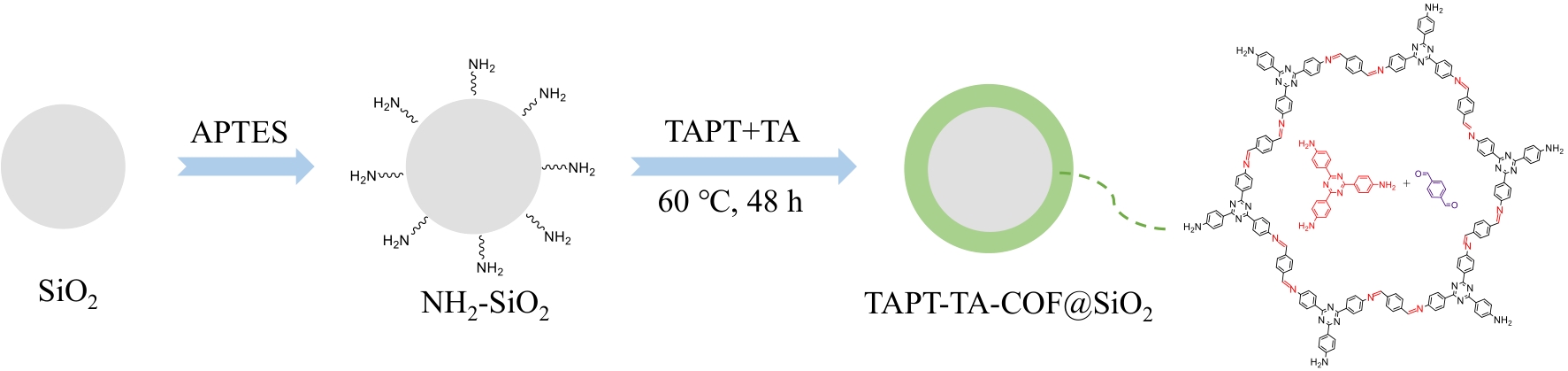
Fig. 1 Preparation schedule of the designed TAPT-TA-COF@SiO2 materialsAPTES: aminopropyl triethoxysilane; TAPT: 2,4,6-tris(4-aminophenyl)-1,3,5-triazine; TA: 1,4-benzenedialdehyde.
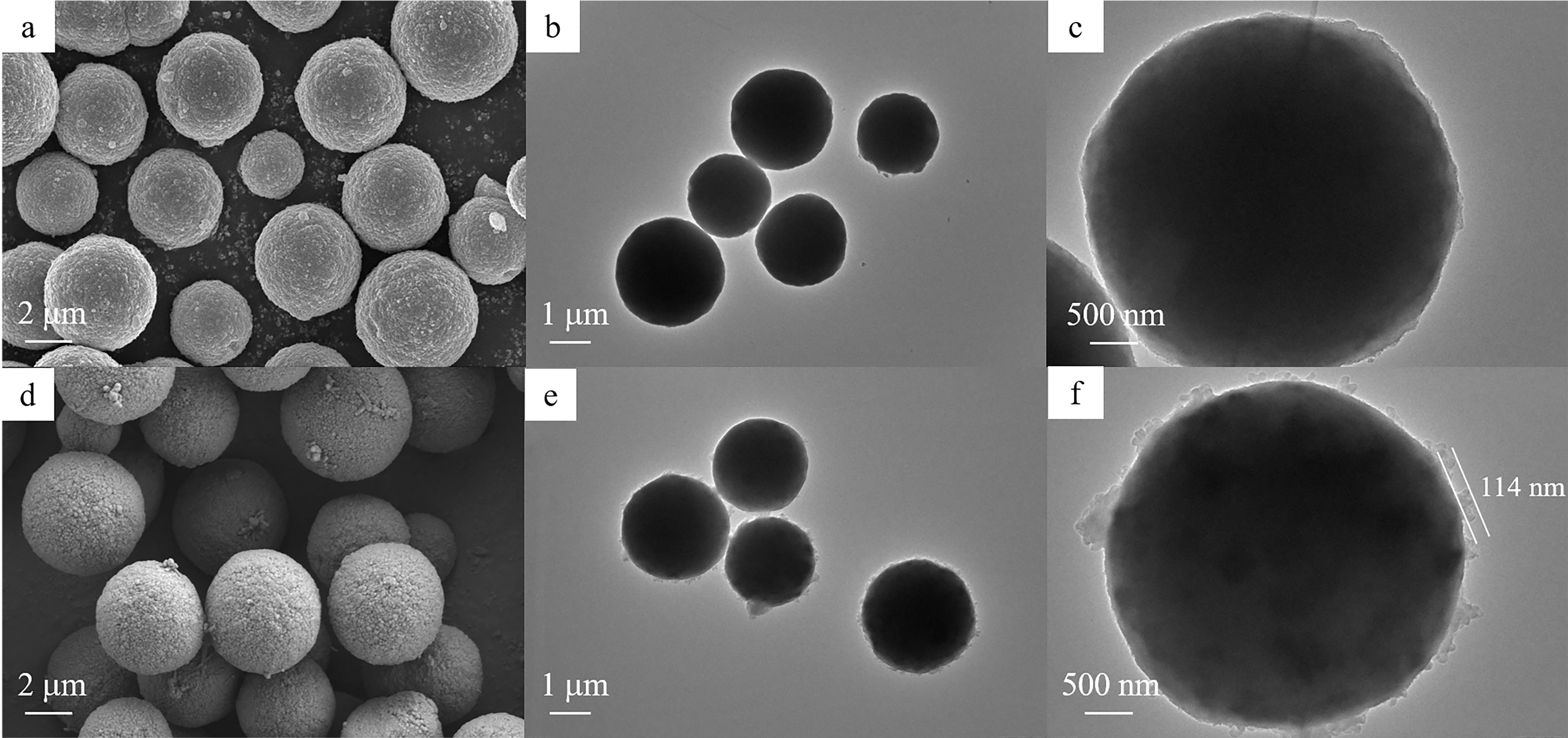
Fig. 2 SEM and TEM images of (a-c) SiO2 and (d-f) TAPT-TA-COF@SiO2 materials
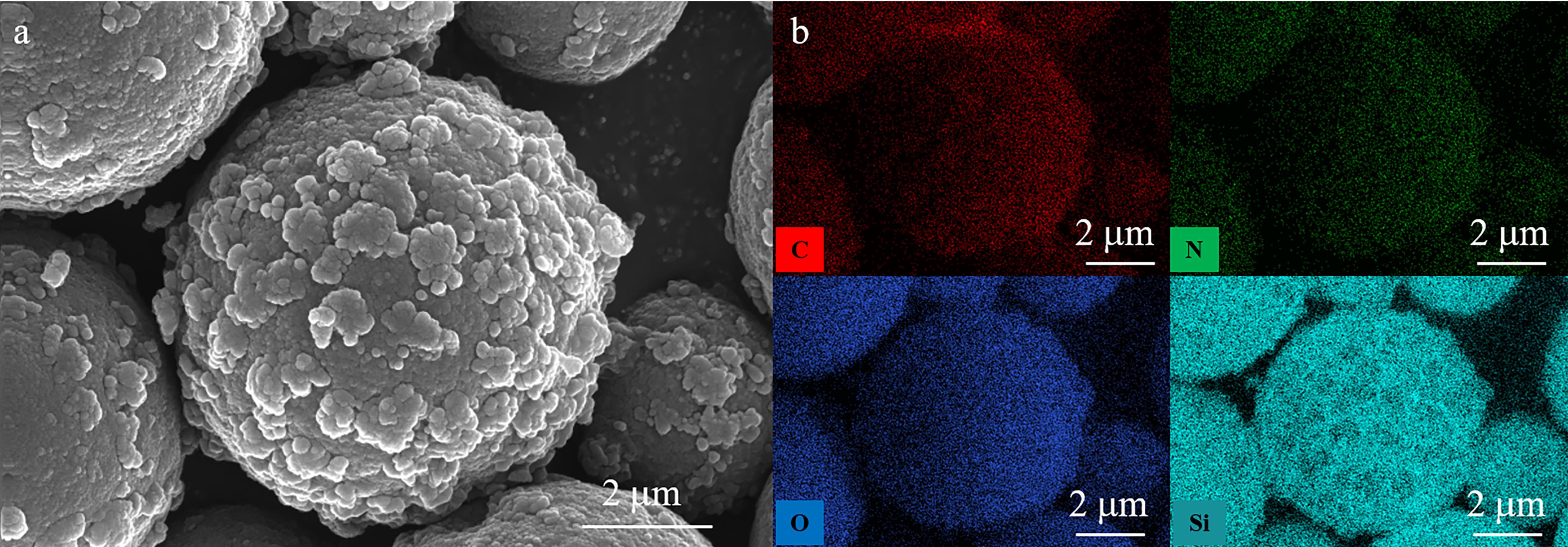
Fig. 3 (a) SEM images and (b) elemental mapping of the TAPT-TA-COF@SiO2
| Element | Weight/% | Atom/% |
|---|---|---|
| C | 22.77 | 32.64 |
| N | 6.96 | 8.55 |
| O | 33.95 | 36.54 |
| Si | 36.32 | 22.27 |
Table 1 Element contents of the TAPT-TA-COF@SiO2
| Element | Weight/% | Atom/% |
|---|---|---|
| C | 22.77 | 32.64 |
| N | 6.96 | 8.55 |
| O | 33.95 | 36.54 |
| Si | 36.32 | 22.27 |
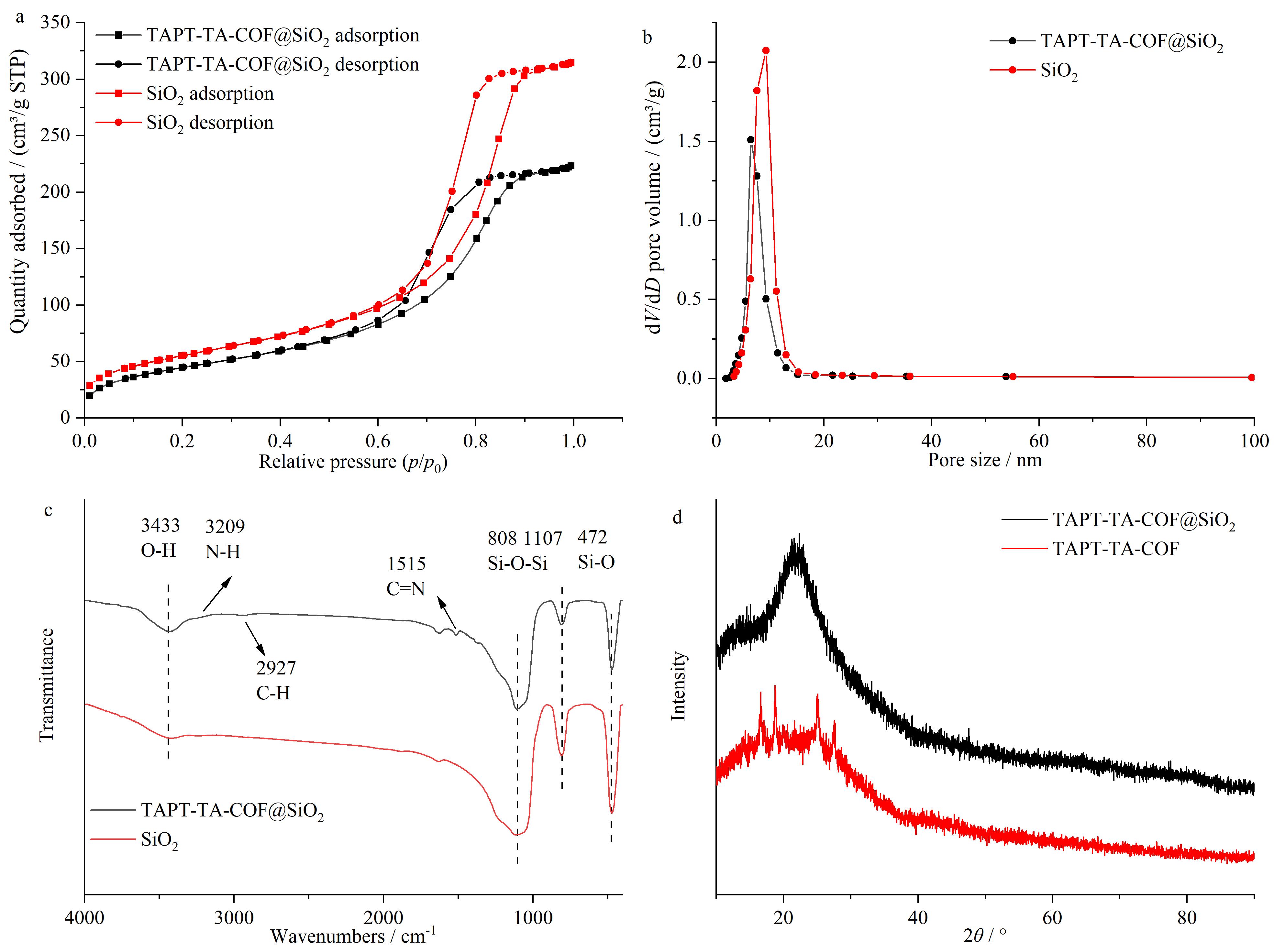
Fig. 4 (a) N2 adsorption-desorption isotherms, (b) pore size distribution curves, (c) Fourier-transformed infrared spectra of SiO2 and TAPT-TA-COF@SiO2 materials, and (d) powder X-Ray diffraction characterization of TAPT-TA-COF and TAPT-TA-COF@SiO2
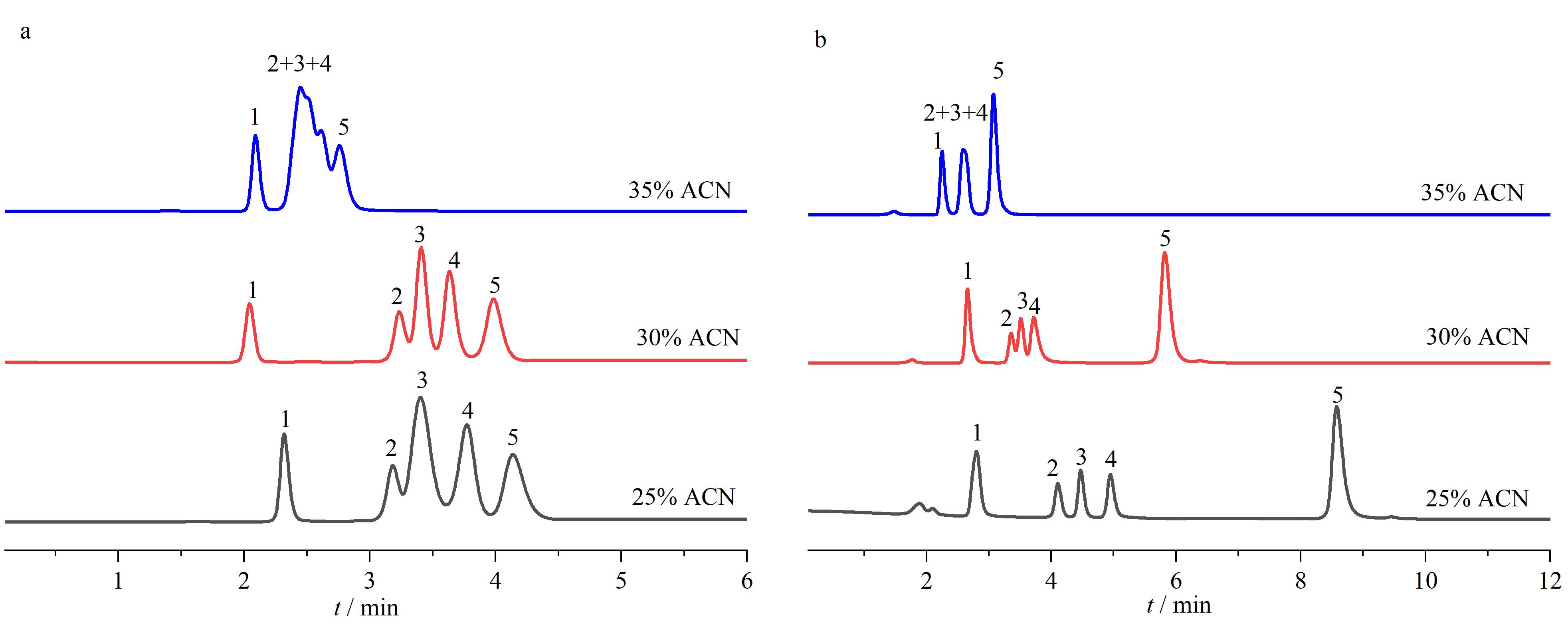
Fig. 5 Chromatograms for the separation of (a) benzenes and (b) alkylbenzenes on the TAPT-TA-COF@SiO2 column at different volume fractions of acetonitrile in the mobile phaseFor Fig. 5a: 1. thiourea; 2. toluene; 3. ethylbenzene; 4. propyl benzene; 5. butylbenzene; for Fig. 5b: 1. uracil; 2. acetophenone; 3. toluene; 4. ethylbenzene; 5. fluorene.
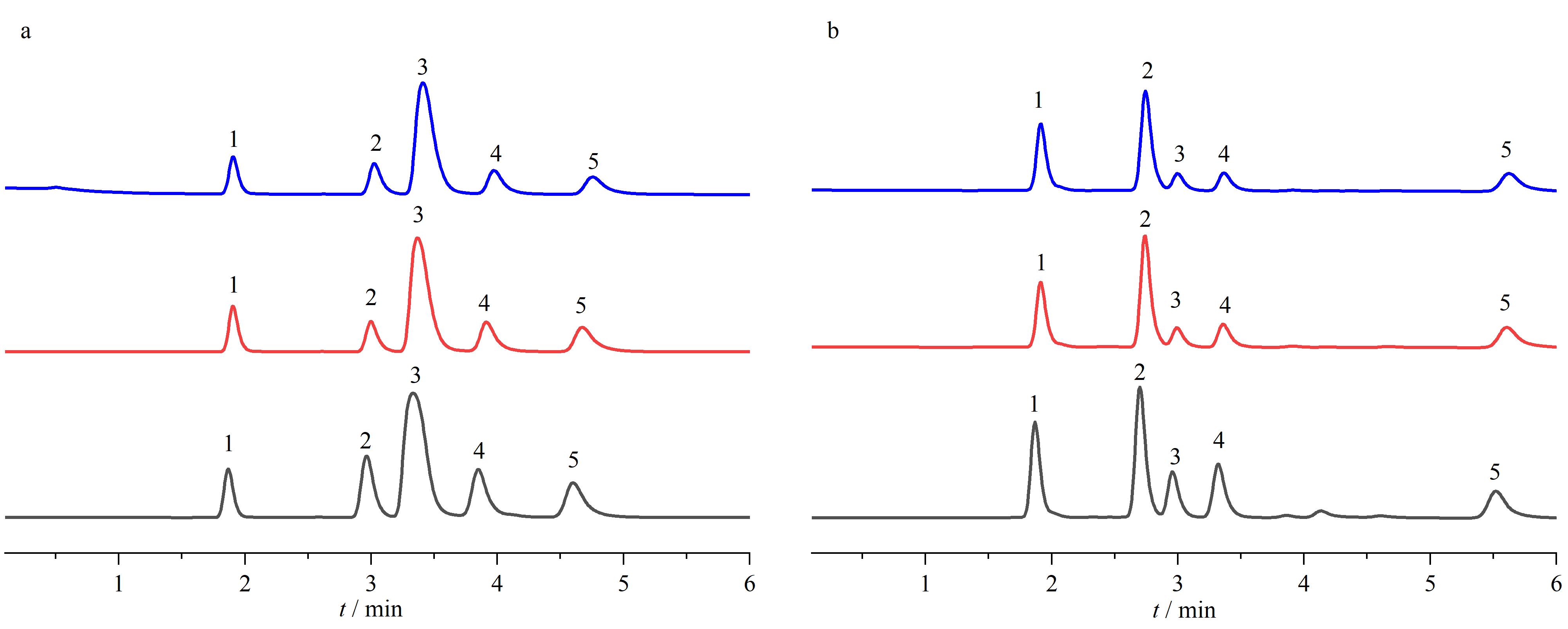
Fig. 6 Investigation of the separation repeatability of (a) benzenes and (b) alkylbenzenes on the TAPT-TA COF@SiO2 columnFor Fig. 6a: 1. thiourea; 2. toluene; 3. ethylbenzene; 4. propyl benzene; 5. butylbenzene; for Fig. 6b: 1. uracil; 2. acetophenone; 3. toluene; 4. ethylbenzene; 5. fluorene.
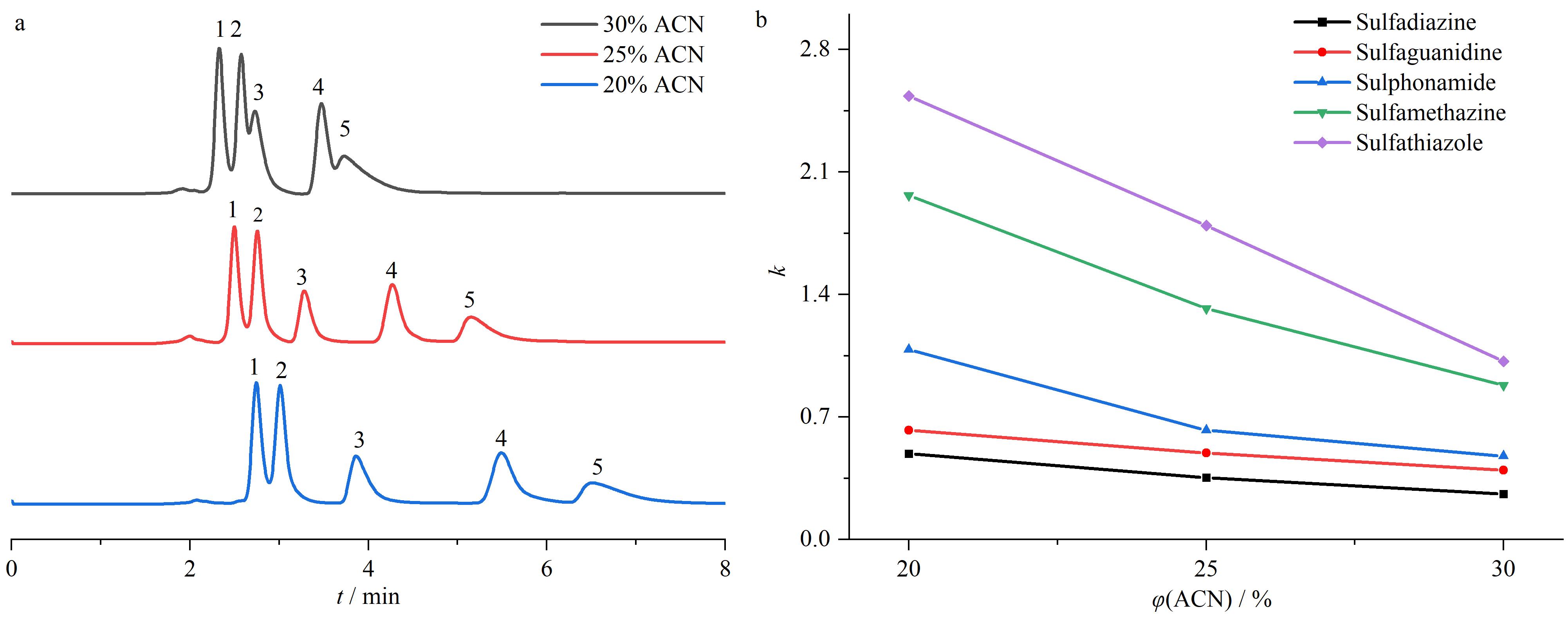
Fig. 7 Effects of different acetonitrile volume fractions in the mobile phase on (a) separation performance and (b) retention factors of sulfonamides using a TAPT-TA-COF@SiO? chromatographic columnFor Fig. 7a: 1. sulfadiazine; 2. sulfaguanidine; 3. sulphonamide; 4. sulfamethazine; 5. sulfathiazole.
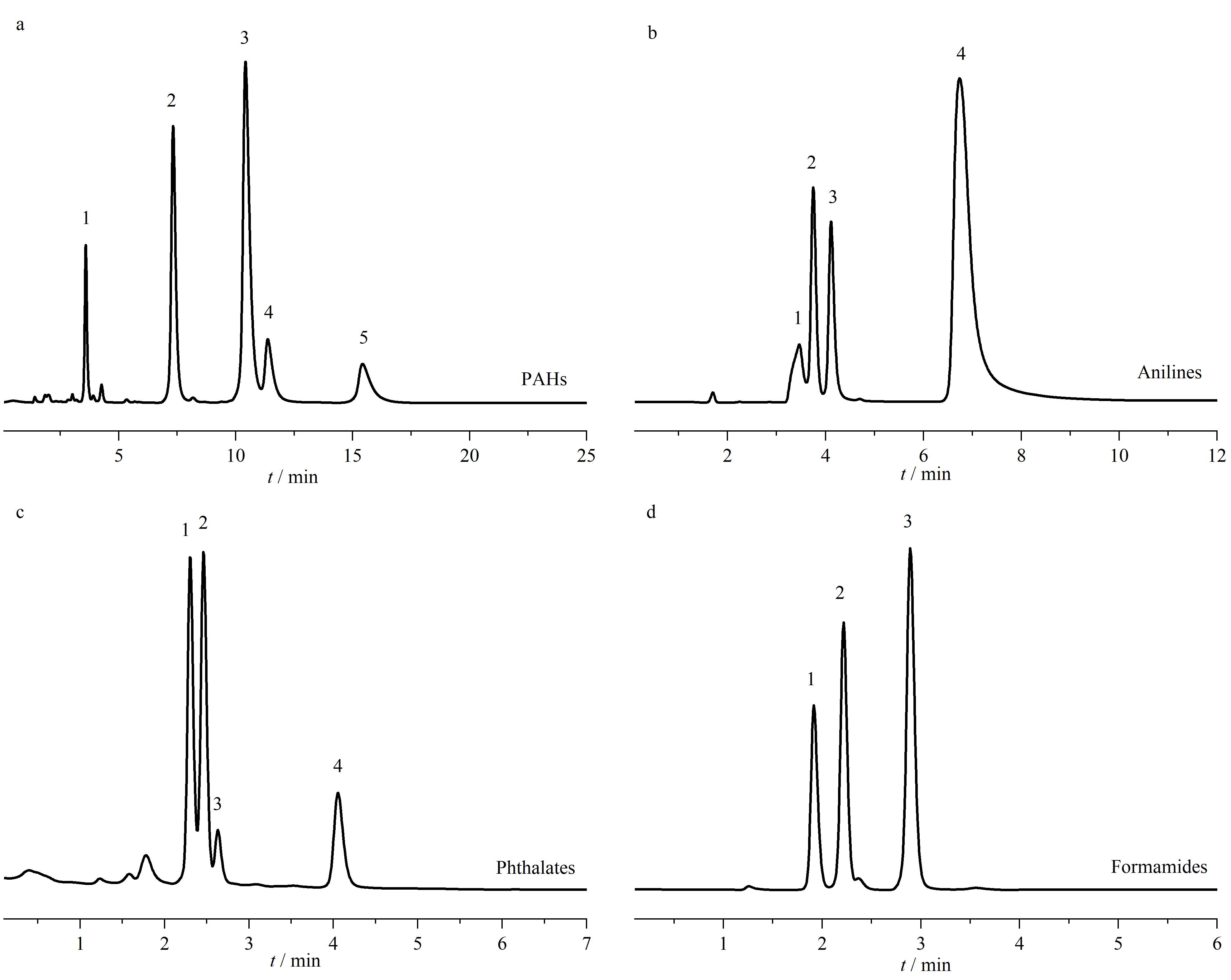
Fig. 8 Separation chromatograms of (a) polycyclic aromatic hydrocarbons (PAHs), (b) anilines, (c) phthalates, and (d) formamides on the TAPT-TA COF@SiO2Mobile phases: ACN-water, (a) 30∶70, (b, d) 15∶85, (c) 40∶60, volume ratio.For Fig. 8a: 1. toluene; 2. acenaphthene; 3. anthracene; 4. phenanthrene; 5. pyrene; for Fig. 8b: 1. aniline; hydrochloride; 2. 1-phenylpropanol; 3. 2-chloroaniline hydrochloride; 4. 1-naphthylamine; for Fig. 8c: 1. dimethyl phthalate; 2. diethyl phthalate;3. dicyclohexyl phthalate; 4. dioctyl phthalate; for Fig. 8d: 1. formamide; 2. N,N-dimethylformamide; 3. N,N-diethyl-formamide.
| No. | Background/mg | Added/mg | Found/(g/L) | Recovery/% | RSD/% |
|---|---|---|---|---|---|
| 1 | 0.85 | 0.5 | 1.316 | 93.3 | 1.43 |
| 2 | 0.85 | 1.0 | 1.799 | 94.9 | 1.71 |
| 3 | 0.85 | 1.5 | 2.333 | 98.8 | 1.25 |
Table 2 Spiked recoveries of astragaloside Ⅳ in the Astragalus sample (n=3)
| No. | Background/mg | Added/mg | Found/(g/L) | Recovery/% | RSD/% |
|---|---|---|---|---|---|
| 1 | 0.85 | 0.5 | 1.316 | 93.3 | 1.43 |
| 2 | 0.85 | 1.0 | 1.799 | 94.9 | 1.71 |
| 3 | 0.85 | 1.5 | 2.333 | 98.8 | 1.25 |
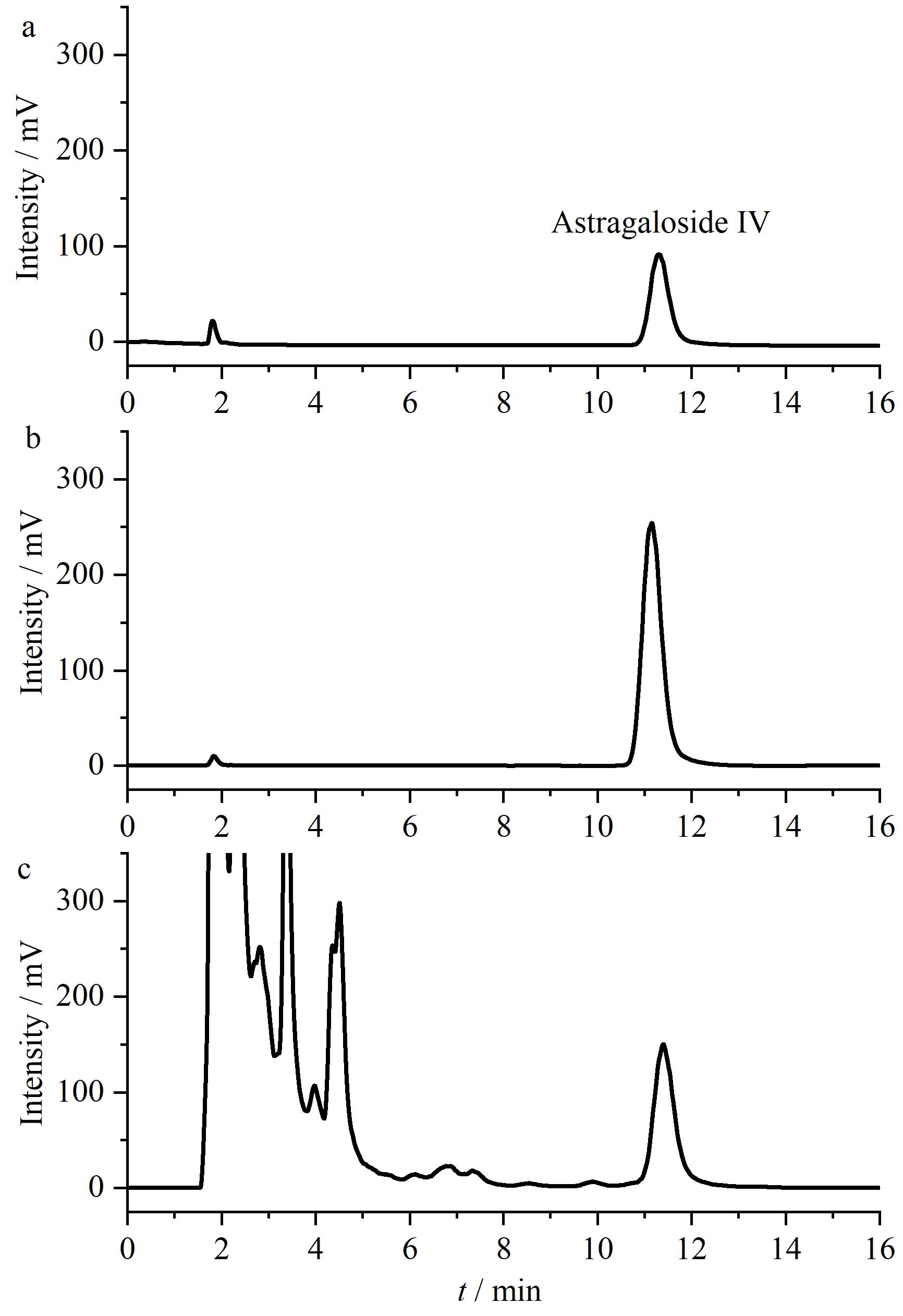
Fig. 9 Chromatograms of (a, b) the astragaloside Ⅳ reference standard and (c) the actual samplea, b. 0.003 g/mL astragaloside Ⅳ standard solution injected at (a) 10 μL and (b) 20 μL; c. 20 μL Astragalus water extract.
|
| [1] | LI Shijie, LI Zhen, TANG Zixia, LYU Mei, WANG Litao. Research progress on high performance liquid chromatography stationary phases based on mixed mode [J]. Chinese Journal of Chromatography, 2026, 44(6): 615-628. |
| [2] | JIAO Ruiwen, ZHANG Dandan, HU Xingyuan, ZHU Wanting, LI Xiang, CAI Yidi, REN Dandan, WANG Qiukuan, WU Long, ZHOU Hui. Preparation of a novel polyhydroxy silica stationary phase and application in the separation of alginate oligosaccharides [J]. Chinese Journal of Chromatography, 2026, 44(4): 373-382. |
| [3] | ZENG Lei, WEI Mengling, WEI Wei, LI Hao, SHI Bo’an, LEI Fuhou. Construction of acrylpimaric acid-bonded silica stationary phase and its application in mixed-mode chromatographic separation [J]. Chinese Journal of Chromatography, 2025, 43(7): 744-755. |
| [4] | XU Gaigai, YI Yang, LIU Pingping, ZHANG Wenfen. Preparation and chromatographic performance evaluation of hydrophilic interaction chromatography stationary phase based on amino acids [J]. Chinese Journal of Chromatography, 2025, 43(7): 734-743. |
| [5] | ZHOU Ding, GUO Dandan, ZHU Yan. Research progress in polyamide-amine dendrimer functionalized ionic separation media [J]. Chinese Journal of Chromatography, 2025, 43(7): 726-733. |
| [6] | YANG Meifang, ZHENG Kangni, LONG Yixing, LI Yijie, WANG Xueping, ZHANG Junhui, YUAN Liming. Two-dimensional chiral metal-organic-framework nanosheets based on Co-BDC-NH2 used as stationary phases for gas chromatography [J]. Chinese Journal of Chromatography, 2025, 43(4): 335-344. |
| [7] | WANG Qianyi, ZHU Yongle, LI Xuehua. Construction of a machine learning ensemble prediction model for gas chromatographic retention index on stationary phases with different polarities [J]. Chinese Journal of Chromatography, 2025, 43(4): 355-362. |
| [8] | WU Jialei, YU Liqin, WANG Bangjin, XIE Shengming, ZHANG Junhui, YUAN Liming. Preparation of a chiral porous organic cage-bonded silica high performance liquid chromatography stationary phase and its application to the resolution of chiral compounds [J]. Chinese Journal of Chromatography, 2025, 43(12): 1314-1326. |
| [9] | HUANG Bin, CHEN Juan, WANG Bangjin, ZHANG Junhui, XIE Shengming, YUAN Liming. Chiral porous organic cage used as stationary phase for gas chromatographic separation of chiral and achiral compounds [J]. Chinese Journal of Chromatography, 2024, 42(9): 891-902. |
| [10] | ZHENG Desheng, TANG Wenqi, ZHU Jianping, GU Zhiyuan. Preparation and application of chromatographic stationary phase based on two-dimensional materials [J]. Chinese Journal of Chromatography, 2024, 42(6): 524-532. |
| [11] | FANG Min, WU Yaping, ZHANG Wenmin, ZHANG Lan, YANG Zhenquan. Research progress of novel functional materials in extraction of algal toxins [J]. Chinese Journal of Chromatography, 2024, 42(3): 225-233. |
| [12] | ZHANG Peng, LI Kuan, ZHOU Jin, HAN Weina, HE Yongrui. Determination of multiple restricted and prohibited ingredients in hair dyes using a novel 3D stationary phase coupled with gas chromatography-mass spectrometry [J]. Chinese Journal of Chromatography, 2024, 42(10): 990-995. |
| [13] | LIU Jin, TIAN Wenchang, WU Fan, ZHANG Qiuting, ZHONG Yanhui, LIN Zian. A comprehensive undergraduate experiment: preparation and chromatographic evaluation of a core-shell stationary phase based on a covalent organic framework [J]. Chinese Journal of Chromatography, 2024, 42(10): 1006-1012. |
| [14] | WANG Xiaoqing, CUI Jian, GU Yiming, WANG Shuo, ZHOU Jin, WANG Shudong. One-pot synthesis of a poly(styrene-acrylic acid) copolymer-modified silica stationary phase and its applications in mixed-mode liquid chromatography [J]. Chinese Journal of Chromatography, 2023, 41(7): 562-571. |
| [15] | LIU Hualin, LI Yanan, ZI Min, CHEN Zheng, DUAN Aihong, YUAN Liming. Separation of chiral compounds using high performance liquid chromatography stationary phase based on covalent organic framework material TpPa-NH2-Glu [J]. Chinese Journal of Chromatography, 2023, 41(2): 187-194. |
| Viewed | ||||||
|
Full text |
|
|||||
|
Abstract |
|
|||||


